
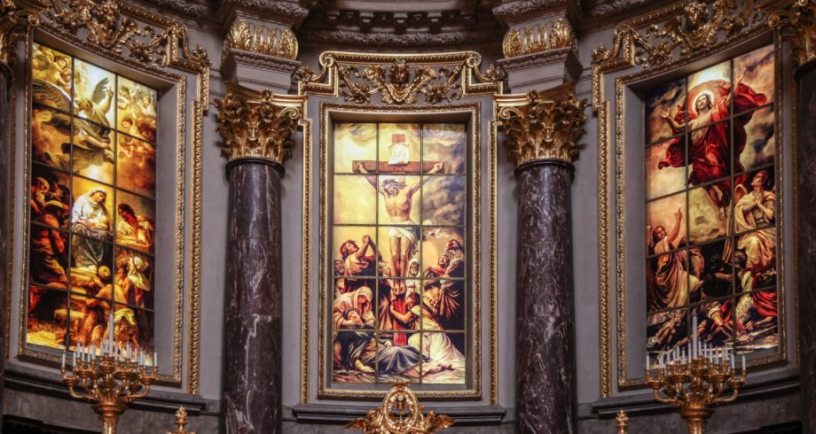
In response to a poem by Ibn al-Qayyim al-Jawziyya
~
O Christ-worshipers!
Fair questions have been put to us in search of wise answers,
By our kin, children of Ibrahim, our father in faith, and worshippers of the One God.
We send them our salaam and our response:
“If the Lord was murdered by some people’s act, what kind of god is this?”
Is God Himself bound by His own omnipotence,
So far above that He might not descend, at His own will,
To take upon Himself the nature of a Man,
And become a slave to others, that we might do the same?
That in the darkness of our godlessness,
The Source might not manifest in fullness,
Shining through that which He crafted
With a strength of light, firmness of mold,
To draw breath as one of us,
And lose breath as one of us,
So that we need never walk alone again?
Are not the sultans praised for dressing in common clothes
And moving in the streets as one with their subjects
To feel as one with those he rules?
Yet this is God, who does no thing by half;
How could He follow us through life, yet not through death?
Do not be shocked that shock is your response;
It is as it should be, or else the Cross would hold no power
And you no sense of awe.
“We wonder! Was He pleased by what they did to Him?
If yes, blessed be they, they achieved His pleasure,
But if He was discontented, this means their power had subjugated Him!”
Is the beloved pleased in consummation, though it bringeth pain?
Is the gardener please by the rose though the thorn should prick him?
For love is ever giving, ever emptying out, water on the sands,
And the spring flows even to those who would do harm.
It is love which makes the cruelest suffering sweet
And the darkest afternoon good.
One cannot rob that which is given freely,
Nor can one subjugate the one who submits,
Like a lamb, led to the altar
Or a lion shaved of his mane.
Are martyrs pleasured in their pain, or is it something more?
Do they know a deeper joy amidst the agony?
Is not the sacrifice of self the greatest glory,
For it shows the greatest giving,
The greatest love?
And if God is love, as we maintain,
Why would He spurn the suffering of union,
Any more than the prophets and saints have done?
“Was the whole entity left without a Sustainer, so who answered the prayers?
Were the heavens vacated, when He laid under the ground somewhere?
Were all the worlds left without a God, to manage while His hands were nailed?”
The One whose center is everywhere and whose circumference is nowhere
Is not bound by tree or tomb, though in substance restrained;
Though mortal heartbeats cease, the soul continues,
And so in both natures, God and Man,
The Christ, soul and divinity, did not die
It is the body and blood of us,
The shaped clay and pulsing liquid
That starts and stops.
And yet it is that stopping that is our starting,
This living reality in the dying multitude
And dying reality in the living being
That brings us to resurrection.
His hands outstretched and pinioned
Were even as the hands of time,
Were even as the arms that embrace
And reconcile man to the bosom of God.
“Why did not the angels help Him, when they heard him while he wailed?
How could the rods stand to bear the True Lord when He was fastened,
How could the irons have reached Him and had His body pinned?”
The angels would throng if but a word was uttered,
Yet He was silent, like a sheep before the shearer
And so the angels too held silent vigil
Scratching cheeks, drawing blood
So the painters show it
Though angels have no cheeks, no blood,
So such scratching was much deeper borne,
Deep as the death of God-made-flesh,
Deep as the weight of the rods foresworn to stand
As a soldier stands by his master’s side
Even unto the final death,
For this was given over to such instruments
Crafted torturous, yet raised glorious,
Wrought with blood-red rubies
And the amethyst of a torn cloak,
He is bound to us and us to Him
In our agonies and ecstasies alike.
“How could His enemies’ hands reach Him and slap His rear,
And was Christ revived by himself, or was the Reviver another god?”
He bowed Himself to their hatred meekly,
Just as he opened Himself to life with vulnerability,
For there is no chance for love without chance of pain.
Such is the nature of destinies, allowed for good,
Though the hand of fate, reaching us, seems cruel,
We who believe in God believe in His purposes.
Is not the Father present to the Son
Tied up together, though the one thirsts for the other?
Has not nearness at times brought desolation?
Has not the strain of human struggle drawn us upwards?
Have we not thought ourselves reviled, only to be refined?
This then, would be Christ, in humanity exposed,
For He would not claim divinity a thing to be lauded
But would empty Himself, yes, even of Himself,
Stretched from sky to soil, skin pressed over ribs
And the heart beating, full of blood
Waiting to be pierced and poured.
Is this not the source of our Thanksgiving?
The chalice and host, the red and white?
The resurrected body, the passion and the purity,
Revived by the Power of the Three-in-One?
“What a sight it was, a grave that enclosed a god,
Stranger still is the belly that confined Him!
He stayed there for nine months in utter darkness, fed by blood!”
Yes, strange, marvelous strange, like the hollowed soul,
Like the dome of mosque or church where God is worshipped,
And the carved reed that plays its melodies.
Is not the Syeda more silent than the grave,
More quiet in her contemplation, in the stillness of her soul,
For she belonged so wholly to the Only One,
Even her own voice might melt into the rhythm of the universe
Or the thumping of her child’s heartbeat.
Strange thing indeed, Blessed Maryam,
She who knew no mortal consort yet bore a son,
On this we all agree, nor do we fear the dark,
For God works in the night as much as the day.
Yes, the darkness of womb and tomb He penetrated,
The Light went into it and the shadows formed,
And a landscape of dependence was His lot…
Is this the only places where God may not tread?
Or is this, too, to be imprinted with His presence,
That incarnation that cannot be kept apart from creation?
Nine months to be planted and to gestate and to sprout,
Nine months, the rose blooming from Jesse’s stem,
And the prophecies of redemption unfolding
In ways none of us would anticipate.
“Then he got out of the womb as a small baby,
Weak and gasping to be breast-fed!
He ate and drank, and did what that naturally resulted,
Is this what you call a god?”
He was not play-acting a midsummer’s ruse
Not like the pagan gods, who take human form
But only for their fancy, out of mischief.
This, Our God, was also Man in truth
For there was no cheating to be found in Him.
He did not come to be pleasured
Nor idle curiosity to satiate,
He came as the warrior comes
To liberate captives and restore the oppressed,
He came as a healer comes
To bind up the broken and set aright the crippled,
He came as a seed comes to be buried and die,
And we are the ones who are risen up with Him.
But to save us, He comes as one of us,
Yes, the humblest of us, the most powerless,
The infant asleep in the hay,
Meek and mild, laying his glory aside,
Hungering as a child hungers,
Begging pity as a child begs pity,
A speck in the spheres,
So tiny a breeze might make Him shiver.
This, the crux of carols and mummers’ dancing,
This, the merriment of Christian lands,
This, the starry glimmer in winter’s womb
This, the haunting, guileless mystery of the faith.
“That is really a cursed cross to carry,
So discard it, do not kiss it!”
Herein lies our paradox, our secret love
That He is cursed, yet we are christened,
That we sing of our happy fault
And bless the hour the apple was taken,
That our nature’s fallenness unearths a greater depth,
The darkest before dawn, death’s face
Which we kiss upon its sallow cheek
Like the saint embraced the leper, in all his ugliness.
In all the horror it evokes
And we might wish to cast it off,
Take the sensible way,
Leave the cross, the shadow, for our grief,
For the Bridegroom has no comeliness,
Nothing to seduce our senses,
The bridal chamber seems a moldering tomb,
The candles lit seem those of mourning not of joy,
The dripping wax seals shut the stone,
Yet the powers above the earth trumpet
And under the earth groan.
How can we shun the symbol of salvation?
How can we hide our eyes from that which heals our blindness?
How can we forget that our bodies are cruciform,
Our souls meant to be wounded, then healed,
Made to be pinioned back against the boards
Of Our Savior’s sacrifice.
No, we do not revel in pain for its own ends,
But rather cling to the love that withholds itself not,
That bleeds itself white, free-flowing,
Running down to the ocean of mercy
On which our ships have set sail.
“The Lord was abused on it, and you adore it?
So it is clear that you are one of His enemies!”
Yes, cursed for our transgressions
And crushed for our sins,
Despised and rejected,
A man of sorrows,
Acquainted with grief.
Yes, this thing, hardest to think upon,
Hardest to face with eyes that wish to turn away,
Hardest to touch with hands we would rather wash clean.
We are His friends, yet it is easier to run away
Naked in the garden of grief,
Yet we press our lips to the wood
And we mourn the Bridegroom
Step by step on the sorrowing way,
For we know that the light may seem extinguished
But the darkness will not overcome,
And even the symbols of defeat
Will be turned to victoria crucis.
This is the victory of His cross
And all the little ones we bear,
Following Him at his word
Down the martyr’s crimson way.
“If you extol it because it carried the Lord of the Worlds,
Why don’t you prostrate yourself and worship graves,
Since the grave contained your god in it?”
The grave is not the gain, but rather the tree,
The act before the passing,
The work before the slumbering,
It is exalted, as the serpent of bronze
Raised high to drain the poison.
All life and death is at the cross,
Beams extending, overlapping
Life to death, death to life.
The grave could hold Him not,
Nor could the depths of Hell contain Him
Though the cross is forever ours,
Etched with the act of expiation,
Stained with the tide of termination,
This labor of love, ludicrous, laughable,
Starkly scrawled at the place of the skull,
It is the key to the gates of God’s own heart
Which no powers of the Evil One can prevail against.
We Christ-worshippers have gazed upon these mysteries,
Of bread and wine, life and death,
Of wood we wear upon our breasts,
And hearts crucified unto death…
And we behold His glory.
 Fellowship & Fairydust