
BY G. CONNOR SALTER
Calendar of Fools, founded by Storm Humbert and others, has announced its second anthology, Intergalactic Rejects, on Kickstarter. To celebrate, we present an expanded version of an F&F interview with Humbert.
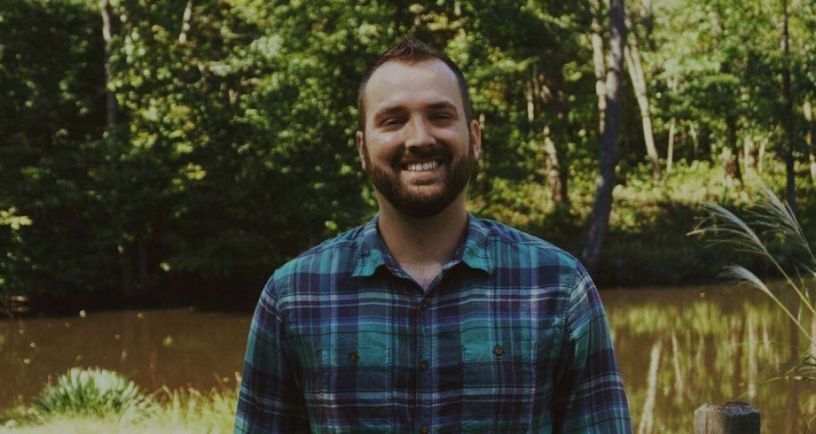
Storm Humbert was born in Fayette, Ohio—which his website observes is “literally a one stoplight town.” Since that time, he has earned an MFA from Temple University, taught (writing, rhetoric, composition) at Temple as well as Sienna Heights University, and published speculative fiction in magazines like Galaxy’s Edge, Interzone, and Apex Magazine.
Some of his greatest success has come through the Writers of the Future Contest. He received a Silver Honorable Mention in the 2016 contest and was a finalist in the 2018 content. Then, he won Third Place in the 2019 contest. His award-winning story, “Stolen Sky,” appeared in Writers of the Future Volume 36.
Due to COVID restrictions, the 2019 contest’s convention and award show were postponed a year. As a result, Humbert didn’t attend the Writers of the Future Awards in Hollywood until 2021, where he got to meet not just the winners from his year, but also the subsequent year. As Humbert put it, “while some of us had twice the wait, it meant all of us got to meet twice as many winners, formed twice as many friendships, and connected ourselves with twice as many of our peers at similar points in our careers.”
The twice-as-large community became the basis for Calendar of Fools, a small press that Humbert helped start. Calendar of Fools released its first book in 2023: Inner Workings, an anthology containing works by other Writers of the Future winners (including previous Fellowship & Fairydust interviewee Luke Wildman). In March 2024, Calendar of Fools announced its second anthology, Intergalactic Rejects.
Humbert was kind enough to answer a few questions.
Interview Questions
To start off, Storm, congratulations on your award. How did you feel receiving that win, after you’d had several stories get close to winning in past contests?
Thank you. I still remember where I was when I got the call from Joni Labaqui. There was this massive rush of validation as soon as she told me I was a winner. I think validation is a major gift that this contest (and most publishing markets, really) give. I think it’s incredibly valuable in this business. We face so much rejection, it means a lot when we experience those moments of “good enough.”
Did the plan for Calendar of Fools emerge slowly, or was there a clear moment where someone said, “Hey, we should start something together”?
I’d say the idea that Calendar of Fools would be a legal entity that exists as a formal business emerged more slowly, but we’d all more or less decided we wanted to publish something together very soon after our workshop and gala week.
How did the press decide on Calendar of Fools as a name?
A: We had multiple meetings about it, actually. Well, we didn’t have meetings exclusively about the name, but it came up multiple times. The name was ultimately inspired by the message they drilled into us at the Writers of the Future workshop: namely that we are the future of our respective genres. The press’s name is derived from an Og Mandino quote that goes “Tomorrow is only found in the calendar of fools.” The quote is obviously meant to be a warning against procrastination, but we kind riffed on it to basically say “We are tomorrow, and here’s where you can find us.”
You’ve described Calendar of Fools as a way to pay forward the gifts that Writers of the Future provided. In your opinion, why is it important to pay forward the gifts we get from creative communities?
I think it’s important because anyone who makes it in this industry did it with help. We owe help to others because it was given to us. More than that, though, for many artists (or creatives in general) we aren’t solely here by choice. This is a need, for many of us. We can’t not do this, so the least we can do is lessen each other’s burdens and help each other along.
What can you tell us about the second Calendar of Fools anthology, Intergalactic Rejects?
This is an anthology made up entirely of rejected stories. The idea here is to both give readers the opportunity to read stories that otherwise might have slipped through the cracks and to give writers a physical object that they can hold in their hand and leaf through when the rejections pile up. We want to print a comfort object to remind them that rejections don’t mean their story is bad or that they’re bad writers. Stories get rejected for any number of reasons, only a few of which are qualitative, so we want to give something writers can have to remind them to keep going.
What inspired you to take this unique approach, to highlight stories rejected from other publications?
The first inspiration is every writer’s familiarity with rejection. We’ve all gotten piled on at one point or another, so we wanted to do something about that. The second inspiration was to fill a hole in the short fiction marketplace. As it currently stands, a great story could be rejected on the editor’s desk of 10 or 15 different magazines and find itself with nowhere left to go–functionally dead even though it’s objectively great. This anthology is seeking to collect those “didn’t quite fit our needs” stories, give them a home, and expose readers to fantastic stories that possibly wouldn’t have been seen otherwise.
Who are some of the guests authors you were able to get for Intergalactic Rejects?
Our featured authors for this anthology are Samuel R. “Chip” Delaney, Robert J. Sawyer, Kevin J. Anderson, Rebecca Moesta, Oghenechovwe Donald Ekpeki, Greg Bossert, Jean Marie Ward, David Boop, and William Joseph Roberts. We also have an essay from Robert Silverberg. I’m so glad all of these established authors agreed to be a part of this, and I’m also excited that, after we fund, we’ll be doing an open call for 8 more stories. So, to any writers out there with rejected stories they love, I hope you back our project and that we can publish your story right alongside our amazing featured author
Did looking at the contributions (what got rejected, the stories from the writers about why these pieces didn’t fit elsewhere) teach you anything you about the rejection process?
I think mostly the histories of these specific stories more drove home things I’d been learning over the last ten years or so, though there are certainly some unique examples and insights in here. The biggest thing you learn publishing, slushing, and editing short fiction for any measure of time is that rejection or acceptance really does come down to so many small, subjective factors, and that anything beyond turning in the best story you can and following the submission instructions is beyond the writer’s control. Sometimes, a magazine already has a werewolf story for this issue or they’ve had one in too many issues that year. Sometimes an editor just might not be in the right headspace to connect with your story on a given day when, on most days, they would. And sometimes, the editor might just hate VR stories (as was the case for one of our featured authors) and you had no way to know that. In short, the biggest lesson I’ve learned is to get a story to where I like it and then just keep submitting, starting with the top market and working my way down. It’s a numbers game, so the surest way to lose is not to play. Keep your work circulating.
Creating community for writers clearly matters to you. Do you think that connects with your teaching experience?
Somewhat, maybe. I think it’s more just grown naturally from my experience as a student and practitioner of this craft, though.
When I studied under Samuel R. “Chip” Delany at Temple, he was always so gracious and patient and kind. I was intimidated the first time I ever came to his office because he was Samuel R. Delany: a living legend, sci-fi grandmaster, and one of my heroes, but he put me at ease so quickly. And it’s been that way with everyone I’ve met in this industry who has been where I want to be. I think I’m so set on building community because the community is one of the things that makes the spec-fic genre unique for both readers and writers, and community some permanent infrastructure beyond time and dilapidation. It isn’t something you make and then enjoy forever. It must be constantly built and rebuilt. You can never stop building community if you want it to endure.
Thank you for mentioning Delaney, I was wondering what your experience was learning under him at Temple University. Can you share any stories about your experience?
A: I have so many, but my favorite is probably how he changed my concept of story structure with what seemed to be an off-the-cuff remark about what the different kinds of stories do. He said, “A flash fiction evokes an emotion, a short story tells a story, and a novel makes an argument.” Viewing my various projects through those lenses has helped me tremendously, and the last bit (about the argument) is actually one of the cornerstones of the class I teach on magic systems as metaphor.
Your “About the Author” profile in Writers of the Future Volume 36 mentioned that you’ve grown a lot through being a slush reader for Clarkesworld—an interesting mention, since so many writers think of the slush pile in totally negative terms. What are some things you’ve learned from reading the slush pile?
Sorry in advance, but this is going to be a longer answer.
Basically, growing as a writer requires reading not because it shapes your style or voice or “gives you the answers.” Writing requires reading because it helps you build a library full of techniques for solving specific problems on the page. Chip taught me that writing is largely about solving problems on the page.
The reason slush reading is so valuable is because you are exposed to a wealth of examples of other writers addressing problems on the page both successfully and unsuccessfully. The reason this is different than just reading published stuff is because you’re more likely to see mostly successful techniques for solving problems in published work whereas slush piles are heaped full of failed attempts.
Slush reading shows you approaches failing to solve problems, and you get to benefit from this because you can look at the story from this removed vantage and ask yourself “Why did this approach fail?” This is a powerful complement to the question asked of successful stories, “Why did this work?” This combination allows you to get maybe some insight into why some techniques are more successful than others—to peek closer at the actual source of this “problem on the page.” I think this knowledge is essential when we’re deciding which tactics are optimal for our own specific stories and their specific goals.
In short, it’s hard to say that slush reading taught me any specific things. It’s more accurate to say that it allowed me to learn my lessons more deeply.
More details about Intergalactic Rejects can be found and on its Kickstarter page.
More details about Inner Workings can be found on Amazon. More details about Humbert’s writing can be found on the Writers of the Future podcast episode where he was a guest alongside Luke Wildman and Zack Be, or on his website.
(Article first published September 5, 2023 on Fellowship & Fairydust. Expanded with revisions on March 6, 2024.)
 Fellowship & Fairydust