
BY G CONNOR SALTER
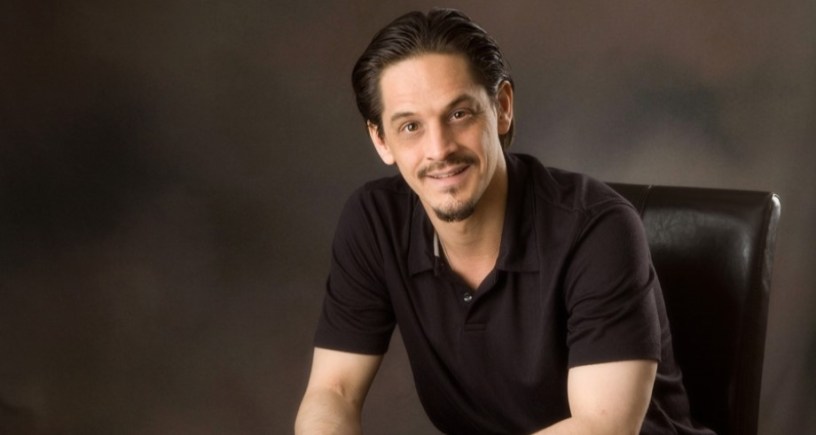
Jeremy Gordon Grinnell has a passion for theology and words which has informed all his work, whether as a pastor, seminary professor, author, actor, or audiobook narrator. His audiobooks (including classics like C.S. Lewis’ poetry collection Spirits in Bondage and G.K. Chesterton’s Orthodoxy) are released under the name Gordon Greenhill. He also operates The Disordered Image, a website cataloging images of English language editions of Lewis’ work.
His own fiction shows Lewis’ influence in a clear, amusing way. In 2019, he released Flight of the Sky Cricket, the first installment in his Relics of Errus series. So far, the series contains three books and one short story, “Once More Into the Breaches.” He has also branched into nonfiction in 2023 with The Bellowing of Cain, a memoir about his recovery journey after a ministry crisis.
He was kind enough to answer a few questions.
INTERVIEW QUESTIONS
You mentioned on your audiobook website that you got your PhD in “moldy old dead European men,” but your first love was always fantasy and myth. How old were you when you began reading fantasy?
Lewis has dogged my steps the whole way. My first memory of the power of fantasy and myth was as a six-year-old, weeping my eyes out as my mother read me the Reepicheep farewell scene in The Voyage of the Dawn Treader. Then it lay pretty dormant till high school when I discovered Isaac Asimov’s Robot novels.
My wife, Denise, actually reads a lot more fantasy and sci-fi than I do. So I end up reading bits of what she says she enjoyed. This is how I came to read Orson Scott Card’s Ender’s Game and Brandon Sanderson’s The Rithmatist, both of which reshaped my view of what fantasy/sci-fi literature could do.
Outside of Lewis and the other Inklings, who were some fantasy authors who inspire you?
My high school/college years were actually more given over to sci-fi. In high school, you would have found me with one of Asimov’s Robot novels in my hand. Then, in college, I discovered not only Tolkien’s work, but also Ray Bradbury’s—ironically, my first exposure to him was not his sci-fi, but Dandelion Wine. After that, I plowed into his other work. As a young couple, Denise and I devoured Anne McCaffery’s Dragon Riders of Pern together.
Other significant authors in this genre were Fletcher’s Stoneheart Trilogy, Funke’s Inkheart (mostly volume one), and Adam’s Hitchhiker’s Guide series. I was also heavily influenced by more ancient authors like Ovid and Hesiod—specifically in the conflicted nature of humanity’s relationship to the gods. They were of profound help in my world-building phase.
After Lewis, J.K. Rowling left the greatest number of marks on me. I encountered Harry Potter about the same time I started writing fiction. She taught me the power of a metanarrative in a fantasy series—meaning, while each book in the series has its own plot arc that resolves (mostly) at the end of the book, there is always this larger story (the Voldemort thing) which slowly grows in the background to eventually take over and become central to the story. It was an eye-opening conceit I had never encountered before. Then when Michael Word asserted in Planet Narnia that Lewis appeared to also have (his term) a “Kappa element” in it as well (the seven medieval planets, each dominating one of the Narnia volumes), I was hooked. This is how to write multi-volume fantasy!
To a lesser degree, Pullman’s His Dark Materials series influenced me somewhat by being a foil. By his own admission, he was a sort of Anti-Lewis, yet his books seemed highly dependent on him for their subject matter and style. Simply as fiction, they were great reads, but as commentary, they also drilled into me, first, that mythic literature could be used to advance any agenda or worldview with the same power, and, second, I learned from him the fact that when fantasy becomes preachy, it becomes dull.
You have written about how you came to writing fiction through an interesting path, a flash of inspiration that led you to write a Narnia sequel, The Black Centaur. What strengths and weaknesses come with writing a story set in an existing fantasy world?
The Black Centaur was a piece of experimental writing I did while writing my doctoral dissertation on C.S. Lewis and it was my first piece of serious fiction. How could I climb inside Lewis’s head and understand his thinking other than to experience the process myself? The result was an eighth chronicle that presented the rise of the White Witch and the devolving of Narnia between Magician’s Nephew and The Lion, the Witch, and the Wardrobe. I’m still looking for a way to make that story available to Narnia readers, but there are legal complications, as you might expect.
That inability to actually publish the work is, of course, the greatest weakness. It doesn’t matter how wonderful the story is … legally, the world and the characters belong to someone else.
Another issue is how faithful you need to be to the original material. We have examples all over of people who gave us their own idea on how the story should have gone (I’m looking at you, Narnia movies!). Sometimes, it works to reboot a franchise in a new way, like Maguire did for Baum’s Oz in Wicked, and sometimes, it just destroys what people loved about the original, as Disney seems bent on doing with every legacy franchise it touches.
By nature, I tend to lean toward the purist side, so I tried my best to present as Lewis-like a setting and characters as I could. I even spent several solid months studying Lewis’s syntax and vocabulary in the Narniad with the goal of reproducing his style—at which I’m not sure I succeeded. However, when Dr. Christopher Mitchel, former director of the Wade Center at Wheaton College, read the manuscript, his wise words to me were, “It doesn’t have to parrot Lewis to be good; it just has to feel like we’ve been to Narnia when it’s all done. And this does that.” He even presented the book to the Lewis Foundation for possible publication, and I’m told that Douglas Gresham read it and liked it, but this was 2005ish, and they were only interested in movies at that point.
Answering this question makes me want to drag it out again, revise it (now that I’ve developed my own writing voice), and figure out a way to release it as, if nothing else, mere fan fiction. Hmm….
Has your theology training informed your fiction writing in ways you didn’t expect?
Absolutely. I remember showing The Black Centaur to my doctoral advisor and making the comment that I could not have written it without the ideas given by my doctoral program.
And it’s equally true of Errus. A great deal of the metanarrative at work in The Relics of Errus (which still hovers mostly in the background in the first few Errus novels) was given to me almost whole cloth from Karl Barth’s hundred pages in The Church Dogmatics on the nature of “nothingness.” Um … yeah.
I could cite endless examples like this. Whinsom the cheerful rotund priest was inspired by the morbidly obese Thomas Aquinas, while for his acerbic brother Cholerish, I drew heavily from John Locke.
And I’ve loved being able to drop theological easter eggs all over the books. For one minor example, the names of Ambrosius Lambient and his son Augustus were drawn from history. Saint Augustine’s spiritual father was Ambros of Rome—so it seems apropos to make the father/son duo an homage to the great thinkers.
Flight of the Sky Cricket made it clear from the first chapter that it was a knowing homage to the Narnia books—playing on its images of children in an old house discovering a secret portal to another world, but taking the story in unusual directions that Lewis never takes. How do you write a meta-fantasy without making it too close to the source?
In truth I don’t know if I didn’t make it too close. Part of me still feels like all I did was pick a different pool in Lewis’s wood between the worlds to jump into (a Magician’s Nephew reference). If I had it to do over knowing what I do now, I could have “borrowed” even less from him, but I was just starting out and trying to find my own voice. I think I unconsciously stayed close to Lewis’s shores initially because it was territory I knew and knew to be solid ground.
That gave me the courage to branch off in my own world of Errus and do my own thing. Lewis was, in a sense, my lifeguard as I was learning to swim. That said, I anticipate that I’m not finished hiding Narnia easter eggs throughout the story that only Lewis readers will get. You’ll also find a number of references to Middle Earth, Harry Potter, Percy Jackson, A Wrinkle in Time, and many others in the story—some overt, some more hidden. I find that cloak-n-dagger approach—seeding my stories with reference to other great fantasy literature—immensely satisfying.
You have a particular sense of humor in your books: the characters are often a bit farcical, but always relatable. What helps you balance the silliness?
A single characteristic dominates. Pushed to the extreme, it creates humor (Aristotle’s virtue).
Take Augie, the inventor from book two, who eats anything, all the time, no matter where he is. There’s nothing funny about a person who eats a normal amount of food, but a person who refuses to eat anything or everything—the ends of the virtue spectrum—can both be humorous in different ways. I think this is because most of us have been in situations where we ate too much—that’s the relatable aspect. This defining characteristic needs to be one that people also experience, if only to a lesser degree; this makes them relatable—“Oh, yeah, I’ve done that too.”
The greater threat for me is leaning too hard into that extreme that it leaves the character looking mono-dimensional.
I was struck while reading the Errus books that you hadn’t just crafted a story, but gone the extra mile to craft the books themselves—great illustrations, excellent covers, well-organized websites. What advice would you give to authors trying to produce a good-looking fantasy book that will excite readers?
These days, it’s possible to launch a book with literally zero dollars through KDP and other places. It is also possible to spend $20,000 in releasing a book if you want professional editing, design, illustrations, etc. You have to find where on that continuum you are; how much are you willing to invest in it? I determined early on that I wanted my books to be the same quality as anything Del Rey or Bantam would produce.
People say not to judge a book by its cover, and that may be a true maxim for not prejudging people, but it is exactly how people evaluate books. If your cover is sloppy, unattractive, or so looks “self-published,” readers will see it and move on.
I’ve sold the vast majority of my books (the ones I’ve hand-sold at events, that is) because people loved the artwork on my covers. My illustrator, Liefsbeth, gives me such great work!
Will book 3 , Might of the Divided City, conclude the Relics of Errus series, or are more stories coming?
To tell the full story will require seven volumes, but it’s a hard stop there. Once I’ve told the story, I’ll move on to something else. I’ve never been a fan of authors who produce a great book or series and then milk it for all it’s worth rather than writing something new (I’m looking at you JK!).
Book 4 is nearly done and almost ready to go into editing. And the remaining books are mapped out.
What has been your favorite assignment as an audiobook narrator?
That’s a hard one, as I have done all sorts of books in all sorts of genres. It would be no surprise to learn that most of all I love narrating my own books, but beyond that…
I have carved out a bit of a niche for myself in theological nonfiction as I have the background for it and am not scared off by technical and non-English words. In that vein, the two that have been most enjoyable and formative were Michael S. Heiser’s The Unseen Realm, about how the Ancient Near Eastern worldview intersects with all the Old Testament material on God’s divine counsel, and the old Roman Catholic Christology text The Lord by Romano Guardini.
My favorite fiction work I’ve narrated was Mike Sauve’s novels. I can’t recommend them to everyone as they can be irreverent and crass in places, but his use of humor and the unexpected are some of the best I’ve ever encountered. For example, in his book I ain’t Got no Home in This World Anymore, imagine a future late-middle-aged version of yourself time traveling back to you to figure out what went wrong in his life to make him so miserable, only for the both you to realize the problem began further back. So both of you—the 30-something you and the 50-something you—get back in the time machine and go back to meet the teenage you. Hilarity ensues. Great stuff and the best time travel story I’ve ever encountered… but again, not for everyone.
I also thoroughly enjoyed being able to produce two of C.S. Lewis’s earliest works—Spirits in Bondage and Dymer. This was a bucket list thing for me.
Now, if only I could find someone to let me narrate a translation of the Bible, I could rest in peace.
What was it like narrating Spirits in Bondage and Dymer, two early Lewis books of poetry that not many people discuss?
I tackled these two works specifically because they are the only two of his works that are now in the public domain (they were the first things he published as a young man) and thus didn’t need permission from the Lewis estate. Spirits is a collection of short poems, and Dymer is a single epic poem.
There is an unnamed despair floating right below the surface in these poems, in part because he wrote them while still in the throes of his youthful atheism, and in part because he wrote them during his service in World War I. “Despair” is a negative word and apropos. However, I am sure the older Lewis would have cast this youthful despair in a different light. He would have said it was part of “longing,” a technical term for Lewis, roughly meaning that deep and inarticulate sense of desire for one knows not what. His youthful atheism wanted more but didn’t believe it was out there to be had. As he said in Surprised by Joy, “I maintained that God did not exist. I was also very angry with God for not existing.” After his conversion, he would rename this inexpressible and unanswerable longing as simply “joy.”
As biographer Alan Jacob says, their primary value is not in their poetry (neither of them sold well because, frankly, they aren’t all that good poetry) but in its primary value is as a window into the younger soul of the man who would eventually produce classics like The Screwtape Letters and the Narniad.
How did your catalog of Lewis’ books, The Disordered Image, begin?
It began as a lark while writing my dissertation. I found myself epaulet-deep in the struggle every Lewis scholar can relate to, “Which edition is this person quoting?” As the site will show, right now, there are 23 completely different editions of The Screwtape Letters, meaning 23 different paginations. So when a scholar would cite, say, “Screwtape, 127,” which of the 23 edition is he quoting? To make matters worse, those 23 unique editions exist in over 50 different covers (which publishers change periodically without changing anything in the interior). In short, the scattered publication history of Lewis’s works makes it nearly impossible to know what edition is being quoted without a bunch of searching.
So I simply started shooting images of Tables of Contents in various editions in libraries and bookstores, trying to get a bead on it. It grew slowly from there and without a particular direction till I got the break. The Marion E. Wade Center at Wheaton College, Illinois, is the largest Lewis collection in the world (perhaps second if the Bodleian Library holdings at Oxford are larger). They were gracious enough to let me sit for many days in the basement of the building and pull literally every edition of Lewis they had off the storage shelves and catalog the publication data.
That gave me enough material to build the site. I still occasionally find something I’ve not seen before, but it’s mostly maintenance at this point.
But I have found that the site is not only useful to scholars, but also to collectors. It’s been a fun hobby and a labor of love.
Some time ago, we were at a virtual Inklings scholar event, and you mentioned narrating The Voyage to Arcturus, the David Lindsay sci-fi novel Lewis loved. I got the impression you found it an unusual challenge. What made it challenging?
The book is unusual in every way. In some respects, it’s so “out there” that it’s almost unreadable, and in other respects, it’s a tour de force in how different an alien culture would actually be—so much so that it’s at least as much allegory as fiction. Lewis said of the book, for example, that Lindsay may be the first author to have coherently offered a “third gender” in fiction (and remember, he is using that term simply as a synonym for “biological sex,” as everyone did till recently).
Lindsay is a cumbersome writer, overbuilding sentences and giving the narrator little help on what the characters would be like in real life. They’re more like symbols than characters. It meant that I was constantly pausing and “punch-editing” another reading in because it was often impossible to cold read a sentence aloud without flubbing the line—very time-consuming.
And while this wasn’t so much a challenge for narration, his surreal style and wandering plot make it a tough slog for the reader. I walked away from the project with the following conclusion: Any given episode of the book was genius, presenting alien concepts in uniquely beautiful ways, but taken as a whole (that is, all the episodes stacked together to make up the book), it is simply strange and at times incoherent. It often reads like a painting by Salvador Dali.
That said, the book has a longstanding cult following for exactly these reasons—he lets you think profoundly new thoughts on every page. The size of that following can be seen in the fact that, despite there being four audio versions of it out there, mine is still the fourth most lucrative audiobook I’ve ever narrated.
Last year, you took a bold step by releasing The Bellowing of Cain, a book about your ministry crisis and how you healed in the aftermath. What prompted you to share the story?
Yes, not to put too fine a point on it, but in 2013, I completely blew up my life with bad choices—an emotional entanglement with another woman, clinical depression, and eventually invasion of privacy charges that ended my pastoral and academic careers. A very sad story for all involved, but God is good, and over the last decade, we’ve done the hard work of getting healthy and ready to serve Christ’s church again in whatever way we now can. I’ve been reconciled to my wife, the church I blew up, and the major players in the story who were willing. My record was expunged in 2023, and now the Wesleyan Church is sending me down the ordination track with them.
As I and my editor looked over the book market for books on “how to survive and grow through trauma,” we realized that nearly every book on the market came from a victim’s perspective—“how to survive and grow through the trauma that comes from without”—the layoff, the diagnosis, the loss of the loved one. Horrible things, yes, but things over which the “victim” bore little blame.
There was nothing out there to help perpetrators heal—a book for people whose greatest traumas in life were self-inflicted. That’s when we realized we needed to figure out how to use my story to help such people.
Writing the book was a miserable experience that required me to go back through texts, emails, and conversations from those dark days—a kind of retraumatizing of myself, but also a really healing experience both for me and my wife.
The result was a book that chronicles the run-up to self-destruction with chapters on self-deception, obsession, sexualized relationships, fear, divine silence, and other destructive patterns with an eye to both explaining to and hopefully preventing the reader how not to follow in my footsteps.
But more, the second half of the book is a unique perspective on putting life back together after you’ve blown it up, wrestling with subjects like how to live with deserved guilt/shame, facing the people you hurt, and living the sense of having failed others and disappointed God—each of these is a unique journey for perpetrators that is very different from that of victims.
It would be a shame to go through just deep waters and have no one benefit from the journey. So, in January 2023, we released the book to significant endorsements. The book has received several awards as well, like Self-Help Book of the Year in the Christian Author Awards and second place in the self-help category for the Illumination Book Awards.
If you know someone who has blown up their life or is in peril of doing so, this may be one of the only books out there that can help them—a book written for perpetrators of evil by someone who knows the journey.
For if, in the end, redemption doesn’t exist for the worst of us, it exists for none.
One thing that struck me in your preface to The Bellowing of Cain is your words about how much we must be willing to let go—“sometimes you have to die a little to live a lot more.” Speaking as someone from a multigenerational ministry family, I’ve seen that many times: the self-medicating behaviors and insecurities we have to let die before we can be reborn. What helped you learn to let go and be reborn?
Life has a way of forcing you to let go of things. We can’t keep our youth, strength, or mental capacities. They will be taken from us sooner or later. Part of entering the second half of life is realizing that the values of the first half of life—as vital as they were in your twenties—don’t work so well in your fifties! You don’t have to have blown up your life to take this journey; we will all take it in some form sooner or later. So we might as well resign ourselves to that reality because only in that realization is there any peace to be had—peace with others, with God, with ourselves.
Brother Lawrence’s The Practice of the Presence of God was a key read for me in the “healing up years.” His desire to be doing “fun monkish stuff” (whatever that is) was always thwarted by being assigned to do the dishes in the monastery scullery. He had to figure out how to meet God, not in the chapel or the church, but in the doing of the dishes. That was exactly my journey. A life of significant public affect reduced to a stay-at-home father of four kids. Who was I when I was no longer a professor and pastor? I didn’t know.
Some specific people were key for me as well—several friends and family, my spiritual director, and (eventually) my pastor in the church we landed in, who helped me deal with the ugliness of my choices and the losses that came with it. A gestation, not of nine months, but many years, and still, I feel only half-reborn. This is the central hope of Christianity—that we shall all one day be changed, fully healed, and be brought home to a place where we are known fully and loved anyway. All these smaller resurrections we experience now are a foretaste of that greater rising one day.
What’s next for you? Another fantasy work, more nonfiction, or something altogether new?
I have a number of irons in the fire. Yes, there are several more Errus books on the horizon. Volume 4 is nearly done and ready for editing.
I also have a highly fictionalized biographical novel about growing up in 1970s fundamentalism (the sort of thing Ciam Potok would have written if he’d been raised Christian instead of Jewish). The novel is complete and currently in editing.
I’m also working on a follow-up work on The Bellowing of Cain. Cain was aimed at people who’ve wrecked their lives. The subsequent volume will be directed at those who are called to live and work with such people (e.g., spouses, elders, administrators, etc.) who have to clean up the mess. How do you do this in a way that doesn’t make the burden heavier on those who messed up?
Additionally, I have a theological work on the Holy Spirit that I’m working on—a sort of everyman’s guide to the biography of the Holy Spirit. Biography meaning more than just a book about spiritual gifts or other hot-button topics, but a true biography—the Spirit’s identity before creation, the Spirit’s work in the Old Testament, in Christ, and, yes, in the church as well.
And then, I have a couple of stand-alone fiction titles in the very first stages of being written. So, over the next several years, my dream would be to release one fiction and one nonfiction title every year. That’s a tall order, but one I’m excited to fulfill.
Authors interested in hiring Grinnell as an audiobook narrator can find out more on his Gordon Greenhill website. More information about his books can be found on the Relics of Errus website, Bellowing of Cain website, or his Amazon page.
 Fellowship & Fairydust