
BY G. CONNOR SALTER
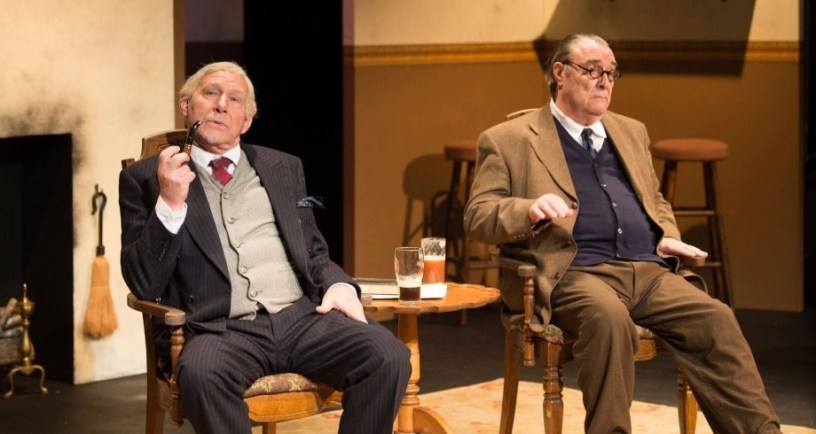
David Payne has become well-known for playing C.S. Lewis, going back to when he played Lewis in a 1996 production of Shadowlands, followed by many performances of his one-actor play An Evening for C.S. Lewis and related works. In this play written by Payne, he explores the awkward final chapter in Lewis’s life. The scene is October 1963. Nine months earlier, Lewis was in the hospital recovering from a heart attack. On November 22, 1963, Lewis died—ironically, on the same day that Aldous Huxley passed away and John F. Kennedy Jr. was assassinated. Peter Kreeft uses that factoid for drama in Between Heaven and Hell. Here, the play follows Lewis meeting J.R.R. Tolkien for one last pint (tea, since Lewis’ medical condition now forbids beer) at the Eagle and Child. Nicknamed the Bird and Baby, this Oxford pub was where many of their meetings with fellow Inklings occurred in the 1920s-1940s.
The script imagines the two men catching up. Lewis has resigned from his position at Cambridge University for health reasons. Tolkien’s The Lord of the Rings is published and is beginning to take off with readers, but it is not yet the phenomenon it will become. In dialogue (paraphrased from various historical letters), they talk about fantasy, movies, and times changing—Tolkien comments about “Elvis the Pelvis” dancing on TV. Eventually, they address the elephant in the room: their differing views about divorce and how that affected Tolkien’s view of Lewis marrying the divorced American writer Joy Davidman. This creates a fun potential for a conversation about Christians discussing differences and how they can overcome differences to emphasize friendship and Christian Fellowship while recognizing their differences. A fictional character, a gregarious American barmaid named Hattie, who knows Lewis and Tolkien, provides some humor to liven up the intellectual discussions and intercede with both men when their disagreements get heated.
It appears that the play premiered in 2018, which is also the copyright date on the DVD I acquired through a library’s secondhand store rack. Copyrighted by Bird and Baby Productions, the same group that produces Payne’s other Inklings plays (Weep for Joy, St. Jack and the Dragon, Relative Surprise, A Christmas with C.S. Lewis, An Evening with C.S. Lewis). Putting those facts together, I assume this movie was filmed with the cast of the original play production, working with whatever props they could reuse and minimal budget.
In fact, it clearly had a minimal budget because the filmmaking quality is, well, lacking. Part of the problem is that stage props can look shoddy under the unforgiving movie camera. At one point, Hattie shows Lewis a teacup with a color picture of her, a glossy color photo that could only be made with one of those Amazon-style custom photo services. The larger problem is that little money has gone into the editing or cinematography. A careful cinematographer or director might have helped the actors hide some of the props (directing Payne on how to hold the teacup, etc.). Here, the camera work is simple (one stationary camera gets wide shots, and other cameras offer closeup shots of Lewis or Tolkien’s faces), meaning editing the footage should be easy. The editor makes some bizarre choices: there are multiple moments where footage cuts between different takes while an actor moves. When this happens, Tolkien or Lewis look like ghosts from a circa 1970s BBC TV movie, their arms or heads fading in and out of view for a few seconds. Sad proof that we do get what we pay for.
Granting that the film quality isn’t great (which is true of most low-budget Inklings movies), the more important is whether the script works. Since it’s paraphrased from Lewis’ letters, it fits into the long tradition of plays-turned-movies like The Most Reluctant Convert and Freud’s Last Session. It feels especially like the latter since the action occurs in one room. The concept (two dear old friends meeting) may not allow for the ruthless barbs Lewis and Freud throw at each other, but Lewis could be a bit shocking. For example, he enjoyed the occasional bawdy joke—a 1962 taped conversation with Kingsley Amis and Brian Aldiss ends with Lewis telling a bawdy story about a teacher seeing an all-female A Midsummer Night’s Dream where the teacher was surprised to see his “first female Bottom.” Payne works that story into his script.
So, there is material to make a lively yet intellectually satisfying play about Lewis and Tolkien. Does Lewis & Tolkien, Of Wardrobes and Rings deliver?
It does a solid job of capturing Lewis and Tolkien’s life stories, explaining why Tolkien disapproved of Lewis marrying a divorcee and describing Lewis’ defenses for why Davidman’s divorce seemed inevitable. It sometimes entertains, although it feels constrained at times. I agree with a TheaterMania reviewer who found the conservations a bit too intellectual. Hattie seems to have been added to add a little more life to the discussion. I wonder if the story could also have learned more into the fact that Lewis had a fun-loving personality that broke stereotypes about stuffy Oxford intellectuals. He liked mildly bawdy jokes, beer, and cigarettes (far more than pipes) and had mannerisms that Tolkien allegedly used when writing Treebeard in The Lord of the Rings. Not precisely the reserved, Englishman lite we see in projects like The Most Reluctant Convert.
The fact that Payne draws on past work, not the most recent scholarship, presents some problems. James P. Helfer commented in his review for Sehnsucht that Payne leans heavily into the Shadowlands take on Davidman’s divorce from William Lindsay Gresham: Gresham’s reported infidelities, not much discussion about whether Davidman had some fault. Abigail Santamaria’s 2015 biography showed that Davidman wasn’t quite as faithfully monogamous as people assumed and included various sources discussing whether she wanted her marriage to end so she could marry Lewis. Speaking as someone who has interviewed Gresham’s stepdaughter and one person who spoke with Gresham’s widow, I see Davidman and Gresham as two very flawed, very interesting humans who both contributed to their marriage breaking down. As many have noted, divorce is rarely a case of one person making all the mistakes. However, for better or worse, Shadowlands has become part of the mythology many people use to discuss Lewis and Davidman. It takes a cunning writer to get past that mythology and say something new and more accurate.
The struggle to get past the mythology built around the Inklings’ lives affects the play in other ways. Readers familiar with Colin Duriez’s book Tolkien and C.S. Lewis: The Gift of Friendship will know that Tolkien and Lewis had reconciled the Davidman discussion while she was still alive. During one of her cancer treatments, Davidman shared a hospital room with Tolkien’s wife, Edith, leading to Tolkien meeting Davidman. More surprisingly, Davidman’s son Douglas reported that when Lewis was in the hospital in 1962, he met Tolkien at the hospital. Tolkien offered him a home if Lewis passed away and Douglas had nowhere else to go.
So, an argument could be made that Lewis and Tolkien, Of Wardrobes and Rings falls apart at the planning stage. There’s arguably a more interesting, more factual play in a hospital, with some offstage narration (Tolkien recalling what happened when he visited Edith and met Joy, etc.) tying things together. But that would take more tech than the simple two-or-three-actors-one-room system that Payne prefers to use. It would also work against the whole Inklings mythology—the Shadowlands narrative, the Eagle and Child meetings—that most fans want to see.
Lewis & Tolkien, Of Wardrobes and Rings is aimed more at popular audiences than scholars, so it’s not surprising that it gives popular audiences what they want. If it doesn’t satisfy specialists, it does show how much plays and movies about Lewis and Tolkien, about wardrobes and rings, have developed into a little subgenre with its own cliches that are hard to break.
(Originally published on August 6, 2024 on Fellowship & Fairydust)
 Fellowship & Fairydust