
BY G CONNOR SALTER
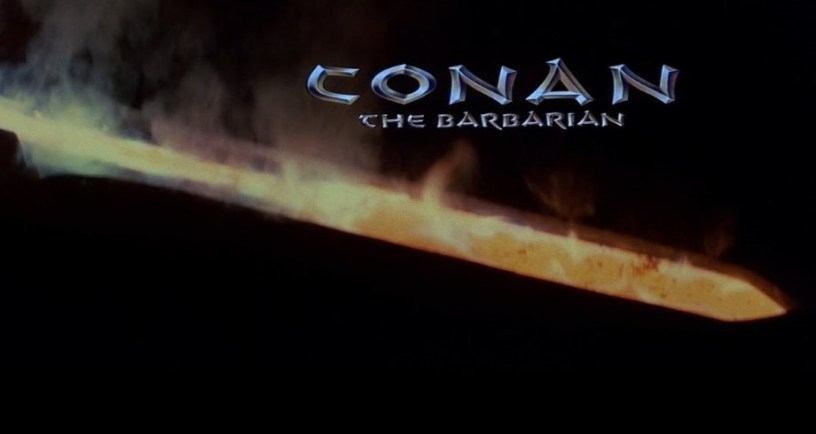
My previous article, “The John Milius Effect,” suggested that John Milius’ 1982 movie Conan the Barbarian has a larger effect on fantasy cinema today than we realize. It didn’t have the same effect as Peter Jackson’s Lord of the Rings trilogy, but its attitude toward fantasy anticipates what made Jackson’s movies so successful.
Ian Nathan notes that Jackson seems to take direct influence from John Boorman’s Excalibur, making his fantasy world so detailed that the movie has “the heft of the real” (14). Milius offers that same sense of detailed world-building but goes where Boorman doesn’t go: making the story feel more like a historical drama than a fairytale. Jackson leans as far into making his trilogy feel like a historical drama (more like Braveheart than Legend), which puts his movie more in Milius’ footsteps than Boorman.
There is another way that the movie curiously anticipates later trends. In fact, it’s a trend that Milius might have found amusing, given that he downplayed any claims that Conan the Barbarian was a comic book movie.
Conan and Comic Books: Why John Milius Matters to Superhero Movie Discussions
One term routinely appears in early reviews of Conan the Barbarian: comic books. For example, Roger Ebert dismissively referred to the movie as comic book material in his review for Siskel and Ebert. When Nat Segaloff interviewed Milius about the movie, he asked, “Most movies made from comic book characters are awful. Why does Conan work?” (62). Milius said multiple times in his director’s commentary and in various interviews (including some excerpted in the 2013 documentary Milius) that he wasn’t aiming to make a comic book movie, preferring to see it as a “Teutonic movie.”
Fans who know that Conan the Barbarian comes originally from Robert E. Howard’s pulp magazine stories may find all this talk about comic books confusing. Part of the answer is that this was how many film critics talked about fantasy or sci-fi adventure stories at the time: when Milius’ film school classmate Goerge Lucas released Star Wars, many reviews called it a comic book movie.
Furthermore, when Conan the Barbarian appeared in theaters in 1982, many audiences were probably more familiar with Roy Thomas’ Conan stories published by Marvel Comics than the original book.
Readers who hadn’t first discovered Conan through comic books often found him through anthologies that read a lot like comic books. Patrice Louinet reports in The Coming of Conan the Cimmerian that the book is the first uniform collection of Howard’s Conan stories in their publication order, free of rewrites by later writers. The book appeared in 2002. Earlier books were mishmash collections of original Conan stories, Conan pastiches, unfinished Howard material rewritten by later writers like L. Sprague De Camp, and even Howard stories rewritten as Conan stories (Louinet xix-xx). To make matters more complicated, some of these writers who wrote Conan pastiches also wrote sword-and-sorcery satires with original characters (like De Camp’s The Reluctant King trilogy). It became hard to separate Howard’s serious fantasy stories from comedy riffs on his material. Small wonder that so many movie critics saw Milius as taking silly fantasy material and treating it too seriously.
However, the superhero movie has arguably inherited Milius’ style even more than fantasy movies. Fantasy films have had some great moments since Peter Jackson’s trilogy appeared, but few high fantasy (fantasy in its own self-contained word) or sword-and-sorcery projects have thrived at the box office. At least, not on a level to cultivate a thriving genre comparable to what has happened with superhero movies. There have been some highly successful fantasy movies here and there, but in terms of sustained series, the biggest success has been low fantasy (fantasy nominally set in “our world,” like the Harry Potter series) or high fantasy on the small screen (TV shows like Game of Thrones or Rings of Power). Fox’s X-Men series, Christopher Nolan’s Dark Knight trilogy, and the Marvel Cinematic Universe cultivated a successful genre that continues to sell well two decades into the trend.
From Capes to Chests: The Hardbody Influence on Milius and Superhero Movies
Milius anticipates the superhero boom in several interesting ways. One minor way is how much his movies—particularly Conan the Barbarian, but also movies like Big Wednesday and Red Dawn—emphasize perfect male bodies. Alfio Leotta argues that Milius “played a crucial role in the emergence of the so called ‘hardbody film,’ a sub-category of the action genre which showcases hyper masculine characters (usually played by bodybuilder-actors) engaged in various feats of heroism” (“‘I love the smell of napalm in the morning’”).
That trend became especially important to Arnold Schwarzenegger’s career after Conan, but also crucial to the most successful superhero films. Early movies like Superman and Tim Burton’s Batman movies rarely put much emphasis on actors whose bodies looked perfect. Christopher Reeve looked healthy as Superman, but not larger-than-life.[1] Blade and The Crow featured elaborate fights that made the actors look athletic but emphasized the special effects (gunshots, explosions, martial arts sequences) over how good their bodies looked. In a recent GQ interview, Michael Keaton recalled that Jack Nicholson advised against becoming too fit to play Batman: why put in the effort when the costume, the superhero emblem, does all the work?
In contrast, the X-Men movies made a trope of Hugh Jackman becoming shirtless or nude in each movie—sometimes in flashbacks, sometimes as part of a funny scene like maids giving him a forced bath in The Wolverine. Captain America literally put a spotlight on Steve Rogers’ now-perfect, bare chest after his transformation, then showed Peggy Carter looking a bit embarrassed after she impulsively touches his pectorals. Preview commercials for Thor highlighted a brief scene of the Norse god shirtless. During a Variety interview with Mark Ruffalo, Robert Downey Jr. recalled how tired Ruffalo got of keeping his body fit for shirtless scenes in the Avengers movie. Actors who started out as wrestlers or models (John Cena as Peacemaker, Dave Bautista as Drax the Destroyer, Dwayne Johnson as Black Adam, and Channing Tatum as Gambit) have played increasingly prominent roles in superhero movies. The superhero craze may not objectify male bodies as much as it does female bodies, but as Leotta would say, these movies share something in common with Milius’ Conan: they are very interested in “sculpted muscularity and physical prowess of the body of the male hero.”
Milius not only anticipated something that became very important to superhero movies cast actors: he anticipated how they portrayed the real world.
Realism and Fantasy: John Milius’ Approach to Worldbuilding
As discussed in a recent article on the original Superman series compared to the X-Men franchise, Superman showed that superhero films had promise, but the most commercially viable films don’t emulate its tone. The definitive superhero tone since 2000 hasn’t been Richard Donner’s epic serious mixed with camp humor we see in Superman nor Burton’s otherworldly visions in Batman. The common DNA between the X-Men franchise, the Dark Knight trilogy (and the more recent efforts to emulate its success), and the Marvel Cinematic Universe has been setting the superheroes in “the real world” as we know it.
For the Dark Knight trilogy, that emphasis on “real world” plausibility was the tech. As David S. Goyer put it in a 2014 BAFTA interview, he and Nolan took the view that even the most outlandish Batman technology had to be roughly based on something real. Marvel took a slightly more fantastic approach with its technology in Iron Man than Nolan and Goyer did in Batman Begins. Still, what stands out about Iron Man is how hard it works to make the setting resemble our world. None of Burton’s “Planet Gotham” stylized landscapes.
Instead, we get hints the story is happening in our world. We get a real-world cameo from Mad Money Host Jim Cramer talking about Stark’s business decisions, not the fictitious Gotham celebrities of Burton’s movies. We get a superhero lair that looks like an especially opulent West Coast billionaire’s home, but nothing too outlandish: none of Josh Kirby’s grand superhero lair decorations here. We get villains who look like twenty-first-century Middle Eastern terrorists before we get the grand final villain. Notably, the most grandiose elements all involve Tony Stark’s tech, and the movie establishes multiple times that Stark’s technology is several generations ahead of everyone else’s tools. So, Tony Stark lives in our world but happens to be a supergenius-turned-superhero who can do what no one else can.
While Marvel moved away from this “real world” approach to include more fantastic elements, it took them a while to make the more fantastic elements feel plausible. The first two Thor films feel unsure of what to do with the fantasy elements and how to make them compelling to viewers. The same applies to Captain America, which seemed unsure how to embrace its dieselpunk elements. The first two Marvel phases were at their best when they emphasized “realism.” It wasn’t until the third phase that they entered more outlandish fare successfully. If they were sci-fi films, they resembled Star Wars (with its “used future” concept that made otherworldly settings feel real) more than Star Trek. If they were fantasy films, they resembled Milius’ Conan more than Bakshi’s The Lord of the Rings.
Telling the Story Slowly: John Milius’ Approach to Storytelling
Both Jackson’s Lord of the Rings trilogy and the Marvel Cinematic Universe parallel Milius in another curious way: taking a series approach to its story.
While Jackson was pressured at least once to make a single movie instead of a trilogy, he chose to tell a long story over multiple movies. No trying to cover as much of Tolkien’s material as possible in one movie, like Bakshi did. Jackson took a risk on telling the story slowly—knowing full well, as Viggo Mortenson pointed out, that a poorly received first movie would mean two very expensive direct-to-video sequels.
While Howard didn’t leave a multi-book Conan story to adapt, Milius did approach his movie as part of a series. In Conan Unchained, Milius discussed his original plan to make a Conan trilogy: the hero would gain power and knowledge, then learn how to use it over two sequels. Ultimately, conflicts with producers meant that Milius did not make any Conan sequels. Conan the Destroyer was made without his involvement. A director’s cut released in 2000 helped show how much Milius meant in his movie to set the stage for something larger: it includes details like Princess Yasiminia watching Conan as he sits in Thulsa Doom’s temple. She genuflects toward him, implying that he could be her master and rule this temple if he wanted to. Instead, he stands, burns the temple, and takes her away from its wreckage. Conan deliberately chooses not to take the villain’s role, which implies he must grow into something else. The story isn’t over.
Understanding Conan The Barbarian as an aborted start to a series presents a challenge for reviewers. Leotta notes that critics often complained that the movie’s hero doesn’t act much like the Conan of Howard’s stories. However, this makes sense if Milius is “interested in the psychological development of the protagonist” (Cinema of John Milius 83) and wanted Conan to grow over several movies. Conan is still becoming the man that we know from the classic stories, in the same way that Tony Stark doesn’t develop into Iron Man until the end of the 2008 movie, and still has lots of room to grow.
Understanding Conan the Barbarian as a series starter also has consequences for the common critique that the movie celebrates might as right. If it is the first chapter of a story, “a revenge story” to be followed by “what happens to Conan when he finally becomes King” (Topel 1), is that a fair critique? Is Conan going to learn from his mistakes in later chapters we didn’t get to see?
It’s like wondering whether we would be satisfied with Frodo’s journey in The Fellowship of the Ring if we never got the later Jackson movies. Or if we only saw the story’s end through movies made by other filmmakers covering the rest of the story—a problem that many viewers had when they went from Bakshi’s The Lord of the Rings to Rankin-Bass’s The Return of the King.
To put it another way, how we would view Tony Stark if we only had Iron Man? No sequels with the same production team guiding the story to create a clear story arc. No follow-ups where his arrogant behavior creates new problems, and he eventually becomes wiser. How would we review Iron Man today if the story ended with him saying, “The truth is… I am Iron Man,” and nothing followed?
Unlike Jackson or the Marvel filmmakers, Milius never got the chance to finish his story. That may mean that Conan will always be an odd film. The start of a trilogy that never finished. A pseudohistorical fantasy that came a little too soon to be appreciated. Yet it hints at the ideas that would become central to our modern fascination with speculative fiction films. Milius was more prescient than many give him credit for.
Works Cited
“David S. Goyer: BAFTA Screenwriters’ Lecture Series.” BAFTA Guru, March 26, 2014. https://www.youtube.com/watch?v=_a-qhIOZcSw.
Leotta, Alfio. “‘I love the smell of napalm in the morning’: violence and nostalgia in the cinema of John Milius.” Jump Cut, vol. 57, 2016. https://www.ejumpcut.org/archive/jc57.2016/-LeottaMillius/index.html.
—. The Cinema of John Milius. Lanham: Lexington Books, 2019.
Louinet, Patrice. “Introduction.” The Coming of Conan the Cimmerian edited by Patrice Louinet. New York: Ballantine Books, 2003, pp. xix-xxv.
“Michael Keaton Breaks Down His Most Iconic Characters.” GQ, March 28, 2024. https://www.youtube.com/watch?v=j2h4lcXUCxw.
Milius. Directed by Joey Figueroa and Zak Knutson. Chop Shop Entertainment and Haven Entertainment, 2013.
“Robert Downey Jr. & Mark Ruffalo: Actors on Actors.” Variety, December 4, 2023. https://www.youtube.com/watch?v=0OLBhkKLmUY.
Robey, Tim. “Viggo Mortensen interview: Peter Jackson sacrificed subtlety for CGI.” The Telegraph, May 14, 2014. https://web.archive.org/web/20140515024323/https://www.telegraph.co.uk/culture/film/10826867/Viggo-Mortensen-interview-Peter-Jackson-sacrificed-subtlety-for-CGI.html.
Salter, G. Connor. “The Superhero’s Challenge: The Christopher Reeve and Hugh Jackman Story.” Fellowship & Fairydust, May 31, 2014. https://fellowdustmag.com/2024/05/31/the-superheros-challenge-the-christopher-reeve-and-hugh-jackman-story/.
Segaloff, Nat. Big Bad John: The John Milius Interviews. Orlando: Bear Manor Media, Kindle, 2021.
“Sneak Previews.” WTTW National Productions, May 6, 1982. https://siskelebert.org/?p=7219.
Topel, Fred. “Exclusive Interview: John Milius on ‘Milius.’” CraveOnline, January 6, 2014. https://www.mandatory.com/fun/625751-exclusive-interview-john-milius-on-milius.
[1] For comparison, consider that Schwarzenegger campaigned to play Superman.
 Fellowship & Fairydust