
BY G. CONNOR SALTER
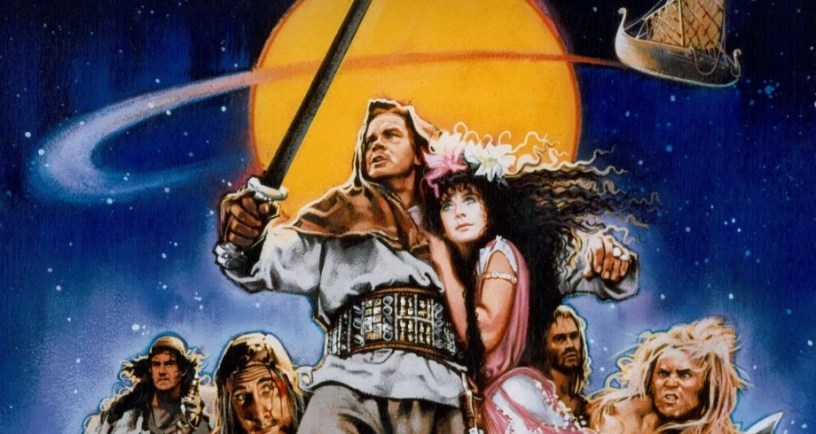
While every member of Monty Python is tied to fantasy filmmaking by the fact they made Monty Python and The Holy Grail, some are much more closely tied to it than others. Terry Jones (1942-2020) didn’t have the acclaimed director career of Terry Gilliam. Still, he kept writing about medieval topics in documentaries like Terry Jones’ Medieval Lives, books like Chaucer’s Knight, and fantasy novels like The Knight and the Squire. However, 14 years after releasing one of the most important Arthurian films ever made, he returned to medieval-based fantasy with his fantasy film Erik the Viking, based on his 1983 children’s book.
While it has a cult status, it’s a surprisingly frustrating film. As we near the movie’s thirty-fifth anniversary, it’s worth asking, “Why?” How did Jones go from making a seminal fantasy film to a curiosity most notable because it spawned a Director’s Son’s cut released by Bill Jones that is considerably shorter?
The Plot (Or Why Not Try A Viking Cruise This Year?)
The story starts similarly to a Monty Python film: a shocking moment of taboo-breaking comedy. Erik shows up in a town to pillage, breaking into the home of a woman baking bread. He sits on her for several moments without doing anything until she says, “Have you done this sort of thing before?”
This leads to a discussion on the ethics and economics of the Viking plunder-and-pillage model. The conversation ends when two more Vikings show up. Erik ends up killing them before they attack the woman but accidentally stabs her.
Cradled in Erik’s arms, she says, “Thanks for saving me from a fate worse than death.”
“Oh, well, I didn’t mean to.”
“Well, that’s alright then,” she says. “It’s the thought that counts,” she mumbles before dying. Opening credits begin.
It’s a very Pythonesque scene, like the debate between Arthur and the socialist peasants about the ethics of a government based on strange aquatic ceremonies. However, it’s also far darker, arguably darker than most Python fare: even The Meaning of Life stops short of rape jokes.
However, The Meaning of Life may be the key here. Throughout the documentary Monty Python: Almost the Truth, all five then-living Pythons talk about engaging in subversive comedy that explored topics people felt shouldn’t be discussed or only in reverent tones. While they affirm that they didn’t have a clear plan for The Meaning of Life until very late in the writing process, it’s hard to avoid noticing how much darker it takes their material. They had pushed boundaries to the point where they had to go very dark to stay subversive. Hence, the film provides scenes like a morbidly obese man named Mr. Creosote exploding at a restaurant, taking gross-out dark comedy as far as possible. Outside of an unrated horror comedy like Peter Jackson’s Braindead, it’s hard to find a movie that takes gross-out comedy further than this.
So, we may see this Viking rape joke as Jones taking subversion somewhere new. He couldn’t take gore further, so that leaves sex.
The rest of the film follows Eric grappling with his guilt over killing the woman and a sense that there must be more to life than raiding. Advised by a mystical woman in a cave, he concludes that his people raid and pillage because Ragnarok is coming, providing a perpetual winter that forces them to live a harsh life. He convinces his friends to travel to Asgard to petition the sleeping gods to stop Ragnarok.
So, as we would expect from Jones’s other work, this is a deconstruction. Erik the Progressive Viking asks why he should follow the gods’ plans. A bit like the angel Aziraphale and the child antichrist Adam asking in Good Omens why the apocalypse has to come anyway. Not a bad concept for a comedy.
But where does the comedy go?
We Have to Act the Jokes A Lot (Better)
There’s plenty of humor on the journey. One of Erik’s fellow travelers is a Christian priest who’s lived in Eric’s village for years and is glad to travel because he’s never managed to convert anybody and is fed up with the village. When he complains about his lack of success to a friend, the friend reminds him that Thorbjorn Vifilsson’s wife converted.
“Thorbjorn Vifilsson’s wife became a Buddhist, not a Christian.”
“Same thing, innit?
“No. It is not.”
On paper, good lines. The kind of lines we’ve heard before in Python films—one person says something absurd, and someone else says, “No, it’s not!”
However, as the movie continues, it becomes clear how much delivery helps sell this humor style. Sometimes, it helps to be entirely serious (John Cleese never “played it light” when he was the Black Knight yelling, “‘tis but a scratch!”). Other times, it helps to be silly but committed (Jones was silly when he yelled, “He’s not the Messiah! He’s a very naughty boy!” in Life of Brian, but he did it so earnestly that his character felt believable). Some comedy falls flat if the actor is winking at the audience. Here, the actors never seem serious or earnest enough to sell the jokes.
The problem becomes obvious when John Cleese makes a cameo. As Halfdan the Black, the village chief the next town over, he listens with a bored expression as a blacksmith entreats him to thwart Erik’s plans, pausing every few seconds to pass capital punishment on offenders (“Eh, flay them both alive, will you?”). Put it down to him having better lines. Or put it down to the fact that the Pythons wrote the material themselves. As Jones said in an interview for Mike Sacks’ book Poking the Dead Frog, “Writing was very serious business; we took it very seriously. But it did take a lot out of us.”
We Should Be Struggling Together! (Or A Python Goes Solo)
Acting issues aside, it’s hard to escape the sense that many of the lines in Erik the Viking don’t feel as funny as Python lines. As one fan wrote, “The jokes inspire smiles rather than guffaws.”
Perhaps that’s because Jones wasn’t the wordplay expert in Python. He and writing partner Michael Palin preferred visual gags (the Funniest Joke in the World). Cleese and writing partner Graham Chapman were the wordplay men (the Dead Parrot). Given this background, it’s unsurprising that the funny lines (and often how Jones directs the actors saying the lines) are hit-or-miss.
More surprising is how often the visual gags don’t work as well as expected. There’s a sequence involving the floating island of Hy-Brasil whose residents all know it won’t sink as long as they don’t break an ancient rule and commit bloodshed. One of the Vikings breaks the rule, and it starts to sink, but the residents won’t believe the sinking is really happening. So, they all sink into the sea, huddled together and smiling as their leader (Jones) babbles about how they have all agreed the island isn’t sinking. On paper, funny. In execution, somehow tepid.
Perhaps this shows that Jones was a visual thinker but not necessarily a great visual filmmaker. Idle observed in Almost the Truth that what made Holy Grail work was it merged two directorial sensibilities: Jones’ comedy and Gilliams’ visuals: “You get these wonderful Gilliam scenes of the boat and so it becomes actually a movie, whereas Terry Jones is very good at making sure the joke is on camera.”
It’s well documented that Jones and Gilliam fought throughout making the movie, even after they settled on Jones directing the actors and Gilliam directing the camera team. But whatever happened behind the scenes, the mix of Gilliam directing the visuals and Jones directing the people worked on Holy Grail, Life of Brian, and The Meaning of Life. Gilliams’ solo films have sometimes been unwieldy (too many strange visuals, not enough plot or human connection). However, Gilliam’s films always look great, even on a small budget (Time Bandits). Jones’s solo efforts were far more hit-and-miss. Even his best-reviewed post-Python film (The Wind in the Willows) isn’t known for its visuals.
Here, the visuals are especially poor—especially in the Asgard scenes, when Erik’s boat travels across a blue screen of stars. Admittedly, since the script is based on a children’s book, Jones may have aimed for something deliberately fake, like the obvious artificial clifftop set in The Princess Bride. But what Rob Reiner made into a joke looks like cust-cutting here.
For all its technical issues, for how it shows how much the team element made Python films possible, a greater problem may be holding Erik the Viking back. It wants to go places that Jones struggles to visit because he’s been there already.
Asgard Is a Silly Place
Eventually, Eric and his friends reach Asgard. They meet many people they’ve known, including the woman from the village. Erik talks to her as she bakes bread (what she was doing when he attacked her village), but they don’t reconcile or learn anything from each other. She points them to where the gods are, by the larger hall, and keeps baking bread.
The gods turn out to be super-powered children who couldn’t care less what their visitors want. Humanity’s problems don’t concern them. After the gods throw them from Asgard (the floor opens, and they plummet through the air), a last-minute twist lets them land somewhere safe. Back in their village. Halfdan’s men invaded the village while they were gone but are swiftly killed by Erik’s ship falling on them.
Ultimately, Erik’s group embraces their family and watches the sunrise. That means that Ragnarok isn’t happening, although it’s unclear what has changed. Perhaps the point is that Ragnarok was never really happening, and the sun would become visible when they started noticing it more.
At any rate, they watch the sunrise, looking to a future…. which probably won’t be too much different from what was really happening. They haven’t learned much except that the gods are fickle. Several Vikings seem to know themselves better: an angry Viking named Sven the Beserk embraces his nearly lost friend Kietel the Blacksmith, suggesting they have feelings for each other they can finally express. Even though this idea hasn’t been developed much, it never becomes a sly way to subvert the story (like the gay Lancelot in Idle’s musical Spamalot).
Jones may be aiming for the idea that Eric and his friends have learned that quests don’t solve anything. Perhaps, as Brian tells the crowd in Life of Brian, the moral is, “You have to figure it out for yourselves! You’re all individuals.”
That theme could be interesting. Given that Jones is a medieval scholar writing about Norse myth, it may even be a clever reminder that Norse paganism never promised that a heroic life would lead to personal redemption. The gods are pretty fickle in the myths. Besides the hope that warriors who die in battle arrive in Valhalla (a hope that Jones seems to critique when his heroes reach Valhalla and find they can’t interact with their long-dead fathers), there’s little hope in this religion. Ragnarok may be ultimately hopeful because it promises a final battle that settles things, but Erik the Viking is all about solving Ragnarok.
Small parts of the Norse religion (like Balder the Beautiful’s death, which C.S. Lewis saw as an echo of the Christ story) may offer a glimpse of hope, but only if seen in Christocentric mythopoeic terms. Jones avoids any hint that the Norse myths may hint at a larger story that Christianity fulfills. The Christian monk is a fool throughout the movie, with no implication that his new gods have anything to offer.
So, perhaps Jones, as a historian, wants to remind readers what a Norse adventure really offers. The gods don’t care about humans. Any attempt to find a redemptive eternal journey inside Norse paganism requires stepping into another supernatural worldview, a step that Jones won’t take. Believing in other gods is the same foolish game. The only solution is optimistic humanism—the creed that the crucified men sing in Life of Brian: to always look on life’s bright side even if life is finally a joke on us.
What Has Secular Humanism Ever Done for Us?
However, if Jones says the solution is optimistic humanism, it doesn’t come across as compelling. That might be because he hasn’t developed the Norse myth idea much: again, it’s a script based on his children’s storybook, not a Norse history text.
However, the key problem may be that Jones had no territory to explore when he made Erik the Viking. He and the Pythons repeatedly used secular humanism to deconstruct heroism in hilarious ways.
Holy Grail explores the grail but ends with no resolution—a postmodern break where the knights get arrested by modern-day police before they can retrieve it.
Gilliams’ first solo movie, Jabberwocky, inverts the hero’s journey so that winning the quest proves horrible. The hero accomplishes what audiences expect—he kills a dragon and marries a princess to rescue the kingdom—but he never meant to be a hero. As Gilliam put it in Gilliam on Gilliam, the hero is punished for having small dreams.
Life of Brian laughs in the face of nothingness, literally crucifying the idea of meaning.
The Meaning of Life explores comedic nihilism. The “Galaxy Song” written by Idle sounds fun, but it’s a reminder that nothing really matters in the movie. The woman who listens to the song decides to kill herself and let someone have her organs. After a glib song about Christmas in heaven, the movie ends with pulling the camera back to show a hostess character from earlier in the film saying that the meaning of life is really “Try and be nice to people, avoid eating fat, read a good book every now and then, get some walking in, and try and live together in peace and harmony with people of all creeds and nations.” Nice words. But as well-meaning as they are, it’s hard to understand why we should do these things if we are all dying in an indifferent universe anyway.
So, the struggle with Eric the Viking is that Jones can’t take the humanism any further. He and the other Pythons have taken deconstruction so far that they found humor in crucifixion, bodily dismemberment, and euthanasia. Perhaps a detailed script that explored Norse culture could have provided a redirection. Still, it’s hard to imagine how Jones could have been more deconstructive after The Meaning of Life. His appeal to smash meaning and support humanism had run out of gas.
Thirty-five years since Erik the Viking appeared, deconstructing fantasy is still popular. The trend with shows like the various Game of Thrones spinoffs has been serious deconstruction (making everything dark and gritty, “realistic”). Yet it’s hard to name a medieval comedy movie that has succeeded where Erik the Viking failed or superseded the influence of Holy Grail. This may mean it’s time…. not to forget the Pythons. That would probably be impossible. But it may be an ideal time to emulate their strengths (the funny dialogue, the surrealism, the team-building approach to making great comedy) with a new vision. Something about why even secular humanists crave hope, and deconstruction isn’t ultimately enough.
 Fellowship & Fairydust