
BY AVELLINA BALESTRI
Tell us a little bit about yourself and your background.
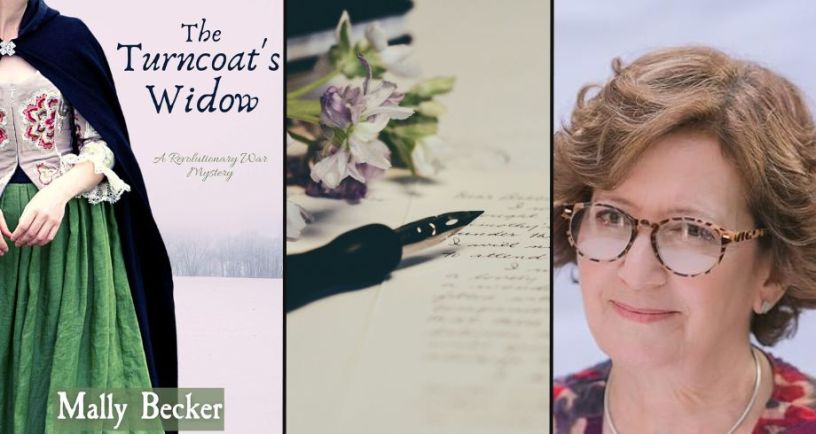
Thanks for the question! I’m the two-time Agatha Award-nominated author of the Revolutionary War Mysteries, which include The Turncoat’s Widow, The Counterfeit Wife, and The Paris Mistress. Book three in the series, The Paris Mistress, was published this month. My stories feature Becca Parcell and Daniel Alloway—George Washington’s two least likely spies—as they search for traitors in revolutionary-era New York City, Philadelphia and Paris. Fictionalized versions of real events and people are woven into each story.
Before writing full-time, I worked as an attorney and volunteer advocate for foster children. When I’m not writing, you can find me at The Writers Circle Workshops, where I teach mystery writing, on Guns, Knives & Lipstick, the crime fiction Podcast I co-host with three female mystery writers, or online at the Historical Novel Society, where I interview other authors. I live with my husband in Somerset County, New Jersey, not too far from the settings in my first book.
What first inspired you to start writing?
I have my mom to thank for my love of writing. She told stories to make sense of the world, as I do now. A neighbor’s recent divorce? My mother would pluck something she’d seen or heard and weave a tale about what might have led to the marital break-up. “You don’t know that. You’re making it up,” I’d argue. But I share her curiosity about the world, and I do the same thing, looking for clues to piece together the puzzle of why people act the way they do. Writing or telling stories is how I make sense of our endlessly interesting, heartbreaking, and heartwarming lives.
How did you first become interested in history, and what are your favorite time periods?
My sixth grade teacher, Mrs. Miller, created an archaeology unit for our social studies class. We were required to learn about ancient Egypt. Then she set us loose to “find” the fake artifacts she’d hidden in a make-believe dig that included copious amounts of sand on the classroom’s tile floor. That experience hooked me on history for life.
What started you on the journey of historical fiction writing in particular?
A nondescript, historically insignificant 245-year-old legal filing set me on this fiction writing path. It changed my life.
I love to hike, and I thought I’d be clearing trails when I volunteered at a national historical park close to home. Instead, I was assigned to work in the park’s archives. That’s where I found an indictment of a local farmer who’d committed the Revolutionary War-era crime of traveling to New York City without the government’s permission.
The government’s permission to head into the city? I’ve lived in and around New York City my entire life. I couldn’t imagine not being able to head into Manhattan or Brooklyn whenever I wanted. So looking for an explanation, I took the document to the park’s historian for an explanation.
He told me the real story of our American Revolution, one I’d never heard. He said historians believe that 50% or less of our population may have supported our independence from England. So many of us here in New Jersey were taking George Washington’s military secrets to nearby Manhattan, which the British controlled, that the American government made it a crime to travel there.
I hadn’t known that our country was as divided at its founding as it is now, and I started playing the writer’s game of “what if” without knowing that’s what I was doing. What if I had to look over my shoulder before expressing a political opinion? What if my husband was (secretly) one of those British spies carrying secrets into New York? What if everyone thought I supported England, too? What if he left behind a list of other American traitors before he died?
One “what if” led to the next, and I started writing my first mystery, The Turncoat’s Widow. Book three in the series, The Paris Mistress, has just been released by Level Best Books.
What are your favorite and least favorite parts of working within the historical fiction genre?
I love creating characters who are everyday people like myself and placing them in danger during tough historical times. I want readers to cheer for those characters and, simultaneously, wonder how they’d handle themselves in similar circumstances.
My least favorite part of writing historical fiction? That’s a tough one. I annoy myself by how often I stop to research just… one… more… historical question. But it’s not historical fiction’s fault that I’m an inefficient but enthusiastic researcher.
How have you chosen which historical characters to feature in your books, and what made their stories resonate with you?
I’m inspired by women—then and now—who ignore society’s limitations to follow their passions. I’ve included some of those 18th-century trailblazers in my stories.
You’ll find Patience Wright, for example, in my newest book, The Paris Mistress. She was an American artist who sculpted British royalty until her support for her home country’s independence made her persona non grata in England. She was one of Benjamin Franklin’s guests outside of Paris in 1781, when The Paris Mistress takes place.
Esther Reed gets a spotlight in The Counterfeit Wife. Mrs. Reed wrote and published an essay arguing that American women were “born for liberty” and had a part to play in securing the country’s liberty. She formed the first all-woman political action committee in the colonies and went door-to-door in Philadelphia to raise money for the Continental Army.
George Washington, Alexander Hamilton, Benjamin Franklin, and Queen Marie Antionette, among other historical figures I feature. I hope readers come away feeling as if these famous men and women have stepped out of their stiff, two-dimensional portraits and come to life.
What is your process in terms of research and bringing historical characters to life?
I start with a few books presenting historian’s view of the places and time periods that interest me. Something an author says will surprise me and make me wonder “what really happened.” That’s when the detective work really begins. I’ll narrow my focus, searching for diaries, journals, and documents from the historical time that provide more hints, turns and twists, some of which find their way into my story.
I read as much as I can about and authored by the historical figures I include in my stories. For example, what brought General Washington to life for me was his affectionate correspondence with wife Martha Washington. She destroyed almost all of his letters, but she missed two of them. I infused “my” General Washington with the warmth I sensed in those letters in scenes that include Martha in The Turncoat’s Widow.
What is your method to integrate fictional characters and situations into the historical setting?
[I don’t have an answer to this one! Hope that’s ok.]
If you had the chance to convey a message to your favorite historical characters, what would it be?
I’d thank them for all the good they accomplished, then warn them that their comfort with the institution of slavery would become a stain on their reputations.
What do you find more enjoyable/difficult: First drafts or editing/rewriting?
That’s like asking a parent which child is their favorite! Or maybe it’s just that both writing and editing are enjoyable AND difficult.
Writing a first draft offers the sheer delight off discovery, whether I’m discovering my plot as I write or discovering the perfect bit of history to set the scene. And I especially love when a character decides to take my story in a new, surprising direction. It does happen.)
Editing uses a different part of my brain, and I like the rigorous challenge of carving away, tightening, and adding scenes to a first draft. The part where I reread a scene I thought was brilliant three days earlier and discover it’s not? That I don’t enjoy as much.
How have you gone about publicizing yourself and your works?
I’ve reached out to libraries and bookstores, to historical societies, writers groups, and newspapers. And I’ve been somewhat active on social media. The biggest treat, though, is meeting readers who are as enthusiastic as I am about good stories!
What are some of the main themes/morals you would like readers to take away from your works?
First, second and last, I hope my stories entertain readers.
I also hope that readers pick up on my quiet message of hope. We’re living through ferociously difficult times. But times that we’ve been told were “simpler” than ours, when we were “all in it together,” were not simple; nor were we unified. The War for Independence was a long civil war. The pandemics of smallpox and yellow fever swept through the colonies, and hyperinflation decimated local economies. Yet everyday people like ourselves survived and thrived. They found courage, found love, and reached out to help others in need. We will, too.
What is some advice you would give aspiring authors, especially those focusing on the historical fiction genre?
Most important, remember how much fun it is to tell stories, even on days when the words don’t seem to come.
Second, even if work and family make it hard to write every day, find a routine that keeps you scribbling each week on a regular basis. That will keep your characters and plot fresh in your mind, which, in turn, will have you coming up with more ideas for your story.
Finally, keep your characters and their conflicts center stage, especially when you’re finding the historical elements in your story absolutely, completely fascinating.
Plug your socials, published works, and current projects!
I’m so excited that The Paris Mistress, the third book in my Revolutionary War mystery series, is out in the world now. It tells the story of George Washington’s two least likely spies for liberty, Becca Parcell and Daniel Alloway, who are determined to marry in Paris and leave their undercover past behind— until a plot to bribe Benjamin Franklin leads to murder.
Becca is eager to reach Paris to marry Daniel, who’s gone ahead to take up a new post there. But their idyllic prenuptial life unravels once they accept an invitation to reside with Dr. Benjamin Franklin, America’s brilliant, enigmatic ambassador to France.
When a murdered man is found on the roof of Dr. Franklin’s home, he calls on Becca and Daniel to investigate. They find themselves searching for the murderer through the labyrinth of 18th century Paris, a city brimming with danger, secrets, and the ever-present whispers of revolution.
With time running out, Becca and Daniel must determine whether the killer is a member of Dr. Franklin’s inner circle or a cunning outsider. And as the couple race from the cobblestone streets of Paris to the gilded halls of Versailles, they discover that their own lives are in grave danger and that the stakes for Dr. Franklin and America are higher than they could have imagined.
You can learn more about The Paris Mistress and my Revolutionary War mystery series at: https://www.mallybecker.com. You can also find me on Facebook at: https://www.facebook.com/mally.baumelbecker/ and on Instagram @mallybeckerwrites. I’d love to hear from you!
 Fellowship & Fairydust