
BY AVELLINA BALESTRI
Tell us a little bit about yourself and your background.
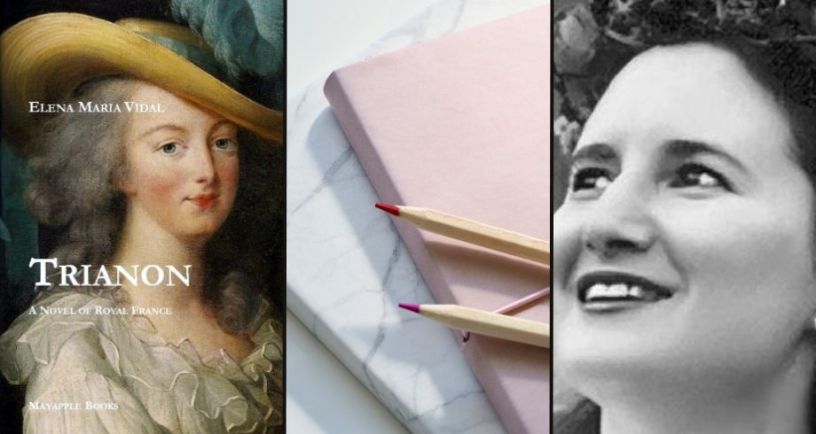
I grew up in the countryside outside of Frederick, Maryland, “fair as the garden of the Lord” as the poet Whittier said of it. As a child I read so many books that my mom had to put restrictions on my hours of reading. During my teenage years, I spent a great deal of my free time writing stories and short novels. I graduated in 1984 from Hood College in Frederick with a BA in Psychology, and in 1985 from the State University of New York at Albany with an MA in Modern European History. In 1986, I joined the Secular Order of Our Lady of Mt. Carmel. I taught at the Frederick Visitation Academy and worked as a private tutor as well as teaching children’s etiquette classes. During a trip to Austria in 1995 I visited the tomb of Empress Maria Theresa in the Capuchin crypt in Vienna. Afterwards I decided to finish a novel about Marie-Antoinette I had started writing ten years earlier but had put aside. In 1997 my first historical novel TRIANON was published by St. Michaels Press.
What first inspired you to start writing?
I wanted to be a writer from the time I was a very small child, just learning to write. I suppose all the stories about girls who wrote, like Anne of Green Gables, inspired me.
How did you first become interested in history, and what are your favorite time periods?
I was always interested in “the olden days” when ladies wore long dresses and had long hair. I wore my aunt’s old prom dresses and played princess. My favorite times periods became the Middle Ages (when Joan of Arc lived) and the 1700’s (when Marie-Antoinette lived).
What started you on the journey of historical fiction writing in particular?
I saw the first Star Wars film when I was 14. I came home and made up a story about a character based on Princess Leia except instead of living in space she lived in a medieval country.
What are your favorite and least favorite parts of working within the historical fiction genre?
I love everything about the genre. Good historical fiction requires thorough research, and I enjoy research. The storyline is basically provided for you; all the author has to do is weave the historical events together in a coherent and entertaining manner. The challenge for the historical fiction writer is to maintain the integrity of the historical persons, remembering that those who were real people have the right to be presented as close as possible to how they were in life. For instance, if an author of historical fiction decided to show Napoleon Bonaparte as a pacifist who hated the sight of weapons, it would be irresponsible to the readers to create such a false depiction. Or, as I actually saw in a miniseries, to show St. Thomas More as a sadist who tortured heretics in his study for the fun of it contradicts all that we know about the cheerful humanism of the More household. Yes, Thomas More as Chancellor applied the laws of the land to religious dissenters but he did not do it at his home or for his personal amusement but because it was his job. Authors owe it to the people they are writing about to present them realistically, even as we owe it to the readers to offer an authentic portrait of the past.
How have you chosen which historical characters to feature in your books, and what made their stories resonate with you?
I almost feel like the historical characters chose me, as certain characters such as Marie-Antoinette captured my imagination at a young age before I even knew much about them or about the world they lived in. St. Joan of Arc as well, although I have not written directly about her, she usually is hovering in the background of everything I do. There is something about certain persons that reaches out to you from the past, the past being like Alice’s mirror that she climbs through into another universe. People who faced hardships with courage, fortitude and faith have always appealed to me. By studying their lives and recreating what we discover into a living portrait we historical fiction writers are able to invite others to join us in our journeys into the past.
What is your process in terms of research and bringing historical characters to life?
I start with studying portraits and then with several good biographies. Then I read letters and memoirs and other primary sources. Then I read as much as possible about the era. I usually include a bibliography in the back of my novels as a guide to further reading on the subject.
What is your method to integrate fictional characters and situations into the historical setting?
The only novel in which I have fictional characters is The Night’s Dark Shade but in that case the fictional characters are roughly based upon people I have known in my personal life. I wish I could say I had a method for integrating them but as any artist knows when one is in the midst of creating it all just comes together.
If you had the chance to convey a message to your favorite historical characters, what would it be?
There is nothing I could say to my favorite historical characters that they did not already know. The trick of writing historical fiction is to hear what the historical characters are saying to us now, in our time.
What do you find more enjoyable/difficult: First drafts or editing/rewriting?
The entire process is hard. It’s all very hard work. What I do enjoy is after writing a chapter is reading it aloud to a family member or a good friend who loves the story and is waiting to hear what happens next.
How have you gone about publicizing yourself and your works?
I have tried just about everything in the last twenty-five years and it is easier now than when I published my first novel in 1997. Now there are publicists who can be hired to plan book launches and blog tours for very reasonable rates. Having an author’s blog, an Amazon page, and other social media accounts is important. Publicity is all about networking and building relationships online, which takes time. It has taken me years of interacting online to build community and the support needed to keep my books selling. I am an indie author but what I say is also true of authors with traditional publishers.
What are some of the main themes/morals you would like readers to take away from your works?
After reading my books I would like people to come away with more of a Christian world view, seeing the hand of God in history as well as becoming conscious of the constant attempts of the Enemy to overthrow Christendom. I also hope that people learn about history from my writings, about how people really were in times that are gone, rather than the anachronisms offered by many novelists and films which fit a contemporary political agenda.
What is some advice you would give aspiring authors, especially those focusing on the historical fiction genre?
Read Tolstoy, Walter Scott, Nathaniel Hawthorne and other great historical novelists. Flood your mind with the best writing and poetry, such as Shakespeare and Keats. Read the Douay-Rheims Bible. And research your historical characters until you know them inside and out.
Plug your socials, published works, and current projects!
I am currently writing the second installment of the Henrietta of France Trilogy to be called Generalissima. I blog daily about history, books, film, art and politics at my Tea at Trianon blog. https://teaattrianon.blogspot.com/
My books are available from Amazon: https://www.amazon.com/stores/Elena-Maria-Vidal/author/B001KMO6C0
X: https://twitter.com/emvidal
Facebook: https://www.facebook.com/ElenaMariaVidal/
Tumblr: https://emvidal.tumblr.com/
 Fellowship & Fairydust