
BY G. CONNOR SALTER
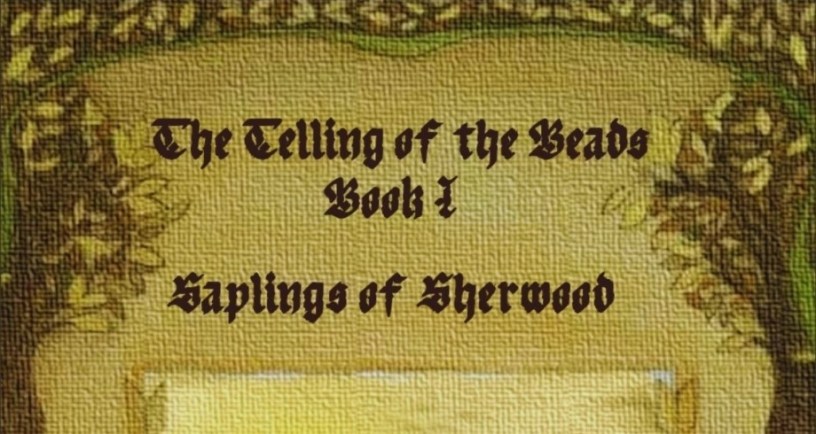
Saplings of Sherwood is a Robin Hood novel written about Avellina Balestri, the first in an ongoing series titled The Telling of the Beads.
The plot begins with Roger Cavendish, a Norman nobleman’s son who is used to seeing life as pain, and knows his father considers him weak. When Roger’s life intersects with Robin Locksley, the son of Nottinghamshire’s last Saxon noble, Roger begins to see a different way of life. The two young men aren’t sure what to think about each other. Robin feels much more comfortable about his other Norman neighbor, Marian Fitzwalter. As the three young adults mature to adulthood, they begin to see the webs that force them together, and against each other. The Normans rule England, frequently taking what they want. The Saxons resist or negotiate, keeping as much of their historic territory as they can. Balestri raises an important question: is it possible for these characters to bridge their differences… or will they each become what their parents expect them to be?
The story of Robin Hood has been told so many times that it’s difficult to say anything new. Consequently, recent retellings have gone for grime or snark. Balestri refuses to give either. She treats Robin’s values—honor, defending the weak, helping the poor—as good things that someone must fight for. However, she doesn’t present a children’s version of Robin Hood’s world, where good is easy to fight for. Scenes from Roger’s point of view show the violent, misogynistic leaders of this feudal society. Scenes from Robin or Marian’s viewpoint show this abuse being replayed in society. For example, one scene features a woman being attacked by would-be rapists, rescued but still traumatized. Balestri refuses to end the details there, and offers some poignant scenes of the woman slowly healing from post-traumatic stress. This is not a graphic book; it never enters George R.R Martin territory. But it is a story where some terrible things happen, and those details are treated as a tragedy, not a fact of life. Those dark moments clarify why Robin becomes the famous rogue (a story to be told in later books), and that his choice will be costly.
Balestri takes the complexity even further by including something that most retellings leave out: religion. Robin is not just a young man who craves justice. He ties that zeal to the Catholic faith his parents passed on to him… which makes it difficult when he realizes how much he sympathizes with the vengeance his pagan friends crave. Historians will know that Robin Hood is a fusion of pagan legends about the Green Man, and British Christian ideas about heroism. Balestri leans into the idea that Robin has these two impulses within him, and must learn how to reconcile them to become a defender of the downtrodden.
A nuanced, interesting Robin Hood origin story that breathes new life into old material.
You can purchase physical and ebook copies of Saplings of Sherwood here.
 Fellowship & Fairydust