
BY ROBERT ROSENWALD
“In the beginning, G-d was created, and G-d created the heavens and the earth. And the earth was without form, and void; and darkness was upon the face of the deep.”
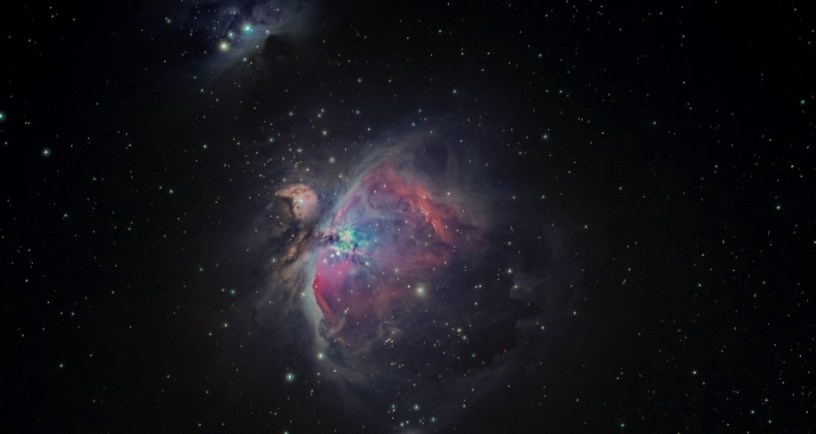
In the beginning there was only Ayin,
Infinitesimal and unitary,
Unstable nothingness
A void beyond comprehension,
The absolute absence of any and everything.
This unity was broken out of necessity
To create the perfect being.
It expanded and created space and became its opposite,
Ein Sof or infinity –
Infinite possibility, energy, and light.
“And ´Élöhîm said, Let there be light: and there was light. And ´Élöhîm saw the light, that [it was] good: and ´Élöhîm divided the light from the darkness.”
It was as if the universe began counting from zero,
Combining the letters of the Hebrew alphabet,
Seeking to understand all that is possible.
He chose from among the divine characteristics
To create a specific, meaningful world,
And contracted Himself to form finite, separate, free beings.
“And ´Élöhîm said, ‘Let us make man in our image, after our likeness.’”
He created an empty space within Himself,
But He was still immanent in all the universe.
This act must be repaired by His creation with Tikkun,
Perfecting the universe
And unifying the sparks of divine light
Leftover from that great contraction.
So begins Kabbalah, known as Tzim Tzum
Developed by the great Rabbi Isaac Luria,
The lion, or the Arizal, to his students.
Half Ashkenazi, half Sephardi Jewish,
He lived in Safed, Syria, or Eretz
At the height of Abrahamic mysticism
And died while still in his youth.
But his Kabbalah would live beyond his years,
Influence the Renaissance,
And help to heal the world.
(This poem first published in Tales of Chivalry: A Medieval Anthology)
 Fellowship & Fairydust