
BY G CONNOR SALTER
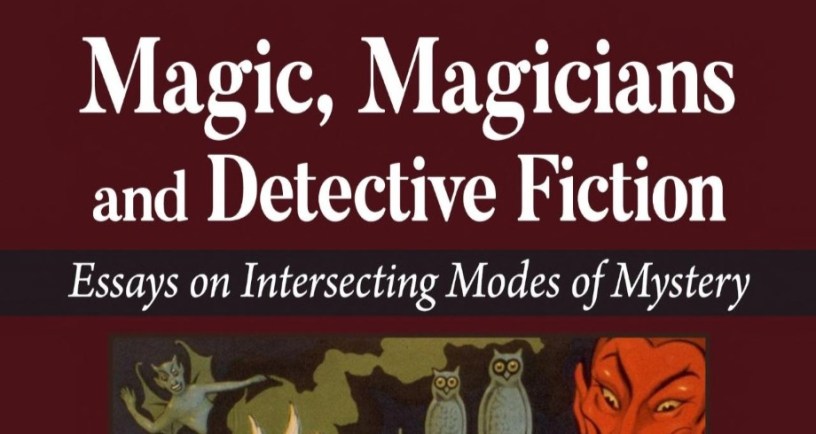
Magic, Magicians, and Detective Fiction: Essays on Intersecting Modes of Mystery. Edited by Rebecca Josephy. McFarland and Company, Inc., Publishers, January 2025. Paperback, 240 pages.
Magic and detective fiction often seem in opposition. After all, many mystery novels offer clear solutions to seemingly otherworldly events, suggesting magic is nothing party tricks. In fact, the detective story has seen many heroes who use stage magic trickery to solve crimes, and many entries featuring heroes (or villains) who draw on genuine otherworldly powers. This new collection of essays edited by Rebecca Josephy considers the curious ways that magic and mystery intersect, from an essay by Zi-Ling Yan on the theory of how magic (ritual or performance?) is portrayed in detective fiction (13-49) to profiles of particular characters or authors.
While this study covers works from multiple cultures, inevitably it is a bit selective. There are intriguing chapters on global detective fiction, including Robert Del Greco discussing Japanese authors Edogawa Ranpo and Murakami Haruki (157-176) and John P. Hope assessing Russian author Boris Akunin (177-194). As noted in another review of this book,[1] there is limited content on British authors, outside of Beatrice Ashton-Lelliot covering Victorian British views on stage magic (93-111) and Christopher Pittard assessing the Grant Allen novel An African Millionaire (112-130). Beyond occasional references to G.K. Chesterton and Dorothy L. Sayers, the most detailed discussion of the Detection Club is on its rare American member, John Dickson Carr (more on that later in this review).
The lack of detail about British authors sometimes makes for interesting gaps. For example, Neil Tobin’s essays on detective characters who are also magicians (64-90) and of magicians (professional and amateur) who also wrote detective stories (40-63) both mention Sax Rohmer, author of the Fu Manchu stories. Yet Tobin never delves into a story about Harry Houdini allegedly co-writing a story with Rohmer (or mentions Lawrence Knapp’s essay in the study Lord of Strange Deaths divulging the details of what really happened).[2]
However, the selectiveness is probably necessary since Golden Age Detective Fiction has become such a well-developed scholarship area. The story of how Sayers, Chesterton, and Charles Williams explored the nature of magic in their stories, and particularly how their treatments of magic intersected with their treatments of religion, may need to be a standalone study. Perhaps someday soon, other scholars will offer something that bridges this book and the earlier study Christianity and the Detective Story.[3]
While Anglophiles may be disappointed, the chapters on North American authors, including a chapter by George Cole on Mexican author F.G. Haghenback’s occult detective Elvis Infante (195-214), offer plenty of interesting material. Tobin’s two essays are particularly useful for documenting twentieth-century American writers like Carr and his friends William Lindsay Gresham and Clayton Rawson. As I’ve discussed in interviews with one of Rawson’s sons [4] and Gresham’s two stepchildren,[5] the latter two authors have been very under-researched (no biography is currently available on either). Even Carr, the basis for a much-acclaimed 1995 biography by Douglas Greene (interviewed in this publication),[6] has proven difficult to research. Perhaps the most obvious reason for the lack of research is that none of these three authors (or many others that Tobin covers) fit the popular perception of American crime fiction after World War I. It can be tempting to focus so much on hardboiled authors like Raymond Chandler who strove to deconstruct the detective story, sometimes squabbling with the Detection Club (see, for example, Chandler’s critical essay “The Simple Art of Murder”), that one forgets there were plenty of Americans still writing conventional detective stories. Some were even finding magical ways to innovate the genre without tearing it down.
An engaging look at an underdiscussed intersection in crime fiction.
Footnotes
[1] Review covering the Detection Club- and Inklings-relevant content to be published in Mythlore, Spring/Summer 2025 issue.
[2] Lawrence Knapp, “Sax Rohmer, Harry Houdini & Fire-Tongues.” In Lord of Strange Deaths: The Fiendish World of Sax Rohmer, edited by Phil Baker and Anthony Clayton. Strange Attractor Press, 2015.
[3] Christianity and the Detective Story. Edited by Anya Morlan and Walter Raubicheck. Cambridge Scholars Publishing, 2013.
[4] G. Connor Salter, “An Interview with Clayton Rawson Jr.,” Mystery*File, May 2, 2024, https://mysteryfile.com/blog/?p=87597.
[5] G. Connor Salter, “Remembering William Lindsay Gresham: Interview with Rosemary Simmons,” Fellowship & Fairydust, March 1, 2024. https://fellowdustmag.com/2024/03/01/remembering-william-lindsay-gresham-interview-with-rosemary-simmons/. G. Connor Salter, “Interview with Bob Pierce about William Lindsay Gresham,” Mystery*File, November 15, 2024. https://mysteryfile.com/blog/?p=89250.
[6] G. Connor Salter, “Remembering John Dickson Carr: Interview with Douglas G. Greene Part 1,” Fellowship & Fairydust, April 3, 2024. https://fellowdustmag.com/2024/04/03/remembering-john-dickson-carr-interview-with-douglas-g-greene-part-1/. G. Connor Salter, “Exploring Oz: Interview with Douglas G. Greene Part 2,” Fellowship & Fairydust, April 10, 2024. https://fellowdustmag.com/2024/04/10/exploring-oz-interview-with-douglas-g-greene-part-2/.
 Fellowship & Fairydust