
BY G. CONNOR SALTER
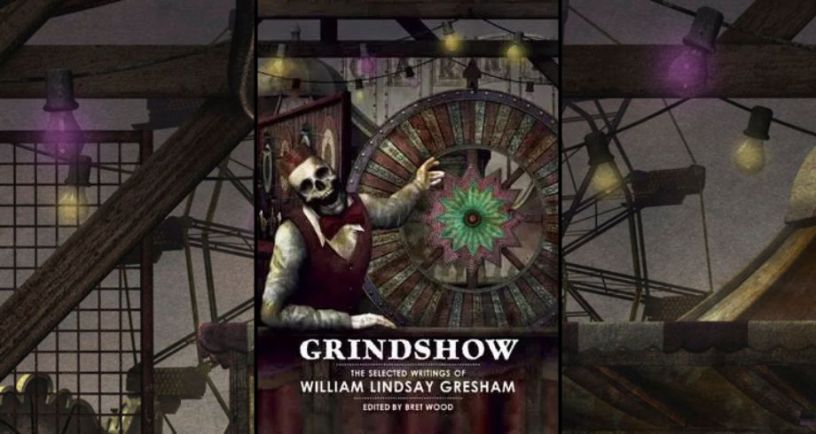
Grindshow: The Selected Writings of William Lindsay Gresham edited by Bret Wood. Centipede Press, 2013.
As Bret Wood discusses in his introduction to this book, it is hard to say how much William Lindsay Gresham (1909-1962) wrote. The books (the biography Houdini: The Man Who Walked Through Walls, a hardboiled crime novel Nightmare Alley, the carnival guide Monster Midway, the body-building guide The Book of Strength) are reasonably easy to document. But there were also many short stories (particularly hardboiled crime fiction and science fiction), many articles (especially pieces on carnivals, which became the basis for his underrated book Monster Midway). Many works for many markets, and not always the most reputable ones. Several articles appeared in men’s magazines with titles like The Dude and Rogue, which Wood observes often allowed writers to publish work under pen names. Since these magazines aren’t the sort of works readers collected and cherished (not for the articles, anyway) and certainly didn’t donate to archives, it becomes a little hard to say how many pieces writers like Gresham published during their lifetimes.
Necessarily then, Grindshow is only a sampling of Gresham’s works. Some of his best-known short stories are featured, including “The Star Gypsies,” (a French translation of which reappeared in 2021, the 64-page book Le Peuple du Grand Chariot) and “Dream Dust Factory” (included by Douglas Anderson in his 2011 anthology Tales Before Narnia since C.S. Lewis seems to have read the story). The articles range from pieces about carnival performers to reflections on prostitution.
While the work is diverse, it is interesting to see how some of the nonfiction offerings provide that same streetwise tone that Gresham offered in Monster Midway, and gave his fictional characters in the novel Nightmare Alley. Gresham may have struggled to produce fiction after divorcing his second wife Joy Davidman, an able editor who later helped Lewis produce his masterpiece Till We Have Faces. But when he explored the carnival or any world populated by magicians, he could capture both the allure and the harsh reality behind the curtain. Some of Gresham’s most interesting passages in Nightmare Alley or Houdini: The Man Who Walked Through Walls are when he discusses what it takes to pull off a magic trick.
For readers interested in Gresham the man as well as the writer, Wood’s introduction is well worth hunting the book down. While the broad strokes of Gresham’s life—the Spanish Civil War experience, the unexpected success of Nightmare Alley, the divorce from Davidman—it is hard to get a detailed look at his life. As of this writing, the most cited resource on Gresham is almost certainly the 13 paragraphs that Paul Duncan wrote for Noir Fiction: Dark Pathways, reposted in 2000 on the internet message board RARA-AVIS. Wood’s 32 pages summarizing Gresham’s life, including quotes from his widow Renée (née Rodriquez) from interviews that Wood performed before her 2005 death, offer far more detail. It is particularly interesting to see the details of Gresham’s life after Davidman—the final and by all accounts happy marriage, the disreputable but necessary men’s magazine work, the moments of brilliance in stories like “The Game Room.” Gresham emerges as still a very complicated man, but more than Davidman’s embarrassing ex-husband, more than the sinister figure seen in Shadowlands (the movie and play about Davidman’s marriage to Lewis). A man whose life ended too soon, but left at least two classics and a wealth of material that scholars are still exploring.
An engaging look at an underrated author of crime and speculative fiction.
(Article originally published March 23, 2025)
 Fellowship & Fairydust