
BY JEB SMITH
J.R.R. Tolkien’s worldview underlies all his writings on Middle-earth.[1] Though not in any way intended as allegory, his great mythological saga of the Elder Days and succeeding ages was in many ways a representation in story of his beliefs, preferences, and understanding of Good and Evil.
Tolkien has been described as an anarcho-monarchist, a stance with its foundation in Anglo-Saxon England and the feudal kingships that flourished in Christian Europe during and after that era. Tolkien’s lifelong scholarly studies influenced his preferences, and he, in turn, incorporated his political ideals into Middle-earth. For example, the realms under the Shadow will have echoes, unintentional as they may be, for those suffering under modern systems of government, while the Free Peoples institute, and enjoy, the liberty enjoyed by those who were under Medieval kingship.[2]We will now explore the form of kingship among the Free Peoples, aiming to uncover consistent themes and show how they arose from the political preferences of J.R.R. Tolkien.
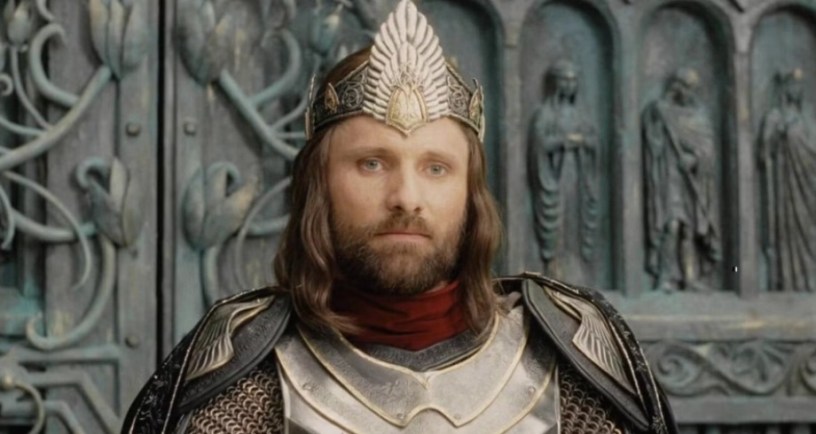
Aragorn
Tolkien’s model of kingship centered on consent and law, resembling feudalistic Europe. Rulers did not lord it over their people, coerce them, or burden them with taxes and regulations. Like under Kingship, within the free peoples’ realms, there is no state that enacts legislation to control the people. The lords allow maximum free will and liberty to those living in their realm. Like a feudal king, they are under the tradition and just laws that came before them. The lords allow maximum free will and liberty to those living in their realm.
Aragorn, the heir of Elendil, rightful heir to the throne of Gondor, is given as an example of an ideal king who rules his realm and judges his kingdom with wisdom. Further he allows self-rule to certain peoples who are under his authority and protection. The free peoples’ kings and lords led and united their realms. Aragorn said, “Only of your free will would I have you come,” and “Those who follow me do so of their free will.” Politicians send their conscripts to die for their gain. Aragorn, like kings of the medieval period, led men to battle, motivating them.
When the captains of the west marched on Mordor to provide a distraction for Frodo’s quest, they did so knowing they were marching into certain death with no hope of a military victory. They took only men who go willingly, knowing their peril. As the army drew closer to the Black Gate of Mordor, some of the men of Gondor and Rohan, out of fear, held back. Aragorn understood their fear, felt pity for them and, rather than beratting or punishing them, gave them another task, to destroy the orc army holding the crossroads. More in keeping with their abilities, these men could carry out this command and keep their honor. Aragorn’s action also rallied some of the men to continue on to the Black Gate.
Despite the vast territory under his authority, Aragorn practiced feudalistic decentralization. The Shire was given full autonomy as well as a gift of land from Aragorn. Faramir was given Ithilien to rule as his princedom. To the Ents, Aragorn gave the valley surrounding Orthanc and more land west of the mountains to allow expansion of their forest. As in a feudal relationship, the Ents, in payment, were to keep watch on Orthanc.
For the aid given to the Rohirrim during their ride to Minas Tirith, the forest of Drúadan was bequeathed to Ghân-buri-Ghân and his people, the wild men.[3] By order of the King, none could enter this realm without their leave. Aragorn did not remove or disempower “less civilized” societies, such as these wild men, or exploit their resources; instead, he gave them self-governance.
Bree was also given autonomy. Butterbur, of the Prancing Pony, grew concerned when he heard there was a new king saying, “So long as he lets Bree alone.” Gandalf assured him, “He will; he knows and loves it.” Rohan kept its sovereignty under King Éomer and Gimli became lord of the Glittering Caves. Others as well, under Aragorn, were given complete autonomy:
“several peoples who were considered part of the kingdom, yet were allowed complete self governance:…the elves from greenwood with Legolas and Ithilien. The Shire and the forest of Drúadan have even forbidden entry by any folk other than their own. Nurn was given to the slaves of Mordor, and peace was made with the Haradrim and the Easterlings.” North of the reunited kingdom Mirkwood had been freed…the middle portion was given to the Beorings and the woodmen.
-Karen Wynn Fonstad, The Atlas of Middle-Earth, Revised Edition [Boston, New York: Houghton Mifflin Company, 1991]
Aragorn did not seek to expand his empire or take advantage of his defeated enemies. Instead, he took back only the lands that rightly belonged to Gondor. He made peace with his former enemies, the Easterlings and Haradrim, who had been allies of Sauron during the War of the Ring.
Medieval Decentralization
Modern centralized states force their citizens to be alike and conform to the will of the majority. The only ruler then is the majority, and only the most significant majority as smaller local majorities are overruled. Therefore, all diversity, and the views and opinions of the minority, are suppressed. Not so with Tolkien who, through decentralization, allows true diversity to thrive across the kingdom among the many different free peoples’ domains.
Dwarves, elves, hobbits, and men are allowed to maintain their own cultures without the need or desire to control any other. Treebeard says to Celeborn, the lord of Lórien, whose lands border Fangorn Forest, “I know mine, and you know yours. Let neither side molest what is the other’s.” Even when various groups live in the same areas, they respect and practice self-governance.
For example, in what is described as an excellent situation in Bree, hobbits, men, dwarves, and elves all pass through or live in Bree in peace. Men are the most numerous and govern Bree, yet the hobbits who also dwell there do so, “minding their own affairs in their own ways.” And Bree itself, like so many of the trade towns in medieval Europe, is entirely autonomous; the men of Bree are described as “independent; they belonged to nobody but themselves.” The practice of self-government cultivated contentment and happiness. Mr. Butterbur said he would not leave Bree for any money.
In and around Laketown, Dale, Erebor, and the Woodland Realm, dwarves, men, and elves live in peace, alliance, and friendship. The men of Dale and Laketown apprentice their sons to the dwarves of Erebor, renowned for their crafting abilities. When the Easterlings attacked the region during the War of the Ring, the dwarves allied with and fought alongside the men of Dale and their king Brand, the grandson of Bard who had killed the dragon Smaug in The Hobbit. The elderly King Under the Mountain, Dáin Ironfoot, was killed defending the lifeless body of King Brand. The Easterlings defeated the dwarves and men of Dale, who retreated to the mountain.
But this harmonious relationship between these diverse cultures was maintained not by having everyone vote to determine a majority opinion that could be used to control and force conformity but the opposite. All were allowed to live as they wished, and thus there was no cause for strife. There was a live-and-let-live attitude, an attitude of tolerance. No one was upset or offended because another group chose to live according to their own customs. No one desired to force others to abide by their customs. They were perfectly content to accept the diversity that allowed themselves and others to live happily. And if any were not, there was no government machinery they could use to impose their own beliefs and purposes. The tyranny of democracy and the majority had not infiltrated the free peoples’ realms.
The last great kingdom of men in Middle-earth, the realm of Gondor, was decentralized and had many townlands and fiefs. Local lords had control within their own domains. Prince Imrahil ruled the great fief of Belfalas from the castle of Dol Amroth and the Dúnedain in Ithilien answered only to Prince Faramir. Also, it seemed that Gondorian lords carried their own banners into battle, such as the Ship and Silver Swan of Imrahil.
The line of Gondorian kings was broken when the last king of Gondor, Eärnur, answered the challenge of the Witch-King to engage in single combat. He never returned. Authority then passed to the Stewards (In Anglo-Saxon England, Stewards cared for the manor while the lords were gone), who would rule in the name of the King until the King returned. At the time of the War of the Ring, the Stewardship of Gondor, also being the Lord of Minas Tirith, was a hereditary succession.
The Ruling Stewards depended on their vassals to supply their army. When Minas Tirith called for military assistance, the other lords sent help willingly, but only what they could spare. They had to maintain a sufficient force to defend their own lands from attacks by the Corsairs of Umbar and others. Therefore, local authority rested with the vassals, not the Steward in Minas Tirith. The Steward did not have ultimate authority over Gondor. Citing tradition that could reach back as far as the days of Númenor, Gondor’s Council could decide if a law was just. Tradition and laws ruled Gondor, not the Steward.
Besides the occasional adventure, we are given the impression that Bilbo is an introvert. For example, on the gate to Bag End, Bilbo hung a sign that read “No admittance except on party business.” The narrator tells us, “Even those who had, or pretended to have party business were seldom allowed inside.”
Our society accepts this kind of discriminating distinction. It is his home, he should choose who to see and when to see them. Bilbo has the right to privacy and complete self-governance within his hobbit hole. We accept some level of self-governance at the family level. In the Middle Ages, they held this same philosophy regarding governance in general. A small community of like-minded individuals was allowed to establish their own laws and customs to live by. No outsiders were admitted. This system provided the happiness and a form of self-governance that are denied in a modern democracy.
Rohan
The riders are a stern people loyal to their Lord but are not governed, as we are, by written codes. They are freer to make their own minds up and regard this as a duty. They surrender less of their independence to their superiors than we do.
-Tom Shippey, J. R. R. Tolkien: Author of the Century [HarperCollins Publishers, 2000
We see a more distinct Anglo-Saxon version of Kingship in Rohan as they are a vassal of Gondor itself. The territory of Rohan was once part of Gondor but was given to the descendants of Eorl (who became the first king of Rohan) in payment of his riding out of the north to aid Gondor at the request of Cirion, twelfth Ruling steward of Gondor, in 2510 of the Third Age.
Gondor had weakened and could no longer guard its northern borders, so giving up its northern land to Rohan provided Gondor with a powerful ally next door, the Rohirrim in turn gaining wider and more fertile lands than their home further north. The steward gave this land to Eorl in return for an oath of mutual loyalty. In “Cirion and Eorl,” we learn that this agreement was bound by the great love and respect they had for each other. And Eorl, as a member of the community, serving as king, did not perceive Rohan as a gift to him but to all his people.
The citizens of Rohan lived “as free men under their own kings and laws, but in perpetual alliance with Gondor.” Like many feudal lords who were subordinate to a feudal king, Théoden, King of Rohan and Lord of the Mark, had full sovereignty but, by his own free will, remained loyal to the king, in this case, the steward of Gondor. Even Aragorn, when in Rohan, had to obey the local sovereign. Before entering Meduseld, the great hall of the kings of Rohan,376 Aragorn was ordered to disarm himself and surrender his sword Andúril. The following conversation ensued with the guard Háma:
ARAGORN. It is not my will to put aside my sword or to deliver Andúril to the hand of any other man.
HAMA. It is the will of Théoden.
ARAGORN. It is not clear to me that the will of Théoden son of Thengel even though he be lord of the Mark, should prevail over the will of Aragorn son of Arathorn, Elendil’s heir of Gondor.
HAMA. This is the house of Théoden, not of Aragorn, even were he King of Gondor in the seat of Denethor.
Háma stepped swiftly before the doors and barred the way. His sword was now in his hand and the point toward the strangers.
GANDALF. This is idle talk…[it] is useless to refuse. A king will have his way in his own hall, be it folly or wisdom.
Typically, Aragorn would have honored the request of any local lord in his own hall, “even a ruler of a woodsmen’s cot.” He objected to Théden’s command only out of a desire to not be parted from Andúril, the sword of the descendant of the kings of Gondor. Andúril had been reforged from Narsil, the sword that had cut off the finger which bore the One Ring from Sauron’s hand. Later, Aragorn would defer to Theoden and Éomer, not allowing Éowyn to ride the paths of the dead with him. He told her he did not have the authority, “Without leave of the King and of your brother.”
Within the realm of Rohan we also see a decentralized form of ruling. Rohan has its king and lords, including the three marshals of the Mark, who govern within Rohan with their own capitals of Helm’s Deep, Aldburg, and Edoras. Éomer said, “The East Mark is my charge, the ward of the third marshal.” King Théoden’s son, Théodred (killed at the battle of Isen), was the second marshal of the Mark and his capital was at Helm’s Deep. King Théoden himself the first of these marshals, and he relies on his vassals, who willingly bring men to his aid. Like in Anglo-Saxon England, the king’s army comprised a minimal number of professional soldiers—the king had to call on his vassals for a muster as Theoden did. The majority of “soldiers” were full-time farmers who loyally served their local lords, who, in turn, served the king.
Outside of the gates of Edoras we encounter other lesser lords of the house of Eorl, such as Dúnhere, the lord of Harrowdale. The men of Rohan are identified by their home regions, an example of which is “the men of the Westfold.” Their local lord is Erkenbrand, who rules and commands independently of Edoras. When the men of Rohan are killed in battle, they are buried separately by place of birth; for example, the men of the Westfold were buried separately from the men of the East Dales. The Rohirrim bury their dead in mounds, as found in Anglo-Saxon cemeteries such as Sutton Hoo.
Even when united in battle against a common foe, the free peoples still identified with and fought for their home regions, calling out their names as a battle cry. During the battle for Helm’s Deep, Éomer, Gimli, and Aragorn engaged in a foray to protect the gate to the Hornburg. Their battle cries included both weapons and homeland. Éomer cried out, “Guthwine for the Mark,” Aragorn cried out, “Andúril for the Dúnedain,” and Gimli cried out his old dwarvish battle cry translated “Axes of the Dwarves! The Dwarves are upon you!” When King Théoden rallied the men and lords of his house near Edoras, he called out: “Arise now, arise, Riders of Théoden! Dire deeds awake, dark is it eastward let horse be bridled, horn be sounded! Forth Eorlingas!
Théoden used the term Eorlingas, referring to the men of his house. He only commanded the men and lords of his own house. During the Battle for Helm’s Deep, Théoden had to ask Aragorn how the battle was going upon the Deeping Wall, where Éomer was in command. In the sortie out of the Hornburg on the second day, Théoden again cried, “Forth, Eorlingas,” rallying the men he commanded since they were of his house. Later on in the battle, Gamling, who led the men of the Westfold in a charge, cried out, “Forth, Helmingas,” as they were specifically the descendants of King Helm. This is in stark contrast to Saruman’s centralized forces, all carrying his symbol of the white hand and following only his commands from distant Orthanc.
Tolkien wrote that the men of Rohan were “wise but unlearned, writ no books but singing many songs.” In Rohan, in each region, information such as law was transmitted by word of mouth and customs. Much of the lore and history of Middle-earth is imparted and handed down through poems and songs. This was considered an acceptable way of learning about events of the past, as it was during our medieval period. Rohan’s feudalistic politics are summed up by Éomer, when he states, “We desire only to be free, and to live as we have lived, keeping our own, and serving no foreign lord, good or evil.”
The Elder Days
A feudalistic Hierarchy is found throughout Middle-earth, beginning with Eru (God), who sits upon his throne outside the created world. Manwë is the king of the Valar (Archangels), and of the Maiar (angels) in paradise (Valinor). We read that Ossë is a vassal of Ulmo. Among the elves of the First Age, Angrod and Aegnor, sons of Fingolfin, were vassals of their brother Finrod.Members of the animal kingdom also had their hierarchies. Thorondor is the king of the giant eagles and “Gwaihir, his mightiest vassal.” In the Third Age, Gwaihir and Landroval, the mightiest of the descendants of Thorondor, led an attack with his vassals on the Nazgûl. Shadowfax was the lord of all horses.
Consent of the governed is also practiced in Valinor. Manwë, king of the Valar, “has no thought for his own honor and is not jealous of his power, but rules all to peace.” The Valar allowed the Noldor elves to enter paradise and leave (secession) when they chose to and did not attempt to take the Silmarils by force.
When the Noldor returned to Beleriand from Valinor, they lived under a feudalistic hierarchy system. There was a high king over all, but the elves were organized by kinship with self-governing realms led by local lords. Similarly, the Sindar elf king Thingol was lord of Beleriand and king of Doriath. In war, they fought under their local lords and banners.
In a feudalistic agreement, the great elf king Thingol gave some of his lands to Haleth, a leader of her people. He did so with the understanding that they would defend a river crossing in payment to king Thingol for his gift. Fingolfin also gave Hador lordship of Dor-Lomin. Elves created friendships and alliances with mankind while allowing men to command their armies and be self-governed to increase the happiness of all. No forced integration. Likewise, it was not uncommon in medieval villages or cities to have quarters—one for Jewish, one for Catholic, or division based on language.
Decentralization allowed various policies across the realms as some Noldor allowed men to enter their realms, and others even sought out and encouraged them. Others did not allow any men to enter their realms. Some elves lived together with men, but each practiced separate self-government, “Seeing that it was not good for elves and men to dwell mingled together without order and that men needed lords of their own kind, set regions apart where men could live their own lives.” Elves created friendships and alliances with mankind while allowing men to command their own armies and govern themselves which maintained the harmony and effectiveness of the relationship.
In Europe during the feudal period, the king was not always the most senior, landed or militarily powerful lord. Such was also the case for the High King of the Noldor. When the elves first returned to Middle-earth from Valinor, we discover that “the realm of Finrod was the greatest by far, though he was the youngest of the great lords of the Noldor… Fingolfin was held overlord of all the Noldor and Fingon after him, though their own realm was but the northern land of Hithlum.” Therefore, lesser lords, even the king’s own vassals, had larger realms and greater armies.
During the Third Age, each elven realm was ruled by its own lord, separately from the other realms. Galadriel and Celeborn led Lothlórien, Rivendell was governed by Master Elrond, and the Gray Havens by Cirdan the Shipwright.
Fealty and Choice
In many circles today, feudalism is portrayed as a system of oppression and inequality. This is not true. In reality, feudalism is based on fealty and loyalty derived from choice, love, and attachment. Today’s interaction with the government is impersonal. In feudal society, everything is personal; everything is local and tribal, and family or clan. The modern post-Marx reader will always see a victim class that must have been unhappy, abused, and underappreciated. This victim class is viewed as unimportant, simply cheap labor to be used to the advantage of the more privileged levels of society. But this was not the medievalist or Tolkien viewpoint. Instead, there is equality within the feudal hierarchy.
During the Middle Ages the nobility exemplified, by and large, Christian servanthood to those over whom they held sway, to a much greater degree than our elected officials today. Further, there is no democracy or segments of society at war with one another; society is a unified whole for the common good. All members of society have value and work together to benefit one another. John of Salisbury wrote “each and all are as it were members of another by a sort of reciprocity, and each regards his own interest as best served by that which he knows to be most advantageous for the others” Around 1000 A.D, Bishop Adalbero of Laon compared the equality within the Trinity to the three-fold division of feudal society as a unified whole. He said the societal division of those who pray [the Church], those who fight [knights, nobility, lords], and those who work [peasants and serfs], all work together and are, as is God the Father, Son, and Holy Spirit. John of Salisbury said that it is the “feet” of the commonwealth (the peasantry) who enable the whole of society to be on “solid ground.” He wrote that they are “the highest degree useful and profitable to the corporate whole of the commonwealth.” Both the nobility and the peasantry are part of a united whole.
In Tolkien’s world, disrupting the hierarchy is often due to pride and brings discord to the unified whole. Morgoth’s (fallen angel) original fall occurred when he attempted to create his own musical theme, not in accord with the grand theme of Eru and the other angelic beings. Morgoth “sought therein to increase the power and glory of the part assigned him.” Later, we learn he coveted Manwë’s crown as King of the Valar. Morgoth refused to accept his position within the hierarchy or to share power with others. Colleen Donelly,I think, captures the medievalist understanding of hierarchy under Kingship.
Tolkien’s imaginative vision highlights the importance of the role of the vassal, the loyal follower, the everyman of medieval society, who defines himself in relation to his fellows and to his lord…where the needs of the “common good” of the whole society and one’s contribution to it far exceed the significance of an individual’s needs and accomplishments. The members of the Fellowship, which represent the free peoples of Middle-earth have a part to play. The success of the mission, and Middle-earth’s future, depends not only upon Frodo but upon each character playing his part and fulfilling his fate… It is also about the need for all peoples to actively perform their assigned duties and willingly embrace the roles they must play… The role of the man who willingly chooses to accept his place below his lord or leader, and who embraces and executes that duty to the best of his ability, is a defining character in Tolkien’s world…their fealty is the mainstay of Middle-earth.”
-Colleen Donnelly, “Feudal Values, Vassalage, and Fealty in The Lord of the Rings,” Mythlore: A Journal of J. R. R. Tolkien, C. S. Lewis, Charles Williams, and Mythopoeic Literature, vol. 25, no.3, article 3 [2007], Avail
In Tolkien’s works, fealty is best portrayed by the friendship of the hobbits Frodo and Samwise. By his own free will, Sam chose to serve and help his master Frodo, even if it meant going to Mount Doom in Mordor to destroy the Ring. Frodo was Sam’s master, and Sam was his servant, but it was not a slavish forced involuntary agreement. Just the opposite. Sam would have it no other way and would make any sacrifice to help his master. Sam and Frodo’s love and devotion for each other portrayed a lord and vassal’s love. Tolkien said that Sam “did not think of himself as heroic or even brave, or in any way admirable except in his service and loyalty to his master.” At one point, Sam was afraid to descend a rock ledge that was so gloomy the bottom could not be seen. Frodo said he would go first, which prompted Sam to rush down to prevent his master’s danger despite his own fear of heights. Sam was not brave, but he was willing to take risks or even die for his master.
The other hobbits, Merry and Pippin, freely offered their services. Théoden asked Merry to become his esquire, “if you will.” The hobbit being “suddenly filled with love for this old man” gladly accepted, telling Théoden, “As a father you shall be to me.” Pippin freely offered “fealty and service to Gondor and the lord and Steward.” Denethor returned “fealty with love.” These hobbits saw a lord they admired and offered their services. As men in the feudal age chose, using their own free will, who was to be their lord, a mutually beneficial agreement was made, and a bond and friendship were formed that lasted generations.
We see this bond and friendship in The Lord of the Rings between Aragorn and those who choose to give their service to him. Legolas declared his desire to keep fighting in the war even after the victory at Minas Tirith. He fought for his homeland and “for the love of the Lord of the white tree” (Aragorn). Éowyn of Rohan told Aragorn that his men followed him because “they would not be parted from thee, because they love thee.” Many argued against taking the paths of the dead fearing only death would come of it, but since Aragorn decided to go, the northern Rangers, Gimli, Legolas, along with Elrond’s two sons followed out of loyalty and love. In Lothlórien, Galadriel and Celeborn would not accept the titles of Queen and King, they were guardians only. Elves chose to come to her because of her beauty and her ability to maintain a realm free of Sauron.
In the Elder Days, while hunting in the woods of Beleriand, King Felagund became the first elf to encounter mankind. The men were impressed by his wisdom and singing ability, and “they loved him” and so “took him for their lord.” When the elf Maeglin entered Gondolin, he was overwhelmed by the vastness of the city and the nobility of Turgon, leading him to accept Turgon as his lord.
Throughout Tolkien’s writings, we see the love of lord as a determining factor in the choice of lord. Tolkien’s characters are followers of kin and household, or they choose the lord they wish to serve, adopting their lord’s customs and laws. Recorded in the Anglo-Saxon Chronicles, we read that “to them, no kinsmen was more loved than their lord.” Anglo-Saxon scholars Lee and Solopova described their love of lord, “Their loyalty to the king is the most important thing to them. These oaths of loyalty, found also in other old English poems, were key to the relationship of the lord and his retainers in Anglo-Saxon society.” C. S. Lewis said that the deepest emotions of the Middle Ages were “the mutual love of warriors…and the affection between vassals and lords.” King Alfred believed “the closest approximation he could make to life in heaven”3was the bond formed in the mead hall between the king and vassals. The feasting, drinking, tales, gifts, and oaths produced friendships they were willing to die for. To the medievalist, serving your lord in battle was a privilege, an honor. Submission was not subjugation.
When the great lords and kings of the free peoples’ appeared, whether entering a town, mustering the men, or arriving on the battlefield, the vassals cheered and sounded horns or sang praises to their lords. Their moral resolve was lifted. Warriors were willing to go into battle for and, if need be, give their lives for their lord. So when standing against the dreadful Witch-King, Éowyn defies him saying, “You stand between me and my lord and kin.” Despite the overwhelming threat to her life, she refused to leave her lord to be slain by the enemy.
In the Middle Ages and in Middle-earth, marriages among nobles were celebrated with great festivals because they helped preserve the continuation of the lords’ lineages. Personal interaction and love for the lord, family, ancestors, and home were vital components of Kingship and we see this reflected in Middle-earth.
In a democracy, we see hierarchy as the modern sin of inequality. To Tolkien, the medievalist, and Sam and Frodo, despite the hierarchical differences, there was no inequality. Under feudalism, all sections of society had separate responsibilities and all were vital. The church taught truth and morality and led people to Christ. The nobility was the protector of the Church and the commoners. The commoners kept everyone alive by providing substance. Feudalism was not a caste system that valued one person as having more worth than another. C. S. Lewis, in his essay “Equality,” wrote:
“I don’t think the old authority in kings, priests, husbands, or fathers, and the old obedience in subjects, laymen, wives, and sons was in itself a degrading or evil thing at all. I think it was intrinsically as good and beautiful as the nakedness of Adam and Eve… Where men are forbidden to honor a king they honor millionaires, athletes, or filmstars instead—even famous prostitutes or gangsters. For spiritual nature, like bodily nature, will be served—deny it food and it will gobble poison.”
Hereditary Inheritance
Among the free people, titles are hereditary in order to prevent those who seek power from getting it. Unlike politicians, the leaders of the free peoples do not and should not desire power. When they do, it is portrayed in a negative light. For example, Éowyn of Rohan was under a shadow as she searched for glory and fame. She could not find happiness until she declared to Faramir, “No longer do I desire to be a queen.” Faramir himself never desired glory or power and willingly gave up his stewardship of Gondor to Aragorn (who refused the surrender and returned the office along with the rule of Ithilien), the rightful and returning king, to go with Éowyn who would “make a garden” in his new realm.
Free peoples’ leaders were known, not only by their own names, but by adding their father’s and ancestor’s names. Aragorn is known as “Aragorn…son of Arathorn of the house of Valandil Isildur’s son, heir of Elendil.” His ancestry defined and qualified Aragorn as the King of Gondor, not his abilities at campaigning or fundraising.
It was commonly believed that Anglo-Saxon kings could heal their people. As the Gondorian nurse loreth said, “It is said in the old lore. The hands of the king are the hands of a healer.” Aragorn’s ability to heal the sick and wounded announced that a true king had returned to Minas Tirith. Similarly, the dwarf Thorin was the rightful king under the mountain, as he declared to the people of Laketown, because he was “Thorin, son of Thráin, son of Thror, king under the mountain.”
Another distinguishing mark of some Germanic kingships was the hereditary kingship’s importance. The origin of choosing a king was not in selecting a great leader or warrior but selecting a great family that displayed courage, bravery, and chivalry. The vassal’s loyalty to the lord was based on devotion to a household or person rather than nationalistic obedience.
The lords of Rohan held the Germanic-like hereditary kingship of Théoden’s house in high honor. Many soldiers of Rohan carried the symbol of a running white horse with a green background on their armament. Familiar to those who have watched the movies, this is not a symbol of Rohan but of the House of Eorl.[4] When Théoden was preparing to ride to battle against Isengard, he told the local lords to elect a leader from among their number. This leader would rule in his stead and would become king if Théoden fell. None of the lords desired the position because they only trusted the house of Eorl.Théoden’s niece Éowyn was chosen. With Théoden and Éomer gone to war, she was the only available member of the House of Eorl. She did not want to stay behind in Edoras, but accepted this duty. She lamented to Aragorn, “May I not now spend my life as I wish?”
This was the kind of leader Tolkien admired, one who does not desire a position of power, but accepts and fulfills it out of a sense of hereditary obligation to the people. The free peoples of Rohan rejected the attainment of power and title by election, rather, they put their trust in the hereditary service and sense of duty of the House of Eorl.
The free peoples’ lords were servants to the people, not beneficiaries. Feudal historian Régine Pernoud wrote, “The lord owes as much faith and loyalty to his man as the man to his lord.” Tolkien once wrote that “touching your cap to the Squire may be damn bad for the Squire, but it’s damn good for you.” Thomas Aquinas believed just authority comes when the one in authority benefits the one under his authority; anything else is tyranny. Lordship was not a benefit for the king or special interests; instead, it was a service done to benefit the people.
Oaths
Other vital aspects of Kingship were honor, oaths, and staying true to your word. The Oath of Eorl was of utmost gravity to Eorl and Cirion, Steward of Gondor. To perform the oath, Cirion and Eorl went to a holy hill upon which stood the tomb of and memorial to Elendil, the first high king of both Gondor and Arnor. He had led the faithful to Middle-earth after the destruction of Númenor. In the Middle Ages, oaths of fealty were often sworn upon relics of beloved saints. For Cirion and Eorl, the tomb of Elendil acts as a relic.
During the War of the Ring, when Minas Tirith was facing an inevitable attack and siege, Denethor, the Steward of Gondor, like his ancestor Cirion, called on Rohan for aid. Denethor’s plea was not conscription or coercive measure; instead, it was based on tradition, the Oath of Eorl. Denethor sent his messenger Hirgon to King Théoden of Rohan with the request, “My lord does not issue any command to you; he begs you only to remember old friendships and oaths long spoken and for your own good to do all that you may.” Denethor appeals to long-held bonds of amity and the vows made by the House of Eorl, Théoden’s ancestors. He asks Théoden to honor those vows. Denethor finally points to self-preservation, insinuating that if Minas Tirith falls, Rohan will surely follow. Théoden responded, “Say to Denethor that even if Rohan itself is in no peril, still we would come to his aid.”
Just as a vassal who had been gifted land in the Middle Ages would be committed to fulfilling their oath, so too was King Theoden. Théoden was a man of exemplary honor. Despite his own desperate situation, he carried out the oath to aid Gondor in its need. His loyalty and fulfillment of his oath were celebrated in song in Rohan, a part of which exclaims:
Forth rode the king, fear behind him, fate before him. Fealty he kept, oaths he had taken, all fulfilled them.
Before riding to Minas Tirith, Théoden encouraged the men of his house, saying, “Oaths you have taken, now fulfill them all, to lord, and land, and league of friendship.”
These men chose to go to war for friendship, loyalty, defense of the homeland, and the oaths they honored.
The men of Rohan held to the medievalist code of honor, wishing to die in battle for a good cause rather than be dishonored. In the immensely popular “The Song of Roland,” we read that the Franks rode off to battle against overwhelming odds with seemingly no chance of victory. For them, it was “Better by far that they there should die, than be driven all from our land to fly, flung to dishonor and beggary.” They would rather die than be “shamed.” Likewise, Faramir, Frodo, Sam, Aragorn, and others all put their lives in peril to stay faithful to their oaths and promises.
In The Silmarillion, Fëanor and his sons, in a biblical manner, took oaths to pursue and recover the stolen Silmarilli from Morgoth and any other that would attempt to possess one. By the name of God, “they swore an oath that none shall break…by the name even of Ilúvatar.” In this manner, “so sworn, good or evil, an oath may not be broken, and it shall pursue oath keepers and oathbreakers to the world’s end”414 (Dt 6:13 Lv 19:12). Fëanor named two witnesses, Manwë and Varda (Dt 19:15). The oath between Cirion and Eorl, described above, is also sworn by the name of Eru and the Valar. When the oath was taken, Cirion declared, “This oath…in the keeping of those who sit upon the thrones of the west and of the One [Eru] who is above all thrones forever.”
After taking the oath to avenge the loss of the Silmarils, Fëanor led the Noldor from Valinor back to Middle-earth. There, in a battle against the forces of Morgoth, which included Balrogs, not least of which was Gothmog, Lord of Balrogs, Fëanor was struck down. His sons came to his aid and carried him from the field. However, Fëanor realized he was dying from his wounds. He now knew that the elves did not have the strength to overcome Morgoth, yet, he did not allow this to change his stance on his or his son’s oaths. Despite seeing no chance of victory, he encouraged his sons to “hold to their oaths.”
In Numbers 30.2, we read, “If a man vows a vow to the Lord, or swears an oath to bind himself by a pledge, he shall not break his word. He shall do according to all that proceeds out of his mouth.”In the Bible, men and women who took oaths were expected to stand by them. Psalm 15:4 said a righteous man was one “who keeps an oath even when it hurts, and does not change their mind.” By this definition, Fëanor, Théoden, and their followers were righteous
men. The Book of Ruth provides an excellent example of the kind of commitment expected when exclaiming an oath and the type of oath that occurred in close personal relationship societies, such as existed in ancient Israel and feudalistic Catholic Europe. Ruth pledges to her mother-in-law Naomi:
Where you go, I will go, [Gimli’s response to Legolas entering the dangerous Fangorn Forest], and where you lodge, I will lodge. Your people shall be my people, and your God my God. Where you die, I will die, and there will I be buried. May the Lord do thus and so to me, and more as well, if even death parts me from you!
-Ruth 1:16–17
King Alfred believed the only way to preserve liberty, and prevent social decay into pagan anarchy, was by having a Christian population loyal to their oaths. They must fear God more than man; they must fear final judgment more than temporal. In the Middle Ages, oathbreakers were guilty of a severe crime. Those that broke their oaths would often be compared to Judas, who betrayed his Lord. If a man breaks his oath to his earthly lord, will he also not do the same to his heavenly Lord? Régine Pernoud writes to “go back on one’s oath was, to the medieval way of thinking, the worst possible disgrace.” Historian Ben Merkle wrote that oathbreakers were “the outcasts of Anglo-Saxon society… Keeping oaths is what separated pagan from Christian nations.” In the Divine Comedy Dante reserved the lowest level of hell for those who have betrayed their rightful lords, chief among whom is Judas.
Tolkien loved the Anglo-Saxon tale of Beowulf. In his time Professor Tolkien was considered by many to be the leading authority on Beowulf. A lord whom men loved and chose to follow, Beowulf was the kind of leader desired under feudalism. He was “a prince well loved, followed in friendship, not fear.” Within his realm, “all men speak softly, here, speak mildly, and trust their neighbors, protect their lord, are loyal followers who would fight as joyfully as they drink.” He was courageous, living by the mantra “In every battle, my place was at the front.” To his people he was “their shield and protector.” Yet when Beowulf fought the dragon, of all his followers, “only one of them remained, stood there, miserable, remembering, as a good man must, what kinship should mean.” All the others fled in fear and, we are told, wereconsidered men disgraced and deserving death.
In The Lord of the Rings, we see this same expectation of an oathtaker when Pippin swears fealty to Denethor; who warns Pippin that oath-breaking would be met with vengeance. Aragorn’s ancestor Isildur cursed the men of Dunharrow for oath breaking when they failed to help in the War of the Last Alliance.[5]
Morgoth consistently took vows and oaths “lightly…as he ever did.” A vow, an oath, was of no matter to Morgoth; keeping his word meant nothing. He repeatedly made vows to Manwë and the Noldor, never intending to keep his word. Rather, he employed vows as aids in his own machinations to deceive and manipulate those he wished to use as tools, such as the Easterlings and the giant spider Ungoliant. Thinking they had entered into an accord, Ungoliant helped Morgoth destroy the two trees of Valinor. Morgoth held oaths much as our modern society does. To see how our contemporary world views oaths, look at so many of the marriages that end in divorce.
Anarcho-monarchist Leaders
An Anarcho-monarchist leader of the free peoples’ leader was the mysterious Tom Bombadil. He was the master of the Old Forest and had power and authority over all within it, yet he never sought to control the beings under his command. Tolkien said that Tom had “no desire for possession or domination at all.” Tom’s wife, Goldberry, said, “Tom Bombadil is the master but not the lord of anything.” Very similarly Professor Frank Van Dun said “a medieval ruler ruled his realm but did not govern anything within it.”
Treebeard, the Ent, may also be considered such a leader. He would do nothing to visitors Merry and Pippin “without your leave” and did not seek to dominate others outside his realm of Fangorn Forest. Gandalf told Treebeard, “You have not plotted to cover all the world with your trees and choke all other living things.”Treebeard had no agenda and did not think of conquest. He told the hobbits, “I don’t know about sides. I go my own way.” Treebeard had no desire to become involved in the war, but he also would not allow the evil to keep chipping away at Fangorn forest saying “We keep off strangers and the foolhardy.”
When Treebeard and the Ents attack Isengard in retaliation for the orcs’ destruction of their domain, Treebeard does not conscript his fellow Ents. Rather, they held council and debated, and of their own free will, many Ents chose to join in the assault. Treebeard did not use coercive means, the Ents were free to choose the path they thought best.Because Saruman had caused so much destruction to both Rohan and Fangorn Forest, Gandalf asked Treebeard to keep the evil wizard locked up in the tower of Orthanc. Yet Treebeard eventually allowed Saruman to leave because “above all, I hate the caging of live things.” Treebeard had no desire to control others, even those who had caused him great harm.
One Ring to Rule Them all
The story is cast in terms of a good side, and a bad side, beauty against ruthless ugliness, tyranny against Kingship, moderated freedom with consent against compulsion.
-J. R. R. Tolkien, “Letter 144”
Tolkien said, “The supremely bad motive [is] domination of others’ free wills.”Tolkien’s heroes in his writings were the free peoples—those who follow Eru’s design. Eru, the god of Middle-earth, chose not to coerce his creation but allows free will. The Istari, or wizards (angelic beings), were sent to help the free peoples but not to “rule the wills of men and elves.” The Istari themselves were allowed free will, even to rebel against Eru. The wizard Saruman the White turned against his creator, and Radagast the Brown forsook his purpose even if he was not in outright rebellion. Gandalf alone followed the course, he “sought neither power nor praise.”
Tolkien makes a noticeable distinction between those who desire power and the control of others’ wills, and those who oppose that control. The evil tyrants, such as Sauron, seek the power to control the will of others. The power of the Ring is used to force the wielder’s will upon another, an act which is evil. When Frodo gave in to the temptation to put on the Ring, he later realized it was not his desire but that of the enemy, Sauron—the actual lord of the rings. We might desire to use a ring of power to enforce our own will, but this is the work of the enemy. The free people reject the use of this type of control and fight to prevent it.
Fealty did not exist in Mordor. Instead, it was fear, intimidation, lies, and the strength of the all-powerful centralized government of the tyrants (similar to our immensely powerful centralized governments of the modern era) that controlled the minions and allies of Mordor. Peace and self-governance were not to be found in the realms ruled by the tyrannical Sauron, Morgoth, and Saruman. They all operated using a highly centralized form of government driven by fear, power, and control. There was no law nor ancient customs in Mordor. Sauron was the law himself. His dictates, his desires, and what he declared was law. Sauron’s orcs did not have law and liberty to protect them; they were only tools to an end.
Orcs also hated one another, constantly fighting and killing each other. Hatred arose among the various groups because all of them were forced into the same system in order to benefit the most powerful tyrants.
Power was centralized in these rulers who desired all Middle-earth to be under authoritarian control. Industry efficiency, militarization, and slavery were all common forces under the Shadow. Everything was directed to benefit the ruler. The rulers desired control of others and would achieve this by any means, whether military, ring, deception or otherwise. Their assumption was that they ought to rule over others (the height of pride) against their own will. Thus, Tolkien desires democracy, seeing it as one big attempt at forcing our ways on others.
Jeb Smith is the author of four books, the most recent being Missing Monarchy: Correcting Misconceptions About The Middle Ages, Medieval Kingship, Democracy, And Liberty. Before that, he published The Road Goes Ever On and On: A New Perspective on J. R. R. Tolkien and Middle-earth and Middle-earth Lore: Tolkien’s Legends Revealed. Smith has authored multiple articles in various publications including The Postil Magazine, History is Now Magazine, and Medieval History.
[1] See The Road Goes Ever On and On: A New Perspective on J. R. R. Tolkien and Middle-earth by Jeb Smith
[2] See Missing Monarchy: Correcting Misconceptions About The Middle Ages, Medieval Kingship, Democracy, And Liberty
[3] The “unsophisticated” tribal people of the Drúedain forest live on the edge of the more civilized Gondrians and Rohirrim; they seem to resemble how Anglo-Saxon sources viewed the Welsh and Irish, who maintained pastoral and roaming tribal practices rather than agriculture. Instead, they had few permanent structures and built seasonal homes/huts, allowing for travel based on weather and herd conditions.
[4] The symbol of the House of Eorl, a white horse on green grass, seems to be derived from a popular site in England. A gigantic horse figure is carved into a hillside of white chalk, giving the appearance of a large white horse with green grass surrounding it. The site is also the location of one of King Alfred’s great victories over Viking invaders and the place where Saint George is said to have killed the Dragon.
[5] Joseph Pearce made an interesting link between Aragorn and Jesus as both were returning kings with the ability to command the dead. Jesus descended into hell to release those in limbo; and Aragorn released the army of the dead from their form of purgatorial limbo.
 Fellowship & Fairydust