
BY G. CONNOR SALTER
A revised version of this interview, including footnotes to explain references and new research, can be found in The Other Inklings: Interviews with Scholars on C.S. Lewis, Charles Williams, Owen Barfield, and Inklings-Adjacent Figures (Apocryphile Press, 2026).
William O’Flaherty’s work extends across several audiences. Readers and scholars interested in the Inklings know him for his podcast All About Jack and his writings for Christianity Today and other media about C.S. Lewis. His book The Misquotable C.S. Lewis explores his best-known contribution to Inklings scholarship: the quotes that forever proliferate online that are attributed to Lewis, but more often said by people like Zig Ziglar. His upcoming book The Screwtape Letters Handbook offers a study guide to the classic satire.
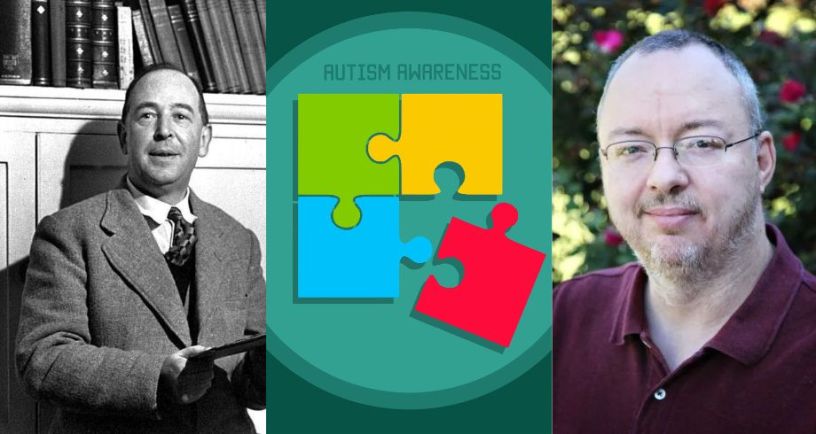
Since being diagnosed with Autism Spectrum Disorder (ASD) Level 1 in 2024, O’Flaherty has been promoting better education about autism through his YouTube channel Adult Autism with William and its associated website. There, he shares his diagnosis story as well as general facts about the condition and the story of other autistics. His interest in autism and other disability topics has sometimes intersected with his work on Lewis; his channel includes interviews with scholars Jennifer Woodruff Tait and Kat Coffin. He hosted a two-part discussion on All About Jack in which Zachary Schmoll and Levi Anderson offered a disability theology lens on Lewis’s book The Problem of Pain and its appendix written by medical doctor Humphrey Havard.
Since April is World Autism Month, O’Flaherty took a moment to discuss new developments.
Interview Questions
It’s now been a year since you were officially diagnosed with autism. How does it feel to pass that milestone?
A lot has happened since being diagnosed in late February 2024. I’ve learned so much about myself that in some ways I feel like I’m still learning about myself as I better understand autism.
What are some responses you have gotten since starting your YouTube channel, which was formally called Adult Autism in 60 Seconds?
The reaction has been positive overall but a little underwhelming. That is, while I didn’t think I’d get a million views, I was hoping the response was more than it was. When I began, I decided to focus primarily on short, no more than 60-second, videos to capture what I was learning about autism because so many other channels shared much longer content. However, I let myself get discouraged and posted less of the shorter material. Then, I noticed a type of video I almost began by accident, something called “Autistic Profile Series,” was getting more views. So, I started to do more of them. In these videos, I have a person answer a list of mostly the same questions in a format that it is just them talking. These profiles are usually less than ten minutes and they provide a brief glimpse into each person’s life. By watching several of them, the viewer sees common themes, but they also realize how different each autistic person is.
You spoke in a video recorded shortly before going into your autism diagnosis appointment about one step in your journey to seek a diagnosis was finding an online Christian community of autistics that could answer questions. What are some ways finding other autistic Christians who can offer sympathy and support has aided your journey?
This has definitely been a great support in my journey. In addition to knowing these individuals could relate to the struggles of better-understanding aspects of my personality from the standpoint of autism, I knew they understood how important faith was in my life. So, I feel more at ease talking among other believers because of the common core beliefs.
Last time we spoke about your autism diagnosis journey, you highlighted how going through a crisis in 2006 was when you began to consider getting a diagnosis. Do you find there is value in seeing crises as times that shake us up and challenge us to refocus?
Most definitely. While I don’t know anyone who enjoys going through trials, the reality is that no real growth can happen without some struggle. I’m reminded of what the first chapter of James says (in the Contemporary English Version), “My friends, be glad even if you have a lot of trouble. You know you learn to endure by having your faith tested.” Related to this, I often remind myself that I can’t do this on my own, and in addition to having the support of family and friends, I can look to the Lord for his wisdom and strength to guide me and give me the courage to make it through the hard times in life.
You hosted an interesting conversation on All About Jack where you and I talked with other writers about Christian perspectives on disability, including ideas explored in C.S. Lewis’ book The Problem of Pain. One of the tougher topics we discussed was how we felt about what theologians call the soul-making theodicy, the idea that struggles become an opportunity to build character. How do you feel about that concept?
That was a great discussion that I need to go back and listen to, and I hope readers will do the same. Not because it’s something I was involved in but because, in addition to the soul-making theodicy topic, there was a lot that was said by you and the others that deserves a listen. Specific to the concept that God allows natural and moral evils as a tool (and I might be over-summarizing here) for people to grow and mature, I see it somewhat in the same light of crises you asked in your last question. While crises don’t have to come from poor choices one makes in one’s life, there is always that possibility. It’s clearer that bad choices others make (the “evils around us”) will negatively impact me, it’s important to realize that how I respond or react is critical to the type of lasting impact it will have on me.
I don’t think I got a chance to ask this during the All About Jack conversation, so I’ll ask now: have you gotten a chance to look at how Lewis writes about disability in his fiction—the boy Harry who is implied to have an intellectual disability in Out of the Silent Planet, anything like that?
Unfortunately, I have not. But you bringing it up makes me want to look into that and I hope it encourages others to do the same.
Shortly after that All About Jack conversation, we both appeared on Stephen J. Bedard’s podcast When Disability Comes to Church, where we talked a little more about autism (and discovered he also likes Lewis). Have you gotten to speak on any podcasts or events about autism since then?
In October, I came across a YouTube channel by Autistic Jenny, and about once a month, she has a collaboration video where she asks a question, and you can submit your two-minute answer to and I’ve been included three times. I’m also scheduled to be on The Confident Autistic channel sometime this month.
Looking back over the last year, what more have you learned about yourself as an autistic person?
While some might feel like focusing on the fact that I’m autistic is an overly narrow perspective of myself, I find that I’m still processing what it means to be autistic, along with regret that I didn’t know sooner. One of the things you will find within the autistic community is the importance of not viewing autism as a negative condition. Most don’t like the fact that “disorder” is part of the current official terminology. I’m not here to debate that. Instead, I want to focus on something that I’m finding is true of several who are diagnosed later in life. That is a certain amount of valid grief you go through. While you shouldn’t dwell on regretting not knowing you were autistic ten, twenty, or more years ago, it’s okay to feel sadness. Recently I posted a video with three lovely autistic Christian ladies and I wasn’t fully aware of how much they could relate to what my experience was with grieving over the “what would life have been like if I knew I was autistic years ago.” During this thirty-minute chat, I shared an illustration that might help others. When you are driving down the road, you obviously need to look in front of you to move forward. While there are times when you need to look at the rearview mirror, if you do it too much, you will have to slow down, lest you wreck. So, for me, looking at the rearview mirror is thinking about or grieving missed opportunities or mistakes in my past. If I spend too much time thinking about them, I will not be able to move forward in my life and that means I could miss out on what’s in front of me.
You’re currently working on plans to publish a new book, a handbook on The Screwtape Letters. Any plans to turn this part of your life into a book?
While it might sound like the change in the name of my YouTube channel to “Adult Autism with William” and starting a website with the same name means I think life is all about me, I think there is value in sharing one’s story to help others. So, while I don’t have specific plans to write a book about my life story, I recently finished reading a self-published book about another guy’s journey as a late-diagnosed adult, and it sort of gave me an idea about how I might share my story.
Any other upcoming projects that you would like to share?
Over the last five years, I’ve worked on and off on a project to encourage others to memorize verses from the Bible. While there are many great resources already available, I thought through an approach that uses meaningful shorter verses so a person can gain confidence in memorizing. Recently, I finished using the results of that project with a small group of people at my church, and after I finish processing the feedback, I hope to release a free PDF version of the material. The current state it is in is a five-week course where ten Bible verses are memorized.
More details about William O’Flaherty’s projects are available on his website essentialcslewis.com as well as on his YouTube and Amazon pages.
 Fellowship & Fairydust