
BY G. CONNOR SALTER
The 2023 movie American Fiction written and directed by Cord Jefferson is filled with clever references of various kinds.
Some are reasonably clear. Struggling author Thelonius “Monk” Ellison is named for two famous and arguably misunderstood African-American artists (jazz artist Thelonius Monk and author Ralph Ellison) and he struggles against white expectations about African-American culture.
Other references may have a double meaning but it is less clear. Reddit users noted that Monk’s literary agent Arthur has a large painting behind his desk: the 2007 painting “Grand Central Station” by Dan Witz, later used as cover art for A Brush With the Real: Figurative Painting Today.[1] Witz, who began his career as a street artist and now has works that appear in galleries, often takes photographs and paints over them to create realist paintings. In other words, his work plays with expectations about career (can you make illegal street art and be a reputable painter selling in galleries?) and taste (can you combine the respected high art of painting with the respected but lower profile art of photography?). Hence, “Grand Central Station” may be in American Fiction because it is striking, or as a comment about artistic expectations intermixing, which is the heart of Monk’s dilemma. Will he be a high art novelist who transcends stereotypes about race or a low art novelist who panders to those stereotypes? It’s hard to say how intentional the reference is.
One of the more surprising references in the movie came to my attention in 2024. Sørina Higgins contacted me after watching American Fiction with Owen A. Barfield, grandson of Inkling Owen Barfield. While watching the movie, they noticed a prominent reference to Barfield’s work.
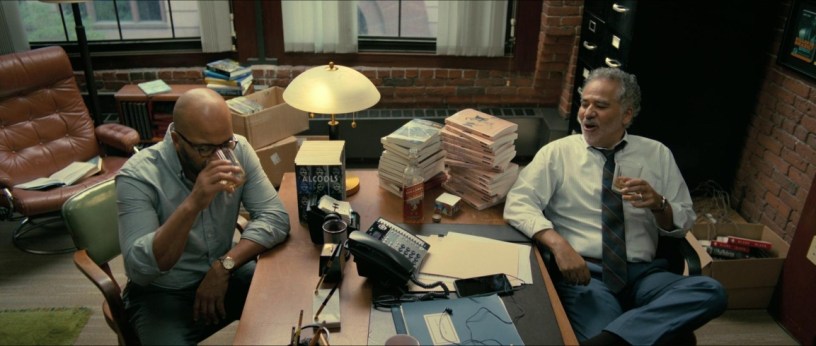
In a scene at Arthur’s office,[2] Monk and Arthur discuss how a tongue-in-cheek novel he submitted pandering to African-American stereotypes has received an attractive publishing offer. An anthology of Barfield’s work is stacks on Arthur’s desk. The book is one of several stacks on Arthur’s desk, but becomes more prominent in a later scene.[3] After accepting a publisher’s offer with a lucrative advance, Arthur and Monk have a phone call with the publishing board in which Monk pretends to be a street criminal running from the law. After the team agrees to a ridiculous request Monk makes, he slams his head on desk, hitting his forehead on the stack of Barfield books.[4]
Does Barfield have a special significance in American Fiction?
Since I am not a specialist in Barfield’s work, I asked writer Collin Massie to give his thoughts on how Barfield’s ideas may intersect with ideas in the movie.[5] The following is based on some brief notes I sent to Massie and others interested in the movie. While Massie has considerably better-developed ideas about Barfield and his relevance to American Fiction, I wanted to offer these points in case anyone else is interested in the discussion.
A Filmmaking or Authorial Choice?
The first point of entry for this discussion is whether Owen Barfield’s work has any special significance to the people who made the movie or in the source novel.
American Fiction is based on a novel, Erasure, by Percival Everett (University Press of New England, 2001). It is possible, though not confirmed, that Everett would have discovered Barfield’s work at university. A timeline of his academic appointments appears on the Owen Barfield Literary Estate website, showing Barfield taught as visiting professor at seven American universities between 1964 and 1980: Drew University, Brandeis University, Hamilton College, State University of Missouri, State University of New York, University of British Columbia, and California State University Fullerton. Everett did not attend any of these schools, but finished his master’s in fiction at Brown University in 1982. Barfield’s heyday as a visiting scholar had only just ended, so he may have been appearing on class reading lists at some American universities.
If Barfield’s work has any special meaning to Everett, it has not been reported. In Erasure, no scenes occur in the agent’s office, so there are no references to books on his desk. A quick search of Perspectives on Percival Everett edited by Keith B. Mitchell and Robin G. Vander (University Press of Mississippi, 2013) and Conversations with Percival Everett edited by Joe Weixelmann (University Press of Mississippi, 2013) found no references to Barfield.
Given this information, it is far more likely that The Barfield Reader appearing in American Fiction is the filmmakers’ choice by the filmmakers rather than the novel’s choice. Jefferson has not mentioned being influenced by Barfield and did not attend one of the schools where Barfield taught (he graduated from the College of William & Mary in 2004).
Since the book does not seem to have any documented personal connection to the author or screenwriter-director, the final option is to consider what significance it may have for the movie’s theme, perhaps alongside the other books stacked on Arthur’s desk.
Parsing the Book Stacks
In the first scene of Monk talking with Arthur in his office, five book stacks appear on his desk (seen in the image below). I was unable to get a clear picture of the small orange paperback book, but was able to identify the other book stacks and the exact editions of each based on the book covers.
Right side of the desk: Bundini: Don’t Believe the Hype by Todd Snyder (Hamilcar, 2020). Book cover also visible in a case hanging on Arthur’s wall.
Left, tallest of book piles: A Barfield Reader: Selections from the Writings of Owen Barfield edited by G.B. Tennyson (Wesleyan University Press, 1999).
Far left side, book closest to Monk: Alcools: Poems by Guillaume Apollinaire (Wesleyan University Press, 2011).
Far left corner of the desk, behind Alcools: Barbed Wire: An Ecology of Modernity by Reviel Netz (Wesleyan University Press, 2010).
Bundini is the only book not published by Wesleyan University Press, which may suggest Bundini is especially important and the prop department drew on the press’s catalog for the other books. However, this does not mean the other books, are not important to the scene as well. The fact that Alcools and The Barfield Reader are the only books on Arthur’s desk in the second scene may suggest they are especially significant.
Themes in the Books
The Barfield Reader is a collection of pieces from across Barfield’s work (poetry, nonfiction, fiction), but especially his nonfiction and particularly pieces from Saving the Appearances.[6] Massie uses some fascinating insights from this book to explore how Barfield’s ideas about meaning and mythology may apply to our cultural understandings of race, which becomes a central concern in American Fiction.
Bundini is a book about Drew Bundini Brown, Muhammad Ali’s cornerman, often called Ali’s “hype man” for helping to create and promote Ali’s public persona. Among other things, Brown coined the phrase “Float like a butterfly, sting like a bee,” which so many people today connect to Ali. The book prompts important questions about how much African-American cultural iconography is a product of many people, not just what appears on the surface. The book’s subtitle “Don’t believe the hype” could easily be the subtitle of American Fiction as well, a story in which Monk struggles with how much the hype surrounding his new book does not match the reality.
Alcools is the best-known collection of poems by Guillaume Apollinaire. In addition to being a crucial figure in modernist poetry, J.B. Donne notes that Apollinaire collected and wrote about African masks, as in his 1917 essay “Concerning the Art of the Blacks.”[7] The same year Apollinaire published the essay, he worked with art dealer Paul Guillaume to host a groundbreaking exhibition of African art, “Sculptures Nègres,” and the two men published a photograph collection from the exhibition.[8] Alcools may also connect to the discussion about hype and perception: Laurence Campa notes in her chapter on Apolliniare for A World History of World War I Poetry that a notable trait in his philosophy was not seeing any distance between art and life.[9] Monk must grapple with how much difference exists between his life and his art, and what happens if the distance becomes broader than he wants.
Barbed Wire is about the history of barbed wire, which Ian Hacking notes is placed in a larger discussion about confinement, about barbed wire as a colonial tool for control of frontiers and also for people.[10] While this may not seem to connect with African-American history, it does perhaps underline how Monk feels: he is caged in by white stereotypes about black people, about colonial conceptions of how the colonized should behave.
FOOTNOTES
[1] A Brush With the Real: Figurative Painting Today, edited by Margherita Dessanay and Marc Valli, Laurence King Publishing, 2013. For the Reddit thread, see https://www.reddit.com/r/WhatIsThisPainting/comments/1ak0zpd/does_anyone_recognize_the_office_art_from_the/?rdt=34233.
[2] See 00:45:42 in American Fiction, directed and written by Cord Jefferson, Amazon MGM Studios, 2023.
[3] See American Fiction, 01:09:05.
[4] See American Fiction, 01:12:49.
[5] Collin Massie, “Owen Barfield and the Idol of Race: An Unassuming Question from the Film American Fiction.” Fellowship & Fairydust, January 22, 2025.
[6] “A Barfield Reader: Selections from the Writings of Owen Barfield.” Encyclopedia Barfieldiana.
[7] J.B. Donne, “Guillaume Apollinaire’s African Collection,” Newsletter of Museum Ethnographers Group, No. 14 (August 1983), pp. 4-9.
[8] “Sculptures Nègres.” Musée de l’Orangerie, https://www.musee-orangerie.fr/en/ressources/fonds-documentaires-et-archives/archives-collection-walter-guillaume/sculptures-negres.
[9] Laurence Campa, “Guillaume Apollinaire (1880–1918),” A History of World War One Poetry, edited by Jane Potter, Cambridge University Press, 2023, pp. 365-378.
[10] Hacking, Ian. “Review of Barbed Wire: An Ecology of Modernity.” Common Knowledge 13, no. 1 (2007), pp. 142-143.
 Fellowship & Fairydust