
BY AVELLINA BALESTRI
Author’s Note: The following is an excerpt from the duology in progress, “All Ye Who Pass By,” which follows the experiences of Edmund Southworth (alias Ned), a young man from an English Catholic Recusant family who finds himself drawn into the turbulence of the American Revolution.
***
When the weekend arrived, General Burgoyne changed up their routine and whisked Edmund off to an elegant garden party in Westminster. The atmosphere perfectly suited the General, who mixed and mingled amiably with London’s stylish elite as they admired some of the earliest spring blooms sprouting from the warming earth. Ned, for his part, stayed out of the way as much as possible, awkwardly hovering over a punch bowl in the corner. For all his blue blood, he felt more at home at a harvest dance with simple country folk than lavish gatherings with glittering assemblies.
As Ned started to fill another glass of punch for himself, there was a sudden fanfare of horns, causing the garden to grow hushed.
Burgoyne made his way over to Ned and whispered in his ear, “It’s the King. Stand up straight.”
Ned dropped the ladle with a splash and clank. “You…you didn’t tell me that—”
“Didn’t I? Oh well. Surprise!”
As the band began to play “God Save the King,” Edmund had the burning desire to hide under the table until the royal visitation was over. This was partly because he realized his white ruffled shirt had been stained with punch, making it look as if he had been stabbed in an ill-fated fencing lesson and his blood ran an insipid shade of pink. The other part was the knee-jerk reaction of any recusant. Most Catholics in Britain might well sing about “Great George, our King” to dispense with accusations of lingering Jacobitism, just as the band in the garden was playing now, but few would be entirely comfortable with said king showing up in the flesh to scrutinize them. They were, after all, marked by their refusal to acknowledge him as supreme governor of the Church in England, and the great and small measures they took to maintain allegiance to the Holy See made them akin to outlaws. Some in the establishment even labeled them “Robin Hoods” to hammer home the point.
But it was too late for Edmund to take refuge beneath the table now, far too late…
Over the course of Ned’s worrying, the King had already made his grand entrance, cut a path through the garden party attendees, making polite small talk with each one as he went, and planted himself in front of Burgoyne and Edmund. Ned imitated the General’s ceremonious bow and kept his eyes down, becoming increasingly fixated upon his stained shirt. He felt sure his face was turning as pink as the punch.
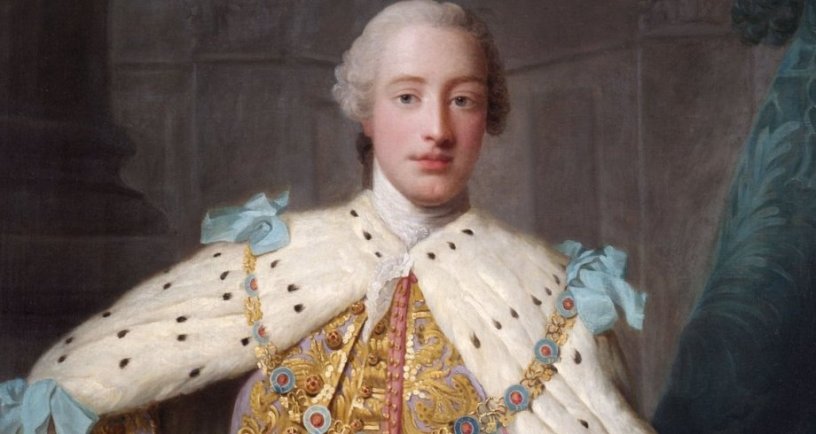
He looked up slightly as the King and the General exchanged courtesies. Burgoyne was soon gushing and grandstanding, but Ned was in no state of mind to properly process his monologue, beyond something to do with His Majesty’s inestimable virtues, and Burgoyne’s inestimable talents, and the colonial troublemakers needing to be put in their place. He did happen to notice that the King’s clothes were formal but not showy, the kind any dignified country gentlemen would wear, in stark contrast to Burgoyne’s ostentatious fare. And on his jacket, there was pinned a very pretty button.
After that, Ned recalled the King turning to him and asking a direct question. He could not manage to decipher what the question was in the midst of his anxiety, but found himself replying, “Yes, Sire,” followed by, “pretty button,” and was absolutely horrified by his own voice sounding so childish. He felt Burgoyne nudge him in the ribs, adding to his mortification.
The King was looking at Edmund full in the face now, his large blue eyes slightly perplexed, and Ned found himself unable to lower his gaze down again.
“Your button, Sire…it’s very fine, very fine indeed…”
“Indeed,” concurred the King, in perfect monotone. “It pertains to our patronage of The Handel Society.”
“Oh…wonderful, I mean…well done,” Ned replied, desperately trying to find some conversational footing. “I-I have always admired him, S-s-sire.”
Joy to the world. He was stuttering now. But this did not appear to faze the King, who smiled kindly, warming Edmund inside.
“As you may know, our grandfather was the first to stand for the Hallelujah Chorus at a performance of Handel’s Messiah in London,” the King remarked.
“Yes, Sire,” Ned acknowledged, “because he found the piece to be so powerful.”
The King leaned forward slightly. “It was not without precedent for our grandfather to slip into slumber during performances, however powerful they might be. When he found himself roused, momentary confusion, mixed with an eagerness to suitably respond to what might have been ‘Rule Britannia,’ could follow…”
“Ahhh.”
“We are not, of course, saying that is how it happened,” the King stated tactfully.
“No, Sire.”
“Either way, we honor the tradition the late king set by standing whenever the Hallelujah is performed, and we are wide awake each time.”
“Me too,” Ned blurted. “I mean…I stand, and we all stand, because Your Majesty stands, and it’s fitting we should do so, for the King of Kings.”
“Yes,” the King said. “We believe Handel would be gratified by the tradition. After all, he said he saw the face of God through his own labors.”
“And now, so do we all,” Ned observed.
“Indeed, indeed. One should be ever watchful for the arrival of their Lord, however He chooses to come, and be ready to render Him any service.” The King’s expression grew wistful. “We once met the great composer backstage when we were still a young prince, under the age of ten. He seemed flattered by our enthusiasm for his work and said, ‘While that boy lives, my music will never want a protector.’ We have not forgotten him, nearly thirty years on, nor shall we whilst God preserve us. We have purchased his harpsichord, in fact. We play it, even.”
“Congratulations, Sire,” Ned responded cheerfully, genuinely pleased to hear the instrument was still in use.
“We hope the original owner does not mind too terribly, wherever he is,” the King said. “His genius was matched by a temper. Nearly ran a man through for touching the instrument without permission.”
“If there’s anyone he wouldn’t mind playing his harpsichord, surely it would be Your Majesty,” Ned insisted. “You…you wear his button, do you not?”
The King chuckled. “Do you play anything, hmm?”
“My sister is like Your Majesty, and plays the harpsichord, though I am no good at music-making,” Ned admitted. “I do tend to put everything else aside and listen, though, whenever she’s playing. Music enthralls me. It’s like…like a prayer, like everything we could feel…joy and sorrow and glory, and the brevity of here, and the eternity of there…” He caught himself rambling, and thought of some way to finish. “It’s as Handel said, Sire. God gives us a glimpse of His face, and we are left to marvel.”
“Yes,” the King said softly. “Marvel. That is the gift Handel gave us.” He turned to Burgoyne, who had a blank expression on his face, having found himself no longer at the center of attention. “This young man, General…he’s not the same one who was with you the last time, is he?”
“No, Your Majesty,” Burgoyne answered, relocating himself. “I’m afraid not. He’s less accustomed to garden parties, though he’s fresh from the farm…”
“Afraid?” The King’s eyes glimmered quizzically. “No need, sir, no need. We like things fresh from the farm.”
Ned smiled. “That…that is fitting, Your Majesty. After all…your name, it means…”
“Farmer,” the King finished. “A tiller of soil, a tender of vines.”
“And what is England if not a farm with soil to be tilled and vines to be tended?” Ned inquired. “She needs a farmer to see to her needs, and nothing else will do. That’s why, according to Providence, our patron saint was named thusly. The blood of the martyrs is the seed of the faith, and so he served his Master as both a soldier and a farmer. And in these years of grace, he has been the guardian of our kings in times of travail.”
“And what does it signify to you that Handel was also christened with that name?” the King asked, seemingly amused.
“That he sowed songs, Your Majesty,” Ned answered, beaming. “One of the finest crops.”
The King snort-laughed, then grew serious. “Heed our advice, young man. Do not abandon your own plot of land for the allure of the court. An honest, humble life spent close to the earth keeps a man’s face bronzed and his eyes bright. Besides, the Creator deigns to reveal Himself to us through the Book of Creation, second only to Sacred Scripture, if we are but willing to look upon it with an open heart and inquiring mind.”
“I strive to keep my heart and mind attentive to such revelation, Sire,” Ned assured. “I am often most sensible to God’s companionship when nature surrounds me, especially walking the hills and moors of home. It is, perhaps, a memory of Old Eden.”
“Good, good,” the King said. “It is right that we should remember Eden, and pine over her. Only then do we yearn for the world to come.” He tilted his head. “This tour of the city seems not to have ruined you yet, though it might be wise not to risk too many more, what?”
“Agreed, Sire,” Ned replied. “I shall abide by your counsel and remain true to my roots.”
“We are pleased,” said the King. Then he unexpectedly took off his button, and extended it to Ned. “Become a member of the Society.”
Ned blinked. “Are you quite sure you want me to take that, Sire? It’s…well, it’s a very pretty button…”
“We have a box,” the King assured.
“Oh…well…in that case…” Edmund reached out and accepted the button from the royal hand. “I am much obliged, Your Majesty.”
The King gestured at the punch stain on Ned’s shirt. “If you affix it there, it might cover that.”
Ned felt his face aflame as he did what he was told.
The King nodded in satisfaction. “In light of your friendship with the General, we wish you every success in your future military career and continuous good health wherever duty takes you.”
“Umm…th-thank you, Your Maj—”
“Oh, he’s not a recruit, Sire,” Burgoyne chortled, laying a hand on Ned’s shoulder. “Faith, he cannot be, I fear! He is a Papist! Lancashire recusant family. Lovely father. Lent me some coin when I was hard-pressed with both the ponies and the ladies! Passed on, poor soul, and here is his lad, under my wing!” He pulled Ned a little close to him. “Now we’re two peas in a pod!”
The King glared at Burgoyne as if the man was touched in the head. Then he glanced over at Ned, seeming to encourage the boy to give a signal if he was being held hostage by a madman and required a royal rescue. At last, he turned back to Burgoyne.
“When next you see Lady Charlotte, pray tell your wife that the King and his Queen who shares her name extend their fondest felicitations and sincerest supplications for her health.”
Edmund knew his cheeks must be flushing crimson now, recalling suddenly that Gentleman Johnny was a married man. Burgoyne himself bore a chastened expression as he muttered a promise to relay the gracious royal greeting back home, whenever he got back home.
Then the King returned his gaze to Ned. “A recusant, are you?”
“Yes, Your Majesty,” Edmund confirmed, butterflies in his stomach.
“Have you made any renovations to your house of late?”
“No, Sire,” Ned answered cautiously, guessing the query might well refer to priest holes and secret chapels. “What we have is sufficient.”
“We see.” The King squinted. “It is good to take care in such matters. Too many alterations risk unsettling the foundation.”
“We are keen to keep our foundation solid, Sire.”
“As are we,” the King responded quietly, then continued, “In terms of your daily bread, what is your source of sustenance up north, hmm?”
Edmund found himself saying, perhaps unwisely, “Very little to speak of, Your Majesty, save for the sacrifice of Christ.”
Any recusant would have known the double meaning, would have known that he meant the sacrifice of the Holy Mass which they risked so much to attend.
But the King seemed unaware of it, or at least chose to act as if he were. Instead, he nodded in approval of Ned’s answer, and replied, “That too is my dependency.”
And in that moment, as the King departed from them, Edmund Southworth saw George the Third not only as his sovereign, but as a sinner, like himself, saved by grace. In that, at least, there was no separation between them.
(This excerpt was published in Happy & Glorious: A Royal Celebration)
 Fellowship & Fairydust