
BY AVELLINA BALESTRI
“A dear bought victory, another such would have ruined us.” – General Henry Clinton
***
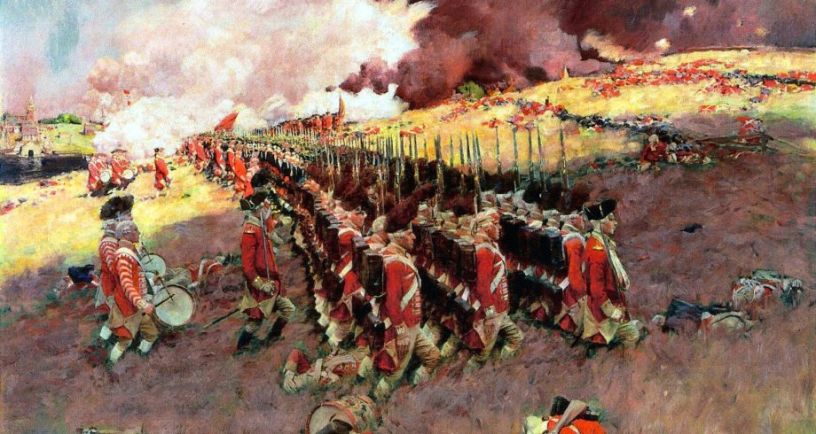
They are playing “British Grenadiers”
As the Grenadiers advance,
Cheering them on, to their doom,
For there are no other songs to play,
Upon this day of reckoning,
But the songs of Englishmen.
Is not that, too, the right of Englishmen,
By breath and blood and bone,
To pipe melodies of shared memories
At this fraternal funeral?
New waves of regiments roll forward
In a sunny scarlet surge,
Trained to move as a single machine
And keep their eyes to the front.
Wait for the whites of those eyes,
And maybe the colors, too—
Sky blue, or grass green,
Earth brown, or cloud gray,
Or the starkness of midnight black,
Or the rare in-between hues
Of violet or hazel,
Or eyes that shift in shade
When fear or pain enlighten them.
They say eyes are windows to souls,
And in this melting moment,
Before souls are torn from bodies,
These soldiers are machines no more,
Only men.
The guns rattle,
All at once,
Then go pop, pop, pop,
One at a time,
Mowing down the brick-red boys,
Hands hard from double drill,
Then picking off the crimson sashes,
The pride of island heraldry.
They are taking down the leaders,
Tearing open their chests,
And painting them purple,
Along with their lips,
Moving, then not moving,
Trying for a final order,
Or a message,
Or a prayer.
Men, high born and low,
Twitch in the salt-grass
And wash it warm
With the flow of their hearts
And mouths.
The fife is shrill, the drum hollow,
Empty songs like empty sockets
In the faces of the slain,
Left with one eye less.
Mocking, the tune repeats:
With a tow-row-row-row-row-row-row
For the British Grenadiers!
The sun punishes the players
And those meeting the music,
Sweat falling with the blood
And blinding everyone.
British songs are drowned out
By British screams,
And men recognize each other
Across the ruthless chasm.
Above the cacophony,
A rebel cries out to his fellows,
“Please, please, please,
Don’t kill that soldier!
I love him like a brother!”
And a lobster, hearing his friend,
Salutes him and dodges the bullets.
William Howe still stands,
Alone, of all the officers,
Crystal tears upon his cheeks,
Too shocked to escape,
With his soldiers stretched, slain,
At his feet.
He vowed they would march no farther
Than he himself would lead.
But fate is full of cruel mercies,
And he remains standing, staring
Up at the enemy.
Putnam is at the top, pistols primed,
And surely he knows the eyes
Of Billy Howe,
Not unlike those of his brother,
George Augustus, the Young Lord,
Who died in Putnam’s arms
In the last war, before the wedge
Was driven between kindred.
Yes, George,
Beloved and revered
By Britons on both sides the sea,
A noble with a common touch,
The future of the army and his house,
Too gallant for his own good.
When he died, he left a chasm,
Even an ocean’s span,
That none could bridge.
William nearly starved himself,
Surrendering to his grief,
And Wolfe, Quebec’s hero,
Said he should be forced to eat
Lest he perish in his tent.
Now, upon this hilly hellscape,
Putnam spares Howe,
A lone survivor in the eye of the storm.
God knows when Sir William
Will manage food again.
Now, here comes the judgment
And the third charge of crimson.
Pitcairn rouses his Marines,
Shouting and swearing in his Scots burr,
Rough ‘round the edges, and real.
Even Bostonians warmed to him,
For all his threats of fire and sword.
There’s something paternal about him,
A gruff, yet genial, presence,
Dark humor and straight talk,
Sharing news from Betty and the children,
And biting his salty tongue
On the Lord’s Day.
He is a family man and a minister’s son,
Almost too easy to know,
Almost too hard to kill.
Twice wounded, he will not retire,
And scorns the summer sun,
Blistering o’er the battlements.
He is the glory of the Marines,
And the day is their own.
But the guns blaze bright again,
And Pitcairn falls,
Four bullets in the breast.
His life’s blood sprays on his soldier-son
Who catches and carries him
Upon his back, down to the ferry,
And, kissing him, returns to fight.
Later,
That same son will wander the streets,
Still gore-soaked,
Murmuring,
“I have lost my father,
I have lost my father,
I have lost my father…”
And some Marines reply,
Almost as a ritual:
“We have all lost a father!”
At last,
The redcoats take the hill,
Young Rawdon waving the flag
For King and Country
As a ball cleaves his hat.
Now the bayonets are gleaming,
Impaling poor Boston boys
Who gambled for liberty or death,
And musket butts are brandished,
Bashing in their brains.
There are farmers’ sons here,
On both sides,
That should be one side,
From Old and New England,
Born in villages with the same names,
Who will never till the soil again.
Dirt is under their fingernails;
Soon, dirt will be over their heads.
They are the seeds to be planted;
The harvest is yet unknown.
Captain Small stands on the mound,
Screaming at General Warren,
His old friend, now foe,
To give up his gun!
Warren just smiles.
And then he is dead,
A bullet in his head,
And the British captain blocks
His own aide’s bayonet
From thrusting through the corpse.
Warren’s children, too,
Have lost a father,
To be dumped in a ditch,
Barely covered from crows,
A revolutionary martyr.
But vultures have no politics.
It is Britannia’s victory…
But another such would ruin her.
Who has won, and who has lost?
Who is alive, and who is dead?
Ask the Lord,
For no man knows.
Soon,
Rain washes down the hill,
Cold and clean,
Red dye weaving rivers
To the sea.
Such drops form tears
Upon ashen cheeks,
And fill empty eyes
Staring into the sky,
With an innocence foreign to them
Since the day of birth,
When all are equal in vulnerability
And swaddled in the mystery
That is God.
As it was in the beginning…
Is now.
 Fellowship & Fairydust