
BY NATHAN STONE
In one of his Continental Op stories, Dashiell Hammett wrote:
“I was reading a sign high on the wall behind the bar: ONLY GENUINE PRE-WAR AMERICAN AND BRITISH WHISKEYS SERVED HERE! I was trying to count how many lies could be found in those nine words, and had reached four, with promise of more when one of my confederates, the Greek, cleared his throat with the noise of a gasoline engine’s backfire.”
“Based on a true story” is the Hollywood version of the Op’s situation.
Titanic, Pocahontas, Braveheart, 300, and A Beautiful Mind are just a handful of examples. What usually happens in these situations is that a few characters in the film, named after people who did in fact live, go to a few places and do one or two things that their historical counterparts did…and that’s about it. Everything else comes from the writer’s imagination. I would be lying if I said 2000’s The Patriot is an exception to this rule. As has been cited by multiple people and writers from the time of the movie’s release to the present, there are several problems which haunt it.
The timeline, for one thing, is a mess, with events shuffled around so as to fit with the narrative flow of the story. Some of these decisions have a certain logic to them; the British capture of Charleston, South Carolina is pushed back from 1780 to 1778 so that our heroes can live under British occupation which can then serve as character motivation at the end of the first act. The same is true for making Mel Gibson’s Benjamin Martin the architect of the Patriots’ strategy at the Battle of the Cowpens. Yes, really it was Nathaniel Greene (sent by General Washington as commander of American forces in the South) and even more so, Dan Morgan, who created the plan, but because Martin is the hero, he is the one who must defeat the British threat. So Script demands.
Other decisions made to the timeline are less so. Moving the Battle of Elizabethtown from North Carolina in August of 1781 to some undisclosed northern colony at the dawn of winter (snow is falling during the battle and the next scene shows the Continental Army freezing at what I assume is supposed to be Valley Forge—never mind that the Army camped at Valley Forge in the winter of 1777), is pointless as it does nothing to advance the story. There would have been plenty of actual battles and skirmishes from 1778 to choose from: Martha’s Vineyard, Fairhaven, Tiverton, Alligator Bridge.
And yet these problems with the timeline are the only hiccups that the movie has. Yes, the black workers on Marin’s plantation are specifically called free workers and not slaves; yes, the militia are made to be the heroes of the Revolution (to the cost of the Continental Regulars); and yes, the British are portrayed as straight up villains; either traitors (Adam Baldwin’s Captain Wilkins), cold stuffed shirts (Tom Wilkinson’s Cornwallis) or monsters (Jason Isaacs’ Tavington). But none of this really matters. Or, to put it another way, these elements are superseded because The Patriot possesses kinopravda.
A concept created in the Twenties by Soviet director, Dziga Vertov, kinopravda meant a process of filming reality in real rather than “bourgeois” environments and then organizing the filmings together so that a deeper truth, which could not be seen with the naked eye, was revealed on screen. Although Vertov made the camera almost a mechanical god in his Kino-Eye Manifesto (where he has the camera say, “I am the machine that reveals the world to you as only the machine can see it. I am now free of human immobility. I am in perpetual motion”) kinopravda demanded not just geometric logic but a union of machine and man, the cold, objective eye and the warm human heart. To put it another way, it required filming poetry. The filmmaker had to be a poet because poetry is the spirit of film.
The French director, Jean Cocteau, made the distinction between poetry and the mere poetic (or pretty), saying, “Poetry is a product of the unconscious. The poetic is conscious. They stand back to back, and a great number of excursions into the poetic contain not the slightest poetry.” For Cocteau, the end goal of all truly great cinematography was the creation of a dream (not the mechanical retelling of a dream) that could be participated in by the entire audience. To do this, “the cinema-poet’s first concern should, therefore, be…to believe in acts of magic as he does in the most routine things.” Or, as Orson Welles would put it later, “A film is never really good unless the camera is an eye in the head of a poet.”
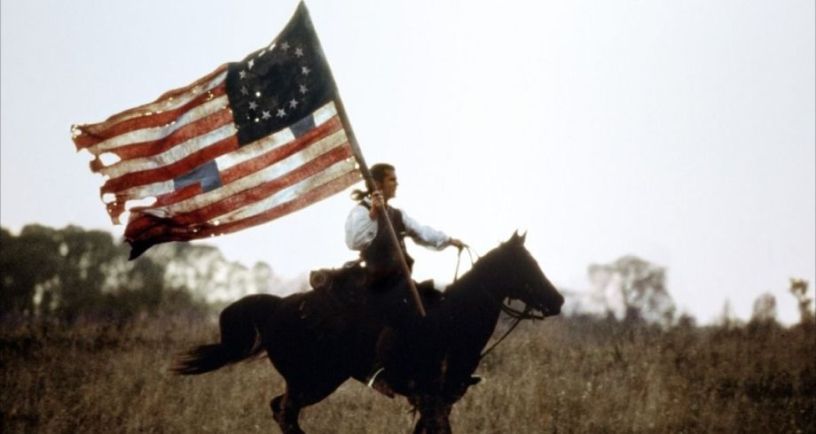
The Patriot, like all great films, is poetry put on celluloid. As such, exaggerations and literary licenses are to be expected but these do not make the movie a lie, bad or propaganda. The key in this is that the exaggerations and licenses in the movie reflect either real events or realities from American history.
Take the film’s portrayal of the British, especially the bloodthirstiness of Tavington. We could say that Tavington is a fictionalized rendition of Banastre Tarleton, who did have a bloody reputation among the Americans, and leave the justification at that, but there is more to the character. Tavington is an embodiment of the abuses which Britons did execute against the colonists. Joseph Ellis, in his most recent book, The Cause: the American Revolution and Its Discontents, reminds his readers that wounded American soldiers were given no quarter at the end of the Battle of Bunker Hill and during the Battle of Brooklyn.
Speaking of Bunker Hill, Rick Atkinson in the first book of his planned Revolutionary trilogy, The British Are Coming, writes that American barns and some homes were burned as the British chased the defenders of Bunker Hill into the interior of Massachusetts. And while he was not an archetype of the British officer corps, General Sir James Grant said that the best thing that could happen to American women would be to be raped by British soldiers. It’s no coincidence that Tavington orders wounded American Regulars to be killed, the Martin home and barns to be burned and the church to be burned (while a church with people was not burned during the Revolution, many churches were destroyed by the British, such as St. Philips in Brunswicktown, North Carolina and Prince William Parish Church in South Carolina.)
The same thing is true for the free black workers and the myth of the militia. The former harkens forward to a post-Civil War, post-Civil Rights Act America, as well as the fact that manumission of slaves and the outlawing of slavery by individual states increased after the Revolution. Call it cinematic shorthand. And the militia reflects the yeoman Republic populated by the only farmers in the world who read Virgil and Homer (to paraphrase Thomas Jefferson.)
A filmmaker leaves kinopravda for propaganda or outright lies when he starts portraying real people acting contrary to how they did in real life. James Cameron takes the prize in this regard. Titanic took First Mate William McMasters Murdoch, a man who sacrificed his own life saving others, and turned him into a corrupt weasel who shoots himself after accidentally killing a third-class passenger. But The Patriot does not go the Cameron route. While it exaggerates and caricatures fictional characters, it stays within the bounds of film-truth by bringing to life a glorious cause and the sacrifices required for making all great causes a reality.
 Fellowship & Fairydust