
BY J. M. HOCHSTETLER
When you write novels you’re going to need names. Lots of them. My American Patriot Series encompasses the entire American Revolution from beginning to end. Thus many of my characters and settings are historical figures and places, which happily eliminated the need to name them . . . though not the need to research them intensively and endlessly. It did leave me with the need to invent my fictional characters and the fictional settings they inhabit out of whole cloth. Which required intensive and endless angst. I wanted each one to be memorable, which meant that in a number of cases settling on a name became hair-rippingly frustrating. Have I mentioned that I’m obsessive?
Thankfully some names materialized with little effort, like my heroine, Elizabeth Howard, a spy, courier, and smuggler for the rebels. Even better, occasionally a character or place was already there, fully named, when I needed it, as though it were a given, as though it existed in the dim recesses of time long before it stepped into my story. Charles Andrews and James Stowe were two of those characters.
But other names required considerable pondering, research; making of lists; or combining, recombining, and flat-out manufacturing different first and last names until the character or place stepped forward and revealed itself. Like Jonathan Carleton, for instance. I landed on the first name Jonathan after a modicum of mental travail. But his last name took lists of names gleaned from my research resources, before I finally settled on Carleton—the last name of Canada’s military governor at that time! Distant cousin, perhaps, though Guy was Welsh and Jonathan is half Scottish, half French. Oh, well.
Jonathan was stubbornly, and exasperatingly enigmatic from the first. Which you’d expect, considering his parentage and the fact that he was adopted by his paternal uncle when he was three and raised in Virginia before returning to England as a young adult. So I had to wait, tapping my foot impatiently, for him to begin emerging from the mists. And then he rather exploded onto the page, the rascal! Below is his intro in Book 1 of the series, Daughter of Liberty, and also that of Charles Andrews. Elizabeth is finalizing preparations for the arrival of two British officers who are to be quartered in her parents’ townhouse in Boston just days before the British will march out to Concord. The scene begins at the end of chapter three and continues into chapter four.
***
In her preoccupation she paid no attention to the distant bang of a door somewhere below, assuming that either the cook or the housekeeper had come inside. But the sudden thump of boots across the floor in the downstairs passageway pulled her around in alarm.
A muffled burst of laughter was answered by a disturbingly masculine voice, husky and good humored. She threw an anxious glance at the door, but before she could move toward it, she heard the tap of boots and jingle of spurs as someone ran lightly up the stairs.
“Andrews!” the voice commanded. “Tell Stowe to bring my kit upstairs. First bedroom, Mrs. Dalton said. And find out who belongs to that cloak and hat in the parlor. I am intrigued.”
Dismayed, she belatedly ran for the door, her slippers making no sound on the woven carpet. Grasping the handle, she jerked the door open and stepped across the threshold in the same motion—and collided headlong with the one who was in the process of entering.
She gasped, heard his muttered oath of astonishment.
“What the deuce—?”
She had a fleeting impression of a brilliant scarlet coat with the white facings of the Seventeenth Light Dragoons, the flash of a silver epaulet at one broad shoulder, the glitter of a sabre swinging from a wide, white shoulder belt. Then she looked up, cheeks burning, to find herself in the arms of a British officer.
“Why, what have we here?” Amazed amusement tinged a British accent softened by the lingering trace of a lazy Virginia drawl.
Hastily Elizabeth took inventory from beneath a veil of lowered lashes. What that glance told her was far from reassuring: Her captor wasn’t handsome so much as arresting in appearance, tanned from the outdoors, with sun-streaked blond hair and smoky blue-grey eyes.
In spite of their unexpected and most improper encounter, he didn’t appear to be in the least taken aback. Nor did he make any move to release her, but held her appreciatively, laughing down at her as he took her in with a bold glance.
“How delightful. Do you come with this place too?”
“I most certainly do not, sir!”
“How disappointing.” His tone reflected genuine regret.
She bit back a hot reply. This wasn’t at all the decorous meeting she had envisioned. Instead, she found herself in a distinctly awkward, not to mention compromising, position.
His hands lingered with entirely too much familiarity at her waist, and the arms that held her captive were disconcertingly hard beneath the woolen fabric of his uniform coat. Unless he chose to release her, she realized with dismay, she would have considerable difficulty in breaking free.
Furious, she lifted her chin to meet his amused gaze with a coldly reproving one, determined to gain the upper hand. “If you’ll be so kind as to let me go, Captain Carleton, I’ll show you where to put your things.” She kept her tone frigid.
“Ah, then you were expecting me.”
“Not until . . . until this evening or . . . tomorrow—if you please, sir!”
Again she attempted to extricate herself from his arms, but it was at once apparent that if she intended to regain her freedom, she was going to have to resort to an undignified struggle.
“We got in late last night,” he explained with a smile, adding pleasantly, “Major Pitcairn was kind enough to put us up.”
“The major forewarned me of your arrival.”
“Did he? And what else did he tell you, enfant? Only agreeable things, I hope.”
She was uncomfortably aware that they stood just inside the bedroom that was to be his, as compromising a situation as one could wish for. It was obvious he took wicked enjoyment in her plight—and in the sensation of her nestled against him.
As though he read her thoughts, his glance lingered for a deliberate instant on her lips. She had played that same game more than once, however, and rage took over.
“Whether it was agreeable or not, his description seems to have been accurate. Release me at once, captain, or I shall scream.”
“Scream away, then,” he answered, seeming to anticipate the prospect with glee. “After all, you were in my bedroom, and you did throw yourself so accommodatingly into my arms.”
“Oh!”
It took heroic effort to master the impulse to attack him with her fingernails. “Faith, but you certainly flatter yourself if you can think for one tiny instant I would ever throw myself at you, sir.”
His response was a hearty and unapologetic laugh. For an instant, his grip slackened. Planting both hands against his chest, she gave a hard push and at the same instant stepped away from him. Unbalanced, he was forced to let her go.
Far from seeming disconcerted at her escape, he grinned and made a deep bow. “You have me at a disadvantage, fair vision. Do you have a name?”
She glared at him. “I am Elizabeth Howard, sir.”
“Oh, that explains why you were lurking in my bedroom.” Before she could gasp out a scathing reply, he added amiably, “I presume I do have the honor of addressing the daughter of my benefactor, Dr. Samuel Howard.”
“Our citizens are obliged to provide quarters for His Majesty’s soldiers whether they consider it an honor or not.”
“I am familiar with the quartering laws,” he conceded, his tone dry.
Having put him in his place, she was inclined to be more gracious, though as a precaution she put a safe distance between them. “And of course my parents are pleased to comply with them.”
“Of course. And you?”
She frowned, wondering if he was always so annoyingly direct. “What pleases my parents pleases me.”
He acknowledged the reproof with the slight lift of an eyebrow, a tug of laughter at the corners of his mouth that made it difficult for her to maintain a pose of outraged dignity. Throwing a swift glance at his surroundings, he said, “I didn’t expect to be billeted in such gracious style, nor to find such hospitality in Boston. Your parents are too kind. I hope I’ll have the opportunity to thank them personally.”
“I’m sure they’ll be delighted to have you wait upon them tonight at His Excellency’s ball.”
“Ah, yes, we’ve been informed we’re to attend. You will be there, I devoutly hope.”
When she inclined her head, he swept her with an approving glance. “It seems my stay in your fair town is going to prove more pleasant than I anticipated.”
Not waiting for her reply, he took two swift strides into the hall and bent over the banister to call downstairs in high good humor. “Charles! I swear we’ve lighted upon one of the clouds of heaven! Come see what a treasure I’ve chanced upon.” He directed a lazy smile at Elizabeth as she stepped to the banister beside him. “She’s no less than a very angel—though a somewhat ill-tempered one, I must say.”
The officer who strolled through the open door of the library to peer up at them, a half-filled glass of brandy in his hand, was perhaps twenty-five years of age. Not as tall as his superior, he was more slenderly built, with a fresh, ruddy complexion and light brown hair.
“I might have known, Jon. We’ve hardly got our land legs back, and you’ve unerringly found your way to the sweetest rose this side of the Atlantic.”
“Watch your tongue. She has a bad enough opinion of me already without your adding to it.” Assuming a schoolmaster’s severity of tone and look, he indicated the lieutenant’s glass.
“And put that down, you dissipated cub—it’s a little early to be drinking. Where are your manners? Come here at once and be properly introduced to Miss Elizabeth Howard.”
With no more urging, Andrews set down his drink and came bounding up the stairs to sweep Elizabeth an elaborate bow. As Carleton introduced Lieutenant Charles Andrews, the officer beamed down at her with unconcealed approval.
“I was right. This one really is as perfect as a rose.”
“Beware her thorns,” Carleton warned sourly. “I’ve already had occasion to feel their prick.”
***
The name of Carleton’s Virginia estate, Thornlea, was also one simply “given.” Later in the fourth chapter Andrews refers to the estate and gives a brief description.
“Oh, it’s just a modest plot of land—twenty thousand acres or so running up into the Blue Ridge. Most of it is heavily forested, but enough is cleared to pasture about three hundred head of cattle and a hundred horses. I swear, the main house rivals the great manors of England, and the countryside around it is second to none for beauty.”
All of that simply spilled out onto the page without any forethought. I had no idea! Nor, in spite of scattered references to “Thornlea” throughout the series, did I have any idea whatever of exactly where this estate would be set, other than in the Blue Ridge Mountains of Virginia, or what it would consist of? I only knew vaguely that at some point the story would go there, and in Forge of Freedom, the last book of the series, the hour of reckoning arrived! So I buckled down and brought this murky idea of an estate to what I hope is vibrant life.
I set Thornlea in Thorn Valley, named for the hawthorn and black locust trees growing thickly in it (thorn), and for the meadows (lea) where Carleton’s herds of livestock graze. Then the river that runs through the valley became the Thorn River. Who knew?! And where in the world did that name come from four decades ago when I first started writing Daughter of Liberty with no idea of making it into a series? A moment of serendipity or something else? Perhaps you’ve experienced an unexpected inspiration like that at some point in your life. But further descriptions of Thornlea will have to wait for another time.
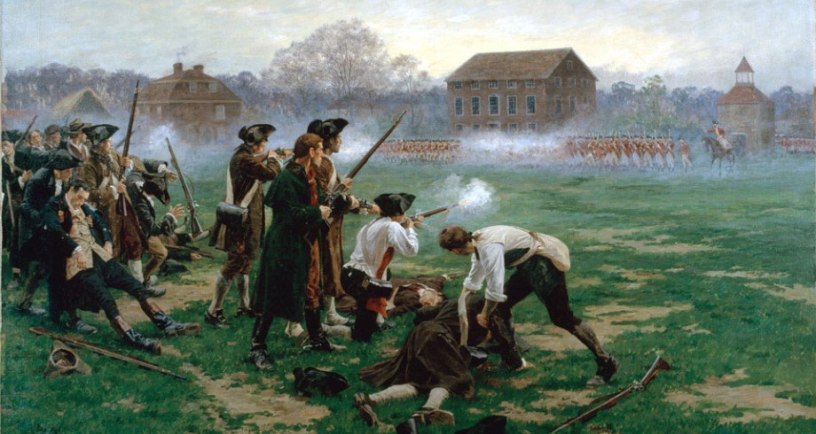
Below, as the introduction to The American Patriot Series, which you’ll find the first scene of Daughter of Liberty. The action begins in the Boston area days before the skirmishes at Lexington and Concord in April 1775.
***
The crack of the pistol’s report came from directly behind the courier. Sizzling past so close to his ear he could feel the heat of it, the musket ball whined off into the windy night.
Instinctively he crouched, bringing his head close to his mount’s straining neck. “Go! Go!”
The mare responded with a burst of speed, stretching the distance between her and the pursuing British patrol. Flying strands of mane whipped tears to the courier’s eyes as he fumbled beneath his cloak for the handle of the pistol shoved into the waistband of his breeches. His hand shaking, he tore the weapon free and cocked it with his thumb.
“Hold! Pull up and surrender, you blasted rebel!”
The shouted command reached him faintly above rushing wind and pounding hoofbeats. Mouth dry, stomach knotted with fear and exhilaration, he searched the shadowy landscape for an escape route.
In the darkness off to his right, beyond a high stone wall, wooded hills loomed up. Inside the line of trees the woodland dropped to a winding creek, then rose again into the hills, the courier knew. Reining his mare hard right, his breath coming in sharp pants, he glanced over his shoulder at the same moment the wind shredded the clouds high overhead.
For an instant splintered shafts of moonlight rippled across hill and hollow, gleaming on icy remnants of a late snow that still clung in sheltered areas. Touching the irregular stone walls that wound through the rolling farmland, the light glimmered across the blood-red uniforms of the soldiers stampeding after him through the murky Massachusetts countryside.
The quick glimpse revealed three soldiers in the patrol. The one who had fired had dropped back, and the officer now held the lead. He hung stubbornly close, trying to aim his pistol while he swung wide in the attempt to cut off his quarry.
The dim bulk of the stone wall raced toward the courier. A tangled growth of brambles topped the wall on the far side, reaching thorny fingers well above the stones. With reckless determination, he urged his mount on, rising in the stirrups at the exact instant the mare gathered her haunches under her and took flight.
She skimmed over the seemingly impossible height as effortlessly as a gull and lit softly on the other side. Hardly breaking stride, she fled toward the line of trees. A crashing sound reached the courier, and he hazarded another anxious glance back.
The officer had angled his mount off to a partial break in the wall some yards down. One of the two soldiers was riding hard toward the wall’s far end.
The other had tried the wall at the same point as the courier but had miscalculated the jump. Before his mare swept around a bend that for the moment cut him off from the patrol’s sight, the courier caught a brief glimpse of dislodged stone slabs spilled across the ground and the thrashing legs of the fallen horse.
He urged his mount between the trees. A dozen strides into the woods he pulled up hard and guided his mare into a narrow space behind a head-high outcropping of rock screened by slender saplings and dense undergrowth. Shoulders hunched, head bent so the wide brim of his hat shaded his face, he sat motionless, calculating that his black cloak and the midnight black of his mare would render them all but invisible in the shadows.
The mare stood silent, head down, lathered sides heaving. Gripping the reins tightly with one hand, the courier aimed his pistol with the other, holding it steady with difficulty. His heart beat so hard that for a moment he was overwhelmed by the irrational fear that his pursuer must hear it.
He could make out the sharp crackle of fallen branches and rustle of dry leaves underfoot as the officer fought his way through the dense growth, cursing in frustration. The muted creak of leather and jingle of metal drew steadily closer.
As he watched fearfully, the dim shape of a horseman materialized between the ghostly trunks of the trees. The thud of hoofbeats slowed, then for long, heart-stopping moments paused within eight feet of the courier’s hiding place.
He became aware of the stinging tickle of perspiration that wound past the corner of his eye onto his cheek. Holding his breath, he aimed his pistol at the rider’s breast at point-blank range, his hand grown suddenly steady, finger tightening over the trigger.
The mare’s ears pricked, but she made no sound. When the tension reached the point at which the courier feared his nerves would snap, the sound of other hoofbeats approached from the left.
“Captain! Scott’s horse fell on him,” a hoarse voice called out. “He’s in a bad way.”
Muttering an oath, the rider reined his horse around to face the oncoming rider. “I’ll be right there.”
The courier could hear the second rider move off, but still the officer did not spur his mount forward. Instead, he brought him in a circle until he again faced the courier’s hiding place.
“I know you’re there somewhere, you rebel devil!” he rasped. “Come on, you cursed Oriole, show yourself! I know it’s you!”
Motionless, eyes fixed on the officer’s indistinct form, the courier willed him to ride on. The pulse of his blood sounded like thunder in his ears.
The officer waited for several moments more, head tilted as though he listened for a betraying sound. Finally he taunted, “One day you’ll make a misstep, and then we’ll have you. And you’ll hang at last.”
Giving a harsh laugh, he moved past the courier’s hiding place, fighting through the low-hanging branches. Within seconds he vanished into the night as completely as though the earth had swallowed him up.
Trembling uncontrollably, the courier lowered his weapon. For some minutes longer he waited, every sense strained to the breaking point. But no sound reached him except for the moan of the wind through the bare limbs of the trees and the creak of interlaced branches high overhead.
Taking a shaky breath, he took the pistol off cock and shoved it back into the waistband of his breeches. “Thanks be to God!” he muttered. “That was entirely too close.”
The mare tossed her head, and he patted her lathered neck. When he was certain the patrol had to be well out of sight and sound, he spurred her out of their hiding place, urged her down the slope and across the shallow creek. Silent as a specter, they moved up the flank of the hill on the other side and slipped over the summit.
Thus unnoticed, the courier⎯known to General Thomas Gage and the British garrison in Boston only by the name “Oriole” for the whistled notes of his characteristic signal⎯melted into the impenetrable cloak of the forest beyond.
APS Description
The American Patriot Series sweeps readers into a tumultuous world of revolution. Beginning in April 1775, Daughter of Liberty sets in motion the thrilling saga that follows Elizabeth Howard and Jonathan Carleton as they face the devastation and triumphs of war—from the American colonists’ first armed confrontation with the British to the spreading inferno along the frontiers of Indian territory, through the battles raging in the Middle and Southern colonies and on the high seas, and at last to the final, decisive assault at Yorktown.
In this vivid retelling of our nation’s founding, the actual historical events, including the real British and colonial leaders who provided the catalyst for them; a diverse cast that includes Blacks and Native Americans; and breathtaking moment-by-moment recreations of pivotal battles, converge with two compelling characters in a suspense-filled story of espionage, intrigue, and romance. On the ruins of war and loss, Elizabeth Howard and Jonathan Carleton will build an enduring legacy of love, hope, faith—and freedom!
Amazon link: www.theamericanpatriotseries.com
Bio
J. M. Hochstetler is the daughter of Mennonite farmers and a lifelong student of history. She spent many years as an editor with the United Methodist Publishing House before founding Sheaf House Publishers and is the author of award-winning historical fiction. Her American Patriot Series is the only comprehensive historical fiction series on the American Revolution. With well-known Christian author Bob Hostetler, she also coauthored the Northkill Amish Series, winner of Forward Magazine’s 2014 Indie Book of the Year Bronze Award for historical fiction. Her novel One Holy Night, set during the Vietnam era, was named the Christian Small Publishers 2009 Book of the Year.
 Fellowship & Fairydust