
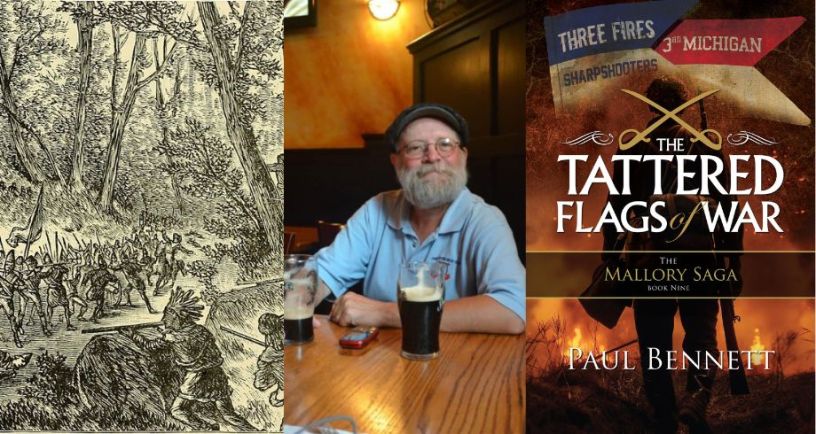
BY AVELLINA BALESTRI
Tell us a little bit about yourself and your background.
I am a retired (2019) data center professional. Not that I started out thinking I would spend nearly 50 years working in mainframe computer environments. My major interests, scholastically, in high school and college were history and anthropology. The Cuban Missile Crisis, Bay of Pigs, assassinations, Vietnam, Watergate, etc., were some of the events that shaped me, forming the basis for my cynical view of government. One of the results of this “hippie attitude” was that I quit school and my job, taking a year and a half off to travel a bit and enjoy life. During that period, I began composing the odd poem or song lyric, but I knew in my heart, and from experience writing school term papers, final exams, and the like, that I was a prose writer. My favorite fantasy for my future at the time was to become a forest ranger sitting in some fire watch tower, writing the great American novel. Life intervened, however, and I put that dream aside to marry and raise a family, which meant I needed to be employed, thus decades of staring at computer screens ensued. As time went on, I began writing about the golf trips I took with my buddies. At first, they were humor-laced travelogues, but now they are fictional tales of my friends; the golf becomes a vehicle for creating a story. Then in 2013, I started writing book reviews and communicating with authors about the process of writing a novel. My dream to write the great American novel returned.
What first inspired you to start writing?
The inspiration to write was, in the beginning, merely to see if I could do it. I had written short pieces over the years, but to tackle a full-blown novel was a daunting prospect. Once the seed was planted, I came up with a rough idea of telling the story of three siblings living somewhere in colonial America. Choosing that general locale was a natural fit for me as I’ve been a lifelong student of American history, and I felt that if I was going to write a historical fiction novel, it might be prudent to choose a subject I knew a little about. I picked The French and Indian War as the starting point for what was now becoming a possible series of books that would follow the Mallory clan through the years. That war intrigued me, and I saw a chance to tell the story through the eyes of the Mallory family. It also provided me with the opportunity to tell the plight of the Native Americans caught up in this conflict. The French and Indian War paved the way for the colonies to push further west into the Ohio River area. It also set the stage for the events of the 1770s. Britain incurred a huge debt winning that war and looked to the colonies for reimbursement in the form of new taxes and tariffs. Well, we all know how those ungrateful colonists responded.
As to the name Mallory – I have a photo hanging on my living room wall of my great-grandfather, Harry Mallory. I got to know him when I was a young boy and was always glad when we visited him. He lived a good portion of his life in western Pennsylvania, which is where much of Clash of Empires takes place. So, as a gesture to my forebears, Mallory became the name of the family.
How did you first become interested in history, and what are your favorite time periods?
When I was a boy, my father and I would talk about the Korean War and other current events. When I was in high school, it became apparent that mathematics and science were not in my future. Writing sort of came naturally, so I gravitated to English and History classes as my elective studies. In college, my focus was on Ancient Greece and Rome with a minor in Physical Anthropology. So, at the time, my reading was mostly of those subjects. However, as time went on, and I moved to New England, I delved into the history of America.
What started you on the journey of historical fiction writing in particular?
I’ve been writing shorter, humorous stories, mostly about my travels with my golf buddies, for many years, but writing a full-length novel was just a fantasy. Then I hooked up with (via the internet) some authors who encouraged me to give it a go. Once the idea of a family saga took hold, I entered the realm of the written word.
What are your favorite and least favorite parts of working within the historical fiction genre?
Well, I like making stuff up within the historical context, but sometimes in order to best reflect the plot or storyline, I’ll tweak the event.
How have you chosen which historical characters to feature in your books, and what made their stories resonate with you?
When you write about early American history, it’s pretty easy to decide who to feature. I mean, George Washington, et al, need to be chronicled. It’s also fun to include minor historical characters to add flavor to the plot.
What is your process in terms of research and bringing historical characters to life?
I try to get a sense of the character’s demeanor; what traits do they have, loyalty, intelligence, arrogance, and the like? Then combine those with any discernible speech patterns for them to have a somewhat reasonable dialogue.
What is your method to integrate fictional characters and situations into the historical setting?
As mentioned earlier, sometimes I tweak the history. For example, I will insert my characters into situations that historically feature a different military unit. At other times, I will create the situation for them.
If you had the chance to convey a message to your favorite historical characters, what would it be?
I hope I haven’t misrepresented them too badly.
What do you find more enjoyable/difficult: First drafts or editing/rewriting?
I forego the usual mantra of ‘just get the words written and fix it later’…my first drafts are edited as I write. Any rewriting is the result of new ideas or the need to expand descriptions of events, etc.
How have you gone about publicizing yourself and your works?
Mostly through Amazon, though I have tried a few promo sites as well.
What are some of the main themes/morals you would like readers to take away from your works?
Although I write fiction tales, the historical aspect of the saga provides the backdrop. History is often overlooked, much to the detriment of humankind, so I hope that what I write might help broaden the reader’s horizon a bit to include history in their repertoire of knowledge and wisdom so that they can look at the world as it is today and exclaim, “wait a minute, I’ve seen this before.” In light of current events in this country, it is more important than ever.
What is some advice you would give aspiring authors, especially those focusing on the historical fiction genre?
Write about something or someone you know. Don’t be concerned about how other authors create their tales. Find your own niche and proceed at your own pace.
More information about the Mallory Saga can be found on its Amazon and Facebook pages, as well as Bennet’s Instagram and BlueSky pages.
 Fellowship & Fairydust