
BY LYNNE B. TAGAWA
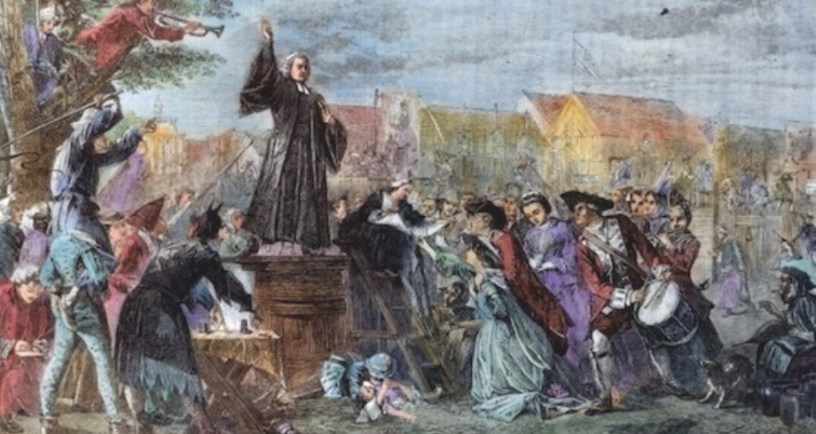
Weeping echoed in the parsonage. How could it be? Why, just yesterday, the beloved minister had preached a sermon in the open air. Just last evening, he’d spoken words of consolation and comfort to those gathered around the parsonage staircase.
And now—he was gone? How could it be?
George Whitefield was not an American, but he was an American icon. He’d taken seven trips to the colonies and preached in churches or anywhere he could. Sometimes in fields, where thousands gathered. Not all ministers welcomed him, for he preached “the new birth,” not the crusty moralism that had infested some areas. Whitefield was a duly ordained Anglican minister who held to the Thirty-Nine Articles, yet he was not interested in human organization. He only sought the good of his hearers.
In the 1730s and into the 1740s, the colonies experienced a spiritual renewal we know today as the “Great Awakening.” This was largely due to Whitefield as well as like-minded men such as Jonathan Edwards. This phenomenon, which gave rise to the Methodist denomination, also existed in Britain, where Whitefield (and the Wesleys) also preached.
In the 1750s and 1760s, the movement ebbed, but it never died. Whitefield continued to preach on both sides of the Atlantic, and souls continued to be saved. Whitefield became a household name.
In 1770, two significant things occurred. In March, the Boston Massacre. In September, George Whitefield received his eternal reward. He died in a port town in Massachusetts, and his remains were entombed at the parsonage there. You can still see the crypt today.
In 1775, when militia mustered at the outbreak of the Revolution, one group came to the crypt and broke it open. About to go into battle, these men wanted a talisman. A clip of Whitefield’s clothing was the closest thing to a holy relic these colonists had.
As a man, Whitefield was beloved. Numerous souls were saved under his ministry. But was there any political fallout from his influence? How did George Whitefield and his ministry affect the American Revolution?
Not everyone in the colonies was saved, of course. Not everyone was a Christian. But Christian thought and worldview permeated the colonies. Many today point to Enlightenment thinking as predominant during this era, and certainly secular writers such as John Locke and Montesquieu were hugely influential. We see the “social contract” theory of government reflected in the founding documents, but we also see something else: the silent hand of Scottish divine Samuel Rutherford.
Like Locke, Rutherford wrote a treatise on government, Lex, Rex, or, The Law and the King, explaining why the rights of kings are limited. He also explains what is lawful—that is, biblical—for a believer under tyranny. He comes to slightly different conclusions than Locke does.
Locke believed that man had the right to resist tyranny on his own recognizance. Rutherford established the doctrine of the lesser magistrate: the idea that men can resist tyrannical rule only if properly under authority. It is Rutherford’s idea, not Locke’s, that is implemented in the Declaration. Yes, there is social contract language, but there is also the language of government. The Founders were saying, we put ourselves under authority. We put ourselves under a new government. A government that accorded both with English custom and natural rights.
The idea of natural rights is another inheritance the Founders had from their faith. Blackstone, the English jurist, is famous for fleshing out these ideas. Natural law is the law all men approve. Even pagans understand thou shalt not murder. But without the underpinning of the scriptures, people become confused. They may question whether law is arbitrary. They may waver on the “wrongness” of certain acts. A biblical worldview informs the doctrine of natural law and supports it. Natural rights are those things given to man in creation. He owns them by virtue of his existence. They are not bestowed on him by a magistrate.
The scriptures also support the Enlightenment idea of separation of powers. If man is sinful, rulers will be sinful. A large amount of authority in a single man’s hands—without legal restraint—is potentially harmful.
The Great Awakening also influenced ordinary people. The ones who had to decide, in the privacy of their homes, whether or not to take up arms against their king. What did the scriptures say? Was the question many asked. Some concluded that continued allegiance was godly. But many ministers, like Jonathan Mayhew, preached about the limitation of human authority. And when war broke out, many ministers took up arms.
Our Revolution was like no other. Our form of government, modeled in some respects on British law and custom, was nonetheless new. Not just because of Washington and Madison, Jefferson and Franklin. But also because of Edwards and Whitefield. And Samuel Rutherford.
Excerpt from A Fallen Sparrow: A Novel of the American Revolution:
The scene: Philadelphia, July 1776. My character stumbles into Dr. John Witherspoon.
This declaration was treason. But it was also the nucleus of a government.
A government.
The reading finished with a record of the signers. Ruth turned away before he finished, struggling with her thoughts. For a long time, her heart had been torn—rebellion was sinful. Rulers could be evil, but God was the one to raise them up and set them down.
Now Pennsylvania—Massachusetts—Virginia—all the colonies—had formed a new nation, with a government. Great shuddering sobs rose from her chest and spilled out her throat. Ruth thrust her hand into her pocket but found no handkerchief. She wiped her eyes with the back of her sleeve.
The cheerful crowd swirled around her, and an elbow jostled her. Her hat became dislodged, and she restored it clumsily. Where was Papa? Somehow she’d lost track of him. She began to stumble home, but before she reached Walnut Street a man in a dark coat appeared in her path.
“May I help you?” The face was kindly over a starched collar, like a minister’s.
Her mind spun. “The document—the Declaration—”
“Lass, does it trouble ye?”
The Scottish cadence of his voice warmed her, reminding her of Jonathan. “Nay, the opposite.” She wiped her eyes with her fingers. Why was she speaking to a stranger? But it was a strange day. Her world was upside down.
“Here.” He handed her a handkerchief.
“Lex, Rex.” She was babbling. “Samuel Rutherford. I know I make no sense, but he would have approved.”
“Ye make perfect sense to me.”
 Fellowship & Fairydust