
BY JEB SMITH
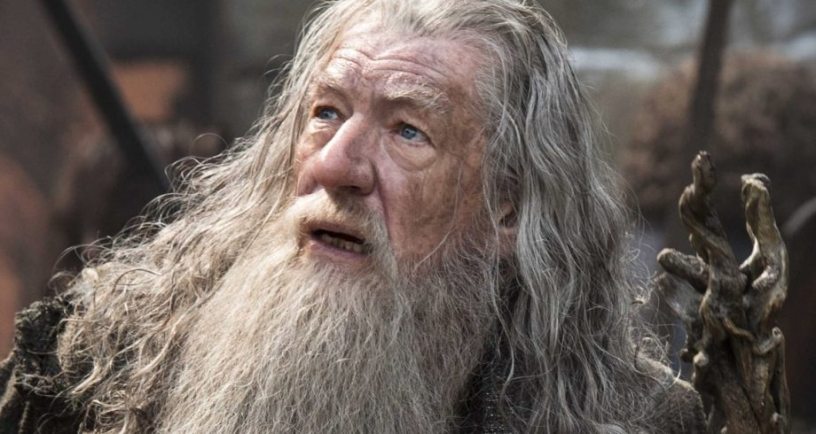
Who was Gandalf ‘really’! Was he the Maia Olórin as most widely held, or was he another?
J. R. R. Tolkien’s late son Christopher did a fantastic job publishing The Silmarillion, Unfinished Tales, The Histories of Middle-earth and in protecting his father’s vision. However, Christopher himself would have agreed that The Silmarillion does not perfectly match what it would have been had his father completed it.
Following the reading of the published Silmarillion, I always thought Gandalf was the Maia known as Olórin. However, The Silmarillion not having been published by his father, Christopher might have made a mistake. After reading the elder Tolkien’s post-Lord of the Rings writings on the First Ages, his essay on “The Istari,” and Unfinished Tales, Tolkien may have given some indications Gandalf was actually Manwë; and Gandalf’s power justified the position as well.
In “The Istari,” we find the wizards were forbidden to rule over men and elves and could not display their full majesty. So they came in the form of old men. It seems from the context Tolkien is referencing, the wizards’ restrictions on displaying their majesty mirrored the same constraints placed on the Valar in the Elder Days. Further we have this,
“They [Valar] sent members of their own high order but clad in bodies as of men.”
(“The Istari” in Unfinished Tales of Númenor and Middle-earth [New York: Ballantine Books, 1988]).
The passage quoted above, written by J. R. R. Tolkien and read straightforwardly, indicates the Valar sent their own “high order” to Middle-earth, here speaking of at least some of the wizards. It could perhaps be understood as being ‘Maiar in the same order as Valar,’ but we might be reading into the text and stretching its plain meaning.
Even Christopher understood it this way too. He noticed this as being “a mistake” his father had made, indicating Gandalf to be a Vala. Yet this “mistake” came from later writings (post LOTR), and Christopher’s only counter to it—his “proof” it was a mistake—was his own version of the published Silmarillion. But should this override what his father wrote?
So Eru gave a specific “prohibition” to the Valar; they were not to reveal their full majesty to his children. This was the same condition given to the wizards. Another text found in “The Istari” described Galadriel as a Manwë-type figure in Middle-earth as he directed events as Manwë did in Valinor. It goes on to say, “Manwë, however, even after the downfall of Númenor…was still not a mere observer. It is clearly from Valinor that [wizards] came…among them Gandalf, who proved to be the director and coordinator both of attack and defense.”
The text thus compared Gandalf’s actions as a director and mover of events to Manwë’s in Valinor, as with Galadriel. It also said Manwë was not simply an observer but acted and did not just sit on his throne in Valinor. After making the connection between Gandalf and Manwë, Tolkien went on to write the following:
Who was “Gandalf”? It is said that in later days… it was believed by many of the “faithful” that Gandalf was the last appearance of Manwë himself…I do not (of course) know the truth of the matter, and if I did, it would be a mistake to be more explicit than Gandalf was.
(“The Istari” in Unfinished Tales of Númenor and Middle-earth[New York: Ballantine Books, 1988])
Tolkien did not outright say Gandalf was Manwë, nor did he deny it. However, Gandalf shared traits with Manwë—such as a love for the elves, a desire for wildlife to be free, the use of great wisdom to control events but not by force, and a love and closeness to the eagles. But Gandalf did not seem consistent with the personality of Olórin, who learned pity and patience from Nienna. Gandalf the Grey was known to be quick-tempered, and even more so was Gandalf the White. This new Gandalf was “more grumpy than the old one.” And out of the five wizards who came Cirdan perceived in Gandalf “the greatest spirit and the wisest,” possibly indicating he was not simply another Maia. The argument Gandalf is a Maia comes from his identification as Olórin. However, even here, it does not prove he is, as Tolkien wrote,
That Gandalf said that his name “in the west” had been Olórin was, according to this belief, the adoption of an Incognito, a mere by name.” (“The Istari” in Unfinished
Tales of Númenor and Middle-earth [New York: Ballantine Books, 1988])
Further support is given for this view in the LOTR chapter “The White Rider.” Gandalf, recently returned to Middle-earth as Gandalf the White, meets Aragorn, Gimli, and Legolas, who are slow to recognize him but eventually do. We read: “Gandalf, the old man repeated as if recalling from old memory a long disused word. Yes, that was the name. I was Gandalf.” It seemed now on his return it took him some memory jogging to recall his incognito name Gandalf. “I was Gandalf,” he said. “You may still call me Gandalf.”
Another indicator Gandalf was Manwë is the Maiar were servants of the Valar, yet Gandalf said he was a servant of the secret fire. The secret fire, Tolkien said, was a symbol of the Holy Spirit, and in Catholic theology, the Holy Spirit is God. Thus, in Middle-earth, the secret fire is Eru’s spirit given as a gift to help accomplish his will. We read in Ainulindalë, “Ilúvatar shall give…the secret fire.” Eru initially gave it to the Valar during creation, and are not the Valar, most especially Manwë, servants of Eru? We read Gandalf “was the enemy of Sauron, opposing the fire that devours and wastes with the Fire that kindles.” This seems an apparent reference to the secret fire (holy spirit) of Eru.
In addition, had Gandalf been a Maia, he would have been sent back to Middle-earth by the Valar since he would be below them in the hierarchy. Yet if he were Manwë, the other Valar would have no authority over their own king. The only higher authority was Eru; thus, it makes perfect sense Eru, not the Valar, is the one who sent Gandalf back to Middle-earth, as Tolkien informed us.
When Pippin considered Gandalf and Denethor, he compared their wisdom and age. The hobbit believed Denethor was the more wizard seeming of the two. Pip knew Gandalf was called a wizard, but “he had not thought of Gandalf as one of them [a wizard].” What was Gandalf? the hobbit thought.” Pippin seemed to sense Gandalf was not like the other wizards; something he did not understand made him different. What if Gandalf was indeed Manwë?
A rapidly jotted, often illegible, brief, hasty sketch written by Tolkien was found by Chrstopher where Manwë asked Olórin to go to Middle-earth to resist Sauron. This section, as Christopher pointed out, seemed to contradict other writings by Tolkien including of the rings of power. As Unfinished Tales tells us, Olórin was afraid of Sauron. It could be when Olórin refused to go because of his fear, Manwë stepped in for him. Like Eru, Manwë and the Valar did not operate by force, and thus Manwë would not compel a frightened Olórin against his will. But because Manwë wished not to reveal who he was, he used the incognito name of Olórin, his original desired servant.
There is another possibility. Gandalf the White was Manwë, coming after Gandalf the Grey (Olórin) was killed. Manwë would know about events in Middle-earth but not all the particulars of Gandalf the Grey’s doing. This would fit in with the chapter “The White Rider” and Gandalf the White’s responses to Gimli, Aragorn, and Legolas, needing to call to memory things Gandalf the Grey would have known.
There is also a decided difference in Gandalf the White compared to Gandalf the Grey in power and attitude. Gandalf the White had far greater authority by comparison. Gandalf the White said to Saruman, “I am not Gandalf the Grey, whom you betrayed. I am Gandalf the White, who has returned from death.” When Pippin asked Merry if Gandalf had changed, Merry responded, “Oh yes, he is!…he has grown or something…he has changed.” He seemed a different person from the original Gandalf. Gwaihir the Windlord also noticed a difference; Gandalf’s weight as he carried him. In the past, he was a burden [to carry], but now Gwaihir thought him “light as a swan’s feather.”
In this scenario, Manwë, king of the Valar, sent the five wizards to Middle-earth, but as Tolkien said, “The ‘wizards,’ as such, had failed,” and since they were the best Maiar Valinor had to offer, Manwë himself stepped in as Gandalf the White to help ensure the downfall of Sauron.
From the evidence, it is possible either Gandalf the Grey was Manwë from the start, or Manwë stepped in when Olórin had failed (or did not want to be sent back a second time) as Gandalf the White, completing the task himself. Desiring to keep his identity concealed and not wanting to dishonor his servant Olórin, Manwë kept Olórin’s incognito name of Gandalf.
 Fellowship & Fairydust