
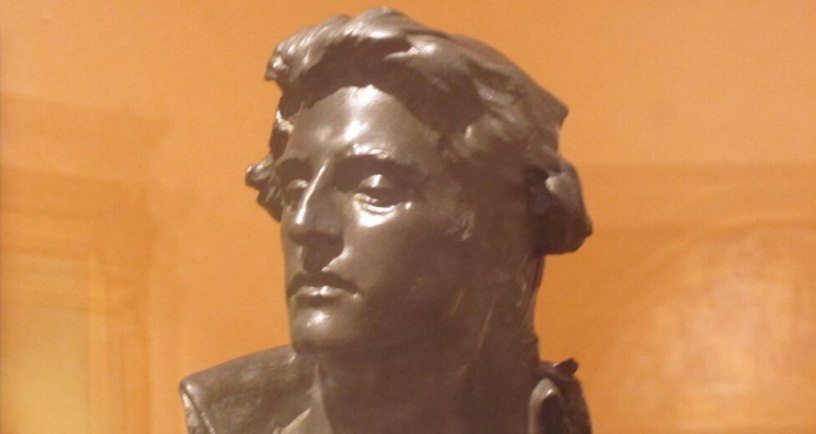
BY SAMANTHA WILCOXSON
“My only regret is that I have but one life to give for my country.”
This quote or a variation of it, attributed to Nathan Hale, is likely the first thing most people think of when they hear the name of this American patriot. It is often the only thing people think of when I mention the name of Nathan Hale. During my research of the American Revolution, I occasionally encountered Hale’s name or brief references to his tragic story, and I decided that a young man who had sacrificed his life for our liberties deserved for us to remember more about him.
Nathan was born 6 June 1755, a middle child in a family with a dozen children. His closest brother, Enoch, with whom he attended Yale, was nineteen months his elder. They were born into a time ripe for revolution and were only children when James Otis insisted that colonists not accept taxation without representation. The life of a farming family in Coventry, Connecticut was unremarkable, and we would not remember Nathan’s name today had he remained at home, tilling the land of his father.
However, Nathan and Enoch did not settle for a future in farming, and they left together for Yale in 1769 at ages fourteen and fifteen. Their ages seem precocious to modern readers, but college attendance began earlier in the eighteenth century. The Hale boys would have already learned their Virgil and Cicero from their local tutor, Reverend Huntington. They could read the New Testament in Greek and discuss classics rarely read by students twice their age today. The brothers were roommates and so close that friends nicknamed them Primus and Secundus. Together, they joined the Linonian Society, a club that discussed and debated philosophy, mathematics, religion, and current events. Perhaps they discussed the Boston Massacre when it occurred and tried to discern whether it had been a riot or a firing line as they compared varied reports. During the Hale brothers’ tenure, the Society started their own library, having found the offerings of the university wanting.
The years Nathan was at Yale were tempestuous politically, with calls for revolution growing in volume and popularity. These boys, who were becoming young men, were tasked with determining their own future and that of their country. Just as we do today, they had to discern between opposing points of view and determine truth from contradictory news reports. Friends were made who would later join the war effort alongside Nathan. Benjamin Tallmadge, who later became a spymaster for General Washington, was one of Nathan’s closest friends.
Though they were erudite students, undergraduates of every era have managed to get into some trouble. Account books for Yale, where Nathan and Enoch were listed as Hale and Hale 2, note an extra billing for windows that were broken one evening. Tallmadge and both Hales were disciplined for their actions but otherwise appear to have been excellent students.
When they graduated in 1773, Nathan had secured a teaching position, and Enoch planned to return to Coventry to study privately for his ministerial license. At their commencement, Nathan participated in a debate on the education of women. A transcript for this event does not survive, but Nathan demonstrated his support of women’s education by offering courses for females once he was in charge of his own school. Shortly after Yale’s class of 1773 went their separate ways, news of the Tea Act arrived on America’s shore, starting a chain of events that would lead to war. The young men undoubtedly talked of freedom and liberty without realizing what it would cost. Soon, they faced decisions with no straightforward answers.
In the meantime, Nathan took on his employment as a schoolmaster. His first position at a schoolhouse in Haddam Landing must not have suited him, because Nathan quickly applied for employment in New London, where he moved in March 1774. Once settled in New London, Nathan opened the schoolhouse doors at 5am for girls to come to classes for two hours before the boys arrived for the day at seven. Nathan enjoyed the work, writing to one friend, ‘I love my employment. I find many friends among strangers, have time for scientific study.’ He set a challenging curriculum for his students but also had fun with challenges such as jumping in and out of hogshead barrels.
We can only imagine where Nathan’s life would have taken him if shots had not been fired at Lexington and Concord in April 1775. He did not plan to remain a schoolmaster forever but might have chosen to study law or go into business. His path was determined, like thousands of other young men, by the circumstances in which he lived. Nathan became an officer in the New London artillery company and marched to Cambridge, Massachusetts in September 1775.
He was quickly disillusioned by the realities of war. In October, Nathan wrote to a friend, ‘I once wanted to come here to see something extraordinary – my curiosity is satisfied. I have now no more desire for seeing things here, than for seeing what is in New London, no, nor half so much neither. Not that I am discontented – so far from it, that in the present situation of things I would not except a furlough were it offered me. I would only observe that we often flatter ourselves with great happiness could we see such & such things; but when we actually come to the sight of them, our solid satisfaction is really no more than when we only had them in expectation.’ Nathan’s surviving letters and army diary reveal the truth that military life is often boredom, cold, illness, and hunger with random spurts of violent danger.
Nathan participated in a successful raid of a British supply sloop, but most of his time was not the glorious experience he might have envisioned. Perhaps his need to feel that he had performed notable service caused him to volunteer for action for which he was ill-suited. Friends and fellow officers attempted to deter Nathan’s espionage mission for a variety of reasons. The work of a spy was considered dishonorable and beneath men with his credentials. At least one pointed out the seriousness of the consequences if caught and low probability of success. Another said, ‘His nature was too frank and open to deceit and disguise, and he was incapable of acting a part equally foreign to his feelings and habits.’ To these friends, Nathan replied, ‘I am fully sensible of the consequences of discovery and capture, but for a year I have been attached to the army, and have not rendered any material service, while receiving a compensation, for which I make no return. I am not influenced by the expectation of promotion or pecuniary reward, I wish to be useful, and every kind of service, necessary to the public good, becomes honorable by being necessary.’
The mission was as short-lived as his friends feared. Nathan was on Long Island only a few days before he was captured by Major Robert Rogers. Nathan was carrying his notes, written in Latin, and confessed his mission. Did he hold hopes of a prisoner exchange or other mercy? If so, he quickly learned that none would come. Without a trial, Nathan was led to his execution.
This is the moment that most Americans remember of quintessential patriot Nathan Hale. He had possibly studied Joseph Addison’s Cato at Yale and perhaps discussed it at a Linonian Society meeting. The play includes the line, ‘How beautiful is death, when earn’d by virtue! Who would not be that youth? What pity is it, that we can die but once to serve our country.’ Did Nathan paraphrase this as he contemplated his few moments left on earth? The Essex Journal ascribed another Cato paraphrase to Nathan, reporting that he said, ‘If I had ten thousand lives, I would lay them all down.’ British Lieutenant Frederick Mackenzie, who witnessed the hanging, wrote that Hale ‘behaved with great composure and resolution, saying he thought it the duty of every good officer to obey any orders given him by his Commander-in-Chief and desired the spectators to be at all times prepared to meet death in whatever shape it might appear.’ Whatever Nathan said in his last moments, he was only twenty-one years old when he uttered those final words.
A testimonial written years after Nathan’s death honors the young man he was and the promising life that ended in tragedy. ‘No species of deception had any lurking place in his frank, open, meek and pious mind; his soul disdained disguise, however imperious circumstances of personal safety might demand a resort to duplicity & ambiguity. On the whole, I then thought him one of the most perfect human characters recorded in history or exemplified in any age or nation.’ It is this man, and many other nameless men like him, we should remember and thank for the nation we live in today.
 Fellowship & Fairydust