
BY ISABELLA SUMMITT
The film only covers Tolkien’s pre-professor days. The Inklings and his friendship with C. S. Lewis came later in his life. The film is told through flashbacks of Tolkien’s as he wanders, feverish and delirious, through the trenches in WWI. He is on a quest to find out what has become of his old college friend. He is accompanied on his journey by a sergeant named Sam who is the only one taking care of him in his fever.
I’m disappointed that his faith isn’t brought up that much. Colm Meaney, famous from Star Trek: Deep Space 9, plays the priest that is Tolkien’s guardian after his mother’s death. But we never see young John Ronald praying or going to mass, and a crucifix is only shown once in his hallucinations. He actually has an argument about how he doesn’t want to be a priest and live celibate. If they had gone more into his faith, they could have made it more of a romance with Edith, his true love. He was Catholic, she was Protestant and he felt like Hercules trying to keep up the relationship through impossible odds. But I suppose they chose to do that because the Beren/Luthien romance that Tolkien based on his own life is not as widely known to audiences as the movies are.
The film instead focuses on his friendship with his schoolmates. The dialogue keeps bringing up how he and his friends don’t really fit in because being an author, a poet, a musician or a painter is not respected as a profession. The four of them really reminded me of the four hobbits in the books with Tolkien picturing himself as being like Frodo. Tolkien is depicted as an oddball even among his aesthete peers. He has the obligatory text and drawings pinned to the walls that apparently filmmakers think creative people do. He often speaks in his own made up languages. I do like how the flow of inspiration for him starts with a made up word and continues from there.
Trees and the meaning of words are recurring themes. He grows up with trees, and on his date with Edith he comes up with an early idea of the two trees that light the creation of Arda in the Silmarillion. She challenges him to find the meaning and story behind his made up words. He has a professional discussion with the philology professor played by Derek Jacobi about the meaning of the names of trees. From what I know of Tolkien’s writing process, he came up with Elvish and the names of characters first and then wrote the story around them.
I like how the film highlights parallels between the things John Ronald experiences and the things his fans will recognize from his written works. I don’t know what kind of agreement the filmmakers had with New Line, but they make scenes look sort of reminiscent of the vistas in the Lord of the Rings. If you know his works there is a lot you can recognize. The idyllic countryside where he plays with his siblings looks like the Shire with its trees and rolling green hills. When he first arrives in Birmingham the smoke stacks and factories look like the pits of Isengard. When he is wandering among the submerged corpses I am strongly reminded of the Dead Marshes. A dragon is seen in the gunsmoke that is revealed to be a German flamethrower. There isn’t any war propaganda, but it is as though the personification of the war itself is Sauron and the Balrogs.
The story covers many of the ancient mythologies that influenced his works, such as Chaucer and Wagner. The rallying cry of him and his three friends is Helheim, the land of the unworthy dead in Norse mythology and where none of them want to end up. It is chilling that two out of his three friends all die at the battle of the Somme. I love how he takes Edith to a production of Das Rheingold which features a magical but deathly golden ring. None of the words or terms featured in his books ever come up except for Middle earth and at the ending. This movie is more about the experience that inspired much of the events in his genre setting books. It’s about his fellowship with his friends and the words he says to his children near the end reinforce that.
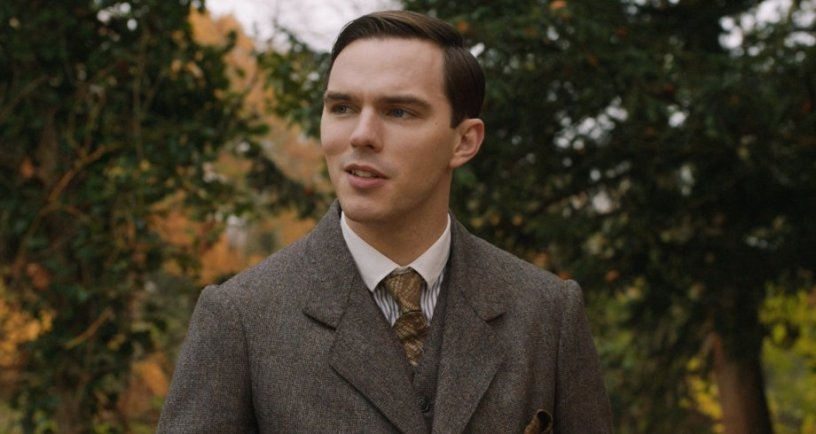
I don’t know if it’s implied that one of his three school buddies had a gay crush on him. I like to think it’s just the male idea of fellowship, but since the boy is a poet and this is a British production, I’m not sure. He gets back from the war and there is a huge time jump, in between which he has married Edith, had a few children and became a professor at Oxford. The few fan service bits here are well chosen. I love seeing Nicholas Hoult posing with the pipe, and the ending of the film in which he actually writes the first lines of ‘The Hobbit’.
 Fellowship & Fairydust