
~by Thomas J. McIntyre
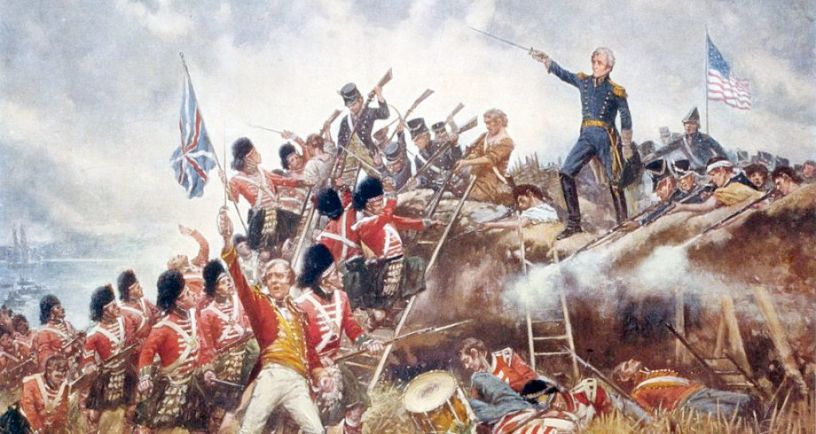
In his book A History of the Catholic Church in the American South 1513-1900, James M. Woods relates the story of the Ursuline nuns who gathered on the night before the Battle of New Orleans to pray for American victory over the invading British force.
On Saturday evening, January 7, 1815, at the chapel of the Ursuline convent in the Vieux Carré (French Quarter) section of New Orleans, Ursuline sisters, other interested women and some elderly men prayed all night before the Blessed Sacrament and a statue of Our Lady of Prompt Succor for victory for American arms and protection of the city from the British invader…The next day being Sunday, the early Mass was celebrated by Abbé Louis William DuBourg, the apostolic administrator for the Diocese of Louisiana. Just as communion was being distributed, a man burst in the chapel with a shout of “Victory is ours!” What started as a Eucharist of petition was transformed in a service of thanksgiving as Abbé DuBourg intoned the Te Deum, a traditional Catholic hymn of gratitude to God.
This was hardly the only support showed by the Catholic establishment of New Orleans. Annabelle M. Melville writes,
“On that same day, the administrator apostolic of New Orleans composed a mandement for public prayers…The mandement which was read at both morning and evening services on Sunday, December 18, ordered that on Monday, Tuesday, and Wednesday public prayers would be offered in both the Catholic church and chapel of the city; the Blessed Sacrament would be exposed from the beginning of the first Mass until the ending of the last, at which the Miserere would be sung and Benediction given. In the evening, from four to five o’clock, the Blessed Sacrament would again be exposed while the Miserere and Litany of the Blessed Virgin were to be chanted.”
Public exposition and adoration of the Blessed Sacrament, which Catholics believe to be the Body of Christ, was the most powerful form of worship, outside of the Mass, that Catholics could offer. It demonstrates that the Catholics of New Orleans were clearly on the side of the American defenders.
The predominantly Catholic population of New Orleans had good reason to pray for American victory, aside from the normal fears felt by the citizens of any city under siege. Peter Gilmour writes, “In 1803, the Ursulines of New Orleans suddenly found themselves under United States rule as a result of the Louisiana Purchase. They were concerned their ministries might be curtailed by this new government. Their sisters had just experienced firsthand the confiscation of church property that followed the French Revolution.” The ideas of the American Revolution had helped to inspire the French Revolution; therefore the nuns had a reasonably valid concern. Melville points out, “French Ursulines had been there since 1727 and had already been subjects of both French and Spanish governments. Mother Theresa de St. Francis Xavier Farjon, their superior at the time of the United States takeover, experienced some uneasiness over the status of the nuns and their properties under the American flag.” Mother Farjon wrote to President Thomas Jefferson three months after the Purchase, asking him to ensure that the sisters would be allowed to maintain actual ownership of their property. “Jefferson responded to their petition on July 14, 1804, less than two months after the petition was penned…‘The principles of the Constitution and government of the United States are a sure guarantee that it will be preserved to you sacred and inviolate and that your institution will be permitted to govern itself according to its own voluntary rules.’” These sisters would very likely have not received such assurances from the British. Although anti-Catholic sentiments had softened somewhat in light of the anti-clerical excesses of the French Revolution, the British still regarded Catholics with unguarded suspicion. Parliament had only recently loosened judicial and legislative restrictions on the Catholic minority, with the Papists Act of 1798 and the Roman Catholic Relief Act of 1791. The concessions in these acts, particularly those in Quebec, were such that even a Catholic priest could, in good conscience, preach in favor of loyalty to the British Crown. “Sherbrooke’s Irish-born Catholic curé, John Baptist McMahon, was also a loose cannon to some extent. Having written a lengthy newspaper column advocating loyalty in November, he now reported a general state of alarm and asked for an exeat because he feared assassination in the event of an attack by the Patriots or local American sympathizers.” Despite these concessions, all chaplains in the British army approaching New Orleans were priests in the Church of England. Pastors of other faiths, including Catholicism, applied to minister to members of their confessions within the British Army, but all were denied. It remains entirely speculative whether a British conquest would have had any practical effect on the ability of the Catholics in Louisiana to freely practice their faith, but the concern undoubtedly weighed on the minds of Ursulines and many other Catholics, as they prayed for an American victory.
Jackson greatly appreciated the Catholic prayers and petitions for American victory. “Jackson was noticeably pleased by DuBourg’s action and ordered Adjutant General Thomas L. Butler, his aide-de-camp, to send a note of appreciation to the administrator apostolic.” On January 19, Jackson wrote to Abbé DuBourg. In his letter, Jackson requested that a public service of thanksgiving be celebrated upon the return of his troops to the city, in gratitude for the “signal interposition of heaven in giving success to our arms against the enemy.” DuBourg agreed and suggested that the service be held in Saint Louis Cathedral, a request to which Jackson acquiesced. Jackson entered New Orleans on January 23 and was honored with the triumph worthy of a liberating hero. The celebration culminated with a Mass of thanksgiving in Saint Louis Cathedral, offered by Abbé DuBourg himself, at which Jackson was seated in the front pew. Although some historians would argue that Jackson welcomed the adulation simply because the grandiose celebration appealed to an egotistical need for martial fame, Woods sees it differently.
“There was more to this event than a city giving thanks to God and the general for an unexpected victory. While raised by a pious Presbyterian mother, Andrew Jackson had not led a particularly devout life…That Jackson asked for some public display might seem striking but that fact that he approached the Catholic leader of Louisiana to hold this service might also have raised a few eyebrows. Yet the American general fully recognized that many, if not most, men in his army were Catholics, even if in name only; moreover, Jackson understood that most of the citizens of New Orleans were Catholics.”
There was certainly a practical aspect to Jackson’s participation in a Catholic service of thanksgiving, but it also demonstrates that Jackson was not uncomfortable with Catholic modes of worship. More than that, he clearly believed that Catholic prayer had been effective.
When the United States declared independence from Britain in 1776, Catholics only comprised about one percent of the population without any discernible increase in numbers by 1812. Nevertheless, Catholics were represented by significant numbers in the American forces, considering the Catholic percentage of the overall American population. Patrick McDonough, was a Jesuit educated Irish-American from Philadelphia who served as a lieutenant in the Second Artillery Battalion of the U.S. Army during the War of 1812. Lieutenant McDonogh was killed in action against the British on August 15, 1814 during the Siege of Fort Erie on the Niagara River. According to legend, the last act of the mortally wounded McDonogh was using the last of his strength to cast a lit match into the fort’s powder magazine. The resultant explosion killed a large number of the British attackers and caused the rest to retreat in panic. McDonough gives no indication of the motivations for his service in his letters to his parents. He could have simply desired to protect his adopted country from invasion by a foreign enemy. His Irish descent, however, suggests that hatred for the British, motivated largely by Britain’s protracted persecution of the predominantly Catholic Irish, may have played a factor as well.
A fellow Catholic Philadelphian of Lieutenant McDonogh was present in New Orleans during the battle. “Joseph O’ Conway from Philadelphia, whose sister Cecilia had been the first to join Mother Seton and whose brother Columbkille was among the first students at Mount Saint Mary’s in Emmetsburg, was a surgeon in the American Navy stationed in New Orleans that autumn.” There were possibly also some Catholics who served under Jackson at the Battle of New Orleans itself. Upon receiving news of the impending British invasion, Secretary of War James Monroe wrote a letter in which he assured Jackson that his force would be augmented by “2,500 from Kentucky.” These Kentuckians formed three regiments. Richard A. Edwards, in an article entitled “Catholic Pioneers in Kentucky,” writes that “Among the first settlers in Kentucky were a few Catholics.” The article lists the names of the most prominent leaders of the Catholic settlers. Dr. George Hart arrived in 1775, and within a decade twenty families had made the trek from the Catholic enclave of Maryland, including the family of Phillip Mattingly. The name Mattingly reappears in the next group of settlers, which included John Lancaster. Thomas Jenkins came with a third group, and yet another pioneer group, which settled Cartwright Creek in 1787, included Thomas Hill and Phillip Miles. Some of these earlier settlers, including Elias Rhodes, were sufficiently well placed to buy land and a final group of pioneers, including Nicholas Miles, arrived in 1792. These names are significant because the seven surnames appear in the roll of the three Kentuckian regiments which served under Jackson at the Battle of New Orleans. Samuel Jenkins, Henry Lancaster, and Bradford Rhodes served in the First Regiment, which was commanded by Lieutenant Colonel William Mitchusson. Joseph Mattingly, Edward Mattingly, William Hart, Alexander Miles and Francis Mills served under the command of Lieutenant Colonel Gabriel Slaughter in the Second Regiment. Another Mattingly, Bennett, served in Third Regiment, commanded by Lieutenant Colonel Presley Gray. All these men were privates, with the exception of Corporal George Hill who served in the First Regiment, and Captain Aaron Hart who led a company in the Third Regiment. If these men are in fact descendants of the earliest Catholics, then there was a sizable contingent of Catholics fighting with Jackson at New Orleans, in addition to the predominantly Catholic New Orleans natives among his troops. Cecil Mattingly, a direct descendant of the original Catholic settlers of Kentucky, confirmed that the Mattinglys who fought at the Battle of New Orleans were indeed Catholic. He states that every Mattingly from Kentucky was a Catholic until the turn of the twentieth century. With this being the case, it is plausible that the other Kentuckians who shared the names of the original Catholic settlers were likewise Catholic. George Hart was not only a doctor but one of the earliest Catholic settlers of Kentucky. He was sufficiently prosperous to be able to donate the land on which St. Joseph, the first Catholic church in Bardstown, was built in 1798. Thus, it is entirely plausible that a son, grandson or even nephew of Hart could obtain a commission as a Captain in the Kentucky militia.
 Fellowship & Fairydust