
BY G. CONNOR SALTER
Not much has been written about Russell Kirk (1918–1994) as a fiction writer. He wrote about two dozen ghost stories and three gothic thrillers: Old House of Fear, A Creature of the Twilight: His Memorials, and Lord of the Hollow Dark. All of these works are well worth reading today, but popular and critical attention has focused on Kirk’s political writing, especially his landmark 1954 work The Conservative Mind.
My own interest in Kirk’s fiction began after attending a 2022 Mythopoeic Society seminar by Camilo Peralta that later became his essay for Mythlore comparing Lord of the Hollow Dark to Charles Williams’ novel War in Heaven.[1] I’ve interviewed Peralta and done what I could to encourage scholarship on Kirk in various places, including writing an introduction to his life and encouraging Teodora Driscu to explore Kirk’s story “The Last God’s Dream.”[2] I hope to see more scholars explore Kirk as an understudied Catholic storyteller and as a contributor to the 1960s horror boom alongside more studied contemporaries like Shirley Jackson. In the meantime, I would like to take this Halloween season to talk a little about Kirk’s final novel.
Biographer Bradley J. Birzer argues that Lord of the Hollow Dark, published in 1979, is Kirk’s best novel. In part, that may be because it culminates two sides of Kirk’s output. His short stories are mostly gothic ghost stories, becoming increasingly theological as Kirk became interested in Catholicism, joining the church shortly before marrying Annette Courtemanche in 1964. While his first novel is a gothic tale set at an allegedly haunted Scottish isle, scholars such as Birzer, Peralta, and Paul Di Filippo note that Old House of Fear does not feature much genuine supernatural content, even though its antagonist (a Soviet spymaster controlling the isle) believes he has supernatural powers.[3] A Creature of the Twilight goes further into espionage thriller territory as it introduces Kirk’s recurring character, spymaster Manfred Arcane. Arcane works in an African country experiencing a coup and finds he is the only person competent (and unbribable) enough to keep chaos at bay.
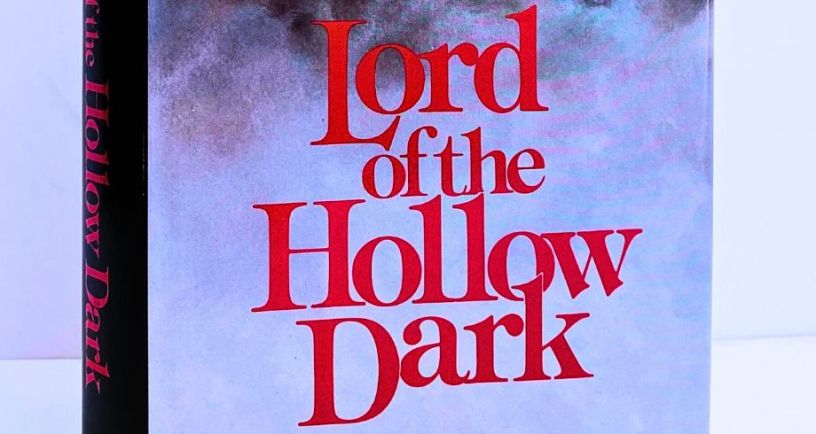
Lord of the Hollow Dark offers more references to Arcane’s espionage past, but is the one Kirk novel that definitely affirms the supernatural’s existence. As I’ve discussed in a piece for the Philosophical Rambler, the story involves Arcane visiting a Scottish castle whose owner spent decades under house arrest after something unspeakable happened at a séance.[4] Arcane arrives shortly after a cult has rented the castle for a ceremony, bringing an unwed mother and her infant son along as “participants.” Curiouser and curiouser things happen as the tale weaves Kirk’s interest in ghosts, T.S. Eliot’s poetry, medieval history, and Catholicism. By the book’s end, it becomes clear that Kirk was also familiar with Eliot’s friend Charles Williams, a member of the Inklings and eclectic spiritual thinker. In fact, Kirk praises Williams, C.S. Lewis, and George MacDonald as masters of genre fiction in both versions of his landmark essay “A Cautionary Note on the Ghostly Tale.”
Peralta’s study on Kirk and two Mythlore essays offer plenty of material on how much Lord of the Hollow Dark resembles Williams’ supernatural thrillers. I cannot add anything substantial to his analysis here, and my own work on Kirk and Williams would make it difficult to say anything new without committing self-plagiarism.[5] Instead, I would like to offer some ideas on how the novel compares with C.S. Lewis’s novel That Hideous Strength (often called “a Charles Williams novel by Lewis”).
Like That Hideous Strength, Kirk’s novel may best be understood as a supernatural thriller deconstructing the usual formula. In both stories, a spiritual leader (Lewis’ Elwin Ransom, Kirk’s Arcane) brings together a group of spiritually-minded people seeking God’s will. The holy community is contrasted with an infernal community (the Orwellian organization NICE in Lewis’ story, the Satan-worshipping cult in Kirk’s story). Both holy communities assume that they must use conventional force to stop their diabolical enemies, but their leaders affirm that something higher is required. Divine forces are planning evil’s defeat in ways that may not make sense at first, but the heroes will help goodness win the day. In the process, the heroes may feel more like witnesses to God’s grace than God’s defenders.
While Kirk reportedly hoped Lord of the Hollow Dark would ride the wave of interest that made Old House of Fear a bestseller, his final novel sold poorly. In hindsight, part of the problem may have been that Kirk grounds Arcane in an espionage past (the recent coup in Africa, adventures that led him to discover the cult), making the book an homage to espionage fiction that doesn’t grasp how much the genre had changed. A year after Kirk published Old House of Fear, Ian Fleming’s James Bond novels skyrocketed in popularity thanks to a Life profile in which John F. Kennedy promoted From Russia with Love. The Anglo-American spy became flashier (the food, the cars, the women) but more cynical (the smoking, the drinking, the ruminations on which mission will be the last). Arcane’s regular allusions to past adventures suggest a man playing with death, more rascal than cynic. In a world where spy stories had become more ridiculous but the spies were more self-serious than ever, Arcane seemed old-fashioned rather than retro.
More than that, Kirk was following in the footsteps of authors who favored complexity that doesn’t translate to easy sales. That Hideous Strength (like the various Williams thrillers that inspired it) has aged well, but did not achieve great sales at the time. Even today, Lewis’ readers either love or hate the novel without much middle ground, because the way Lewis breaks thriller conventions leaves little middle ground in its depiction of heroism. Most commercially viable supernatural thrillers play a sleight-of-hand trick where God wins the day, but does so through heroes who are so physically active that they are more like God’s subcontractors than his emissaries. As written by writers like Dennis Wheatley (reportedly Britain’s second bestselling author during the twentieth century), the heroes dash from location to location to deposit crucifixes in vampire coffins or hurl incense into cult meetings, their vigor standing out more than their piety.[6] God may officially be the one who wins the day (or a freak “accident” attributed to providence, like the flood that kills the Satan worshippers in Wheatley’s The Haunting of Tobey Jugg), but God seems barely present for most of the narrative. Novels about fighting the devil often pay homage to God but are more about fisticuffs than faith.
Kirk and Lewis, playing on the formula of Williams’ novels, eschew such slick tricks. Instead, they offer heroes who truly have to consider what it means to serve God and not use “worldly methods” to fight the devil. God’s grace accomplishes what humans can never achieve, and serving him looks far more like being a servant than being a crusader. Little surprise then that Kirkus Reviews felt Lord of the Hollow Dark was a good book but not commercial enough for horror fans.[7] It is the sort of work that readers will love or hate without much middle ground, because it refuses to let readers believe that they can act like pagan heroes while fighting God’s good fight. A person can willingly be God’s instrument by following his will, or try to be God by striving for good things without God’s guidance.
The horror fiction landscape has changed considerably since 1979, as has the way many Americans interpret the label “conservatism” that Kirk helped to popularize. Curiously, the question that Kirk and Lewis pose about Christian heroism feels more relevant today than ever. Instead of equating heroism with toughness, they ask readers to consider whether fighting the good fight looks a lot more like servanthood than bravura. They tell rip-roaring adventure stories while challenging readers to consider what adventurers are really for: to serve God or attempt to take his place?
Works Cited
Birzer, Bradley J. Russell Kirk: American Conservative. University Press of Kentucky, 2015.
Di Filippo, Paul. “Kirk, Russell (Amos).” In St. James Guide to Horror, Ghost, and Gothic Writers, edited by David Springle, St. James Press, 1998, 327–329.
Dennis Wheatley: A Letter to Posterity. BBC4, October 31, 2006. https://www.radio4all.net/program/57223.
Driscu, Teodora. “The Redeemed Villain in C. S. Lewis’s The Last Battle and Russell Kirk’s ‘The Last God’s Dream.’” Fellowship & Fairydust, September 10, 2025, https://fellowdustmag.com/2025/09/12/the-redeemed-villain-in-c-s-lewiss-the-last-battle-and-russell-kirks-the-last-gods-dream/.
Peralta, Camilo. “Delight in Horror: Charles Williams and Russell Kirk on the Supernatural.” Mythopoeic Society Online Midwinter Seminar, The Inklings and Horror: Fantasy’s Dark Corners, February 5, 2022, https://dc.swosu.edu/oms/oms1/schedule/8/.
—. “‘Delight in Horror’: Charles Williams and Russell Kirk on Hell and the Supernatural.” Mythlore vol. 41, no. 1 (Fall/Winter 2022): 127–142. https://dc.swosu.edu/mythlore/vol41/iss1/8/.
—. “Timeless Moments: Russell Kirk, Charles Williams, and Stephen King on the Afterlife.” Mythlore vol. 42, no. 2 (Spring/Summer 2024): 103–120. https://dc.swosu.edu/mythlore/vol42/iss2/7/.
—. The Wizard of Mecosta: Russell Kirk, Gothic Fiction, and the Moral Imagination. Vernon Press, 2024.
Salter, G. Connor Salter. “Charles Williams & Dennis Wheatley: Writing of Dark Forces Part 1.” The Oddest Inkling, March 21, 2022, https://theoddestinkling.wordpress.com/2022/03/21/charles-williams-dennis-wheatley-writing-of-dark-forces-part-1/.
—. “Charles Williams & Dennis Wheatley: Writing of Dark Forces Part 2.” The Oddest Inkling, March 30, 2022, https://theoddestinkling.wordpress.com/2022/03/30/charles-williams-dennis-wheatley-writing-of-dark-forces-part-2/.
—. “Charles Williams and Russell Kirk: Coinherence in Lord of the Hollow Dark.” The Oddest Inkling, February 28, 2024, https://theoddestinkling.wordpress.com/2024/02/28/charles-williams-and-russell-kirk-coinherence-in-lord-of-the-hollow-dark/.
—. “The Inklings, Russell Kirk, and Myth: Interview with Camilo Peralta.” Fellowship & Fairydust, original publication date March 20, 2024, https://fellowdustmag.com/2023/12/30/inklings-russell-kirk-interview-with-camilo-peralta/.
—. “Russell Kirk and the Inklings: Suggestions for Future Research,” CSL: The Bulletin of the New York C.S. Lewis Society Vol. 55, No. 3, Whole No. 521, May/June 2024, pp. 6-10.
—. “Tellers of Dark Fairy Tales: Common Themes in the Works of C.S. Lewis and Terence Fisher,” Mythlore vol. 41, no. 1 (Fall/Winter 2022): 143–168. https://dc.swosu.edu/mythlore/vol41/iss1/9/.
—. “Truth Over Relevance in the Last Novel of Russell Kirk.” The Philosophical Rambler, January 4, 2025, https://philosophicalrambler.com/truth-over-relevance-in-the-last-novel-of-russell-kirk/.
—. “The Wizard of Mecosta: Russell Kirk, Gothic Fiction, and the Moral Imagination, by Camilo Peralta.” Mythlore vol. 43, no. 1 (Fall/Winter 2024): 271–274. https://dc.swosu.edu/mythlore/vol43/iss1/19/.
—. “What Can Christian Conservatives Learn Today from Russell Kirk?” Christianity.com, April 16, 2024, https://www.christianity.com/wiki/people/russell-kirk-conservative-mind-christian-thinker.html.
“Lord of the Hollow Dark.” Kirkus Reviews, October 1, 1979, https://www.kirkusreviews.com/book-reviews/a/russell-kirk-5/lord-of-the-hollow-dark/.
Footnotes
[1] See Paul Di Filippo, “Kirk, Russell (Amos),” Peralta, “Delight in Horror: Charles Williams and Russell Kirk on the Supernatural,” and Peralta, “‘Delight in Horror’: Charles Williams and Russell Kirk on Hell and the Supernatural” in Works Cited. For my essay in the same Mythlore issue drawing on Kirk’s nonfiction, see Salter, “Tellers of Dark Fairy Tales: Common Themes in the Works of C.S. Lewis and Terence Fisher” in Works Cited.
[2] See Driscu, “The Redeemed Villain in C.S. Lewis’s The Last Battle and Russell Kirk’s ‘The Last God’s Dream’” and Salter, “The Inklings, Russell Kirk, and Myth: Interview with Camilo Peralta,” “Russell Kirk and the Inklings: Suggestions for Future Research,” and “What Can Christian Conservatives Learn Today from Russell Kirk?” in Works Cited.
[3] See Peralta, The Wizard of Mecosta, and Birzer, Russell Kirk: American Conservative in Works Cited. For review of Wizard, see Salter, “The Wizard of Mecosta” in Works Cited.
[4] See Salter, “Truth Over Relevance in the Last Novel of Russell Kirk” in Works Cited.
[5] See Salter, “Charles Williams and Russell Kirk: Coinherence in Lord of the Hollow Dark” in Works Cited.
[6] For more on Wheatley’s influence, see Salter, “Charles Williams & Dennis Wheatley: Writing of Dark Forces Part 1,” and Salter, “Charles Williams & Dennis Wheatley: Writing of Dark Forces Part 2” in Works Cited. For Wheatley’s reported bestseller status, see Dennis Wheatley: A Letter to Posterity in Works Cited.
[7] See “Lord of the Hollow Dark” in Works Cited.
 Fellowship & Fairydust