
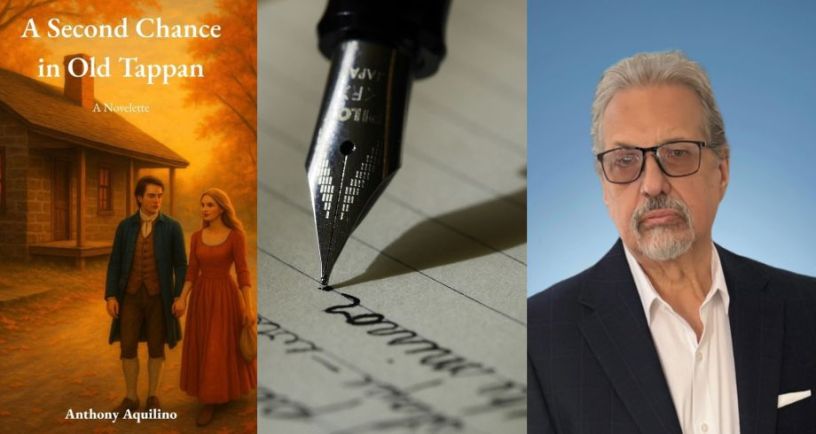
BY AVELLINA BALESTRI
Q: Tell us a little bit about yourself and your background.
A: I was born in Newark, N.J. I married my beautiful wife, who I met in high school. I left the city when I married, but my heart is still there. There is an old saying, “You can take the boy out of the city, but you can’t take the city out of the boy.” This is certainly true in my case. The lessons I learned on those rough city streets of loyalty, friendship, and honor are with me still and find their way into my writing.
I have also learned even more valuable lessons from my son, who is a young man of different abilities. He has no expressive language, but has taught me much about unconditional love, trust, commitment, and responsibility. I also have a beautiful married daughter and a grandson with another on the way.
I graduated from New Jersey University and received a master’s degree from William Paterson University. I have taught at both my alma mater and Monmouth University.
I am privileged to be the Director of The Rugby School at Woodfield, a private school for special education students in Wall, NJ.
Q: What inspired you to start writing?
A: Writing was an outgrowth of my involvement in theater. I started as an actor and began writing and producing my own plays. I found my written plays were well received and moved on to writing screenplays. One of which was sold to an academy award winning actor and a story for hire with Village Roadshow Pictures.
Q: How did you first become interested in history, and what are your favorite time periods?
A: My love for history started in the fifth grade. I had a teacher, Mr. Buckley, who made American history come alive. I remember pouring over the names of the signers of the Declaration of Independence and my elation when I came across the name of Robert Pacca. Being the son of Italian American parents, I was filled with a burst of pride. I showed the signature to Mr. Buckley, and he confirmed that Pacca was indeed Italian. Although his ethnicity is somewhat disputed today, Pacca instantly became one of my heroes.
To this day Early American history remains a passion. I have spent considerable time researching and teaching Early American Black History also. I have produced three drama’s detailing the Christian foundation of our nation as well as the role faith played in the lives of black luminaries from the time of the American Revolution through the antebellum period, the civil war era, and into the modern age.
I also love Biblical History as well as the history of the Christian church.
Q: What started you on the journey of historical fiction writing in particular?
A: I wrote several full-length and one-act plays with historical themes and carried some of these themes into short stories and my current novelette. It is obvious that whatever is inside of you will come out in your writing. Your hope your fears, your faith or lack thereof. History is a wellspring within me and it naturally found a tributary into many of the pages I have penned.
Q: What is your favorite and least favorite parts of working within the historical fiction genre?
A: My favorite aspect of historical fiction is the joy of creating an entertaining story within the framework of accurate historical content, weaving a tapestry of truth laced with fantasy. My least favorite aspect is when I am tempted to depart from historical truth for the sake of the storyline. Many writers, especially those writing for films, choose to alter historical events; however, I have decided not to do so, maintaining this as a self-imposed guideline.
Q: How have you chosen which historical characters to feature in your books, and what made their stories resonate with you.
A: I am attracted to complex characters who have overcome or succumbed to inner struggles. For instance, what is compelling to me about Benedict Arnold is the irony that he was a heroic figure on a sure path to glory who ended up walking the road of betrayal and shame instead. Pride and vanity, as well as his choice to marry a bride with loyalist ties and sympathies, in my opinion, became his undoing.
Q: What is your process in terms of research and bringing historical characters to life?
A: Once I have settled on a storyline, I seek multiple sources in an attempt to verify truth. I intentionally look for any information that appears to be contradictory in an effort to reconcile events and motivations of a historical figure until I am satisfied that I have attained an accurate and sustainable understanding of the person and events.
Q: What is your method to integrate fictional characters and situations into the historical setting?
A: I attempt to introduce major fictional characters that observe and may even participate in historical events without changing the factual history as it occurred and I understand it to be. For instance, if I am writing about Washington crossing the Delaware I am telling the story from the perspective of a fictional character who is in the boat with him.
Q: If you had the chance to convey a message to your favorite historical characters, what would it be?
A: I would send a word of thank-you to the Framers for their wisdom in establishing our nation as a constitutional republic rather than a democracy. I would also raise my hand to salute the brave patriots of the Revolution who fought and died so we could live free.
Q: What do you find more enjoyable/difficult: First drafts or editing/rewriting?
A: The most enjoyable aspect of writing is when I get that first story idea. For days on end I carry a note pad to jot down ideas and themes. I sleep with that pad at my bedside and carry it in the car as thoughts come and go until I am ready to write a first draft. Once the first draft is written I love tweaking and adjusting, writing and re-writing until it is completed to satisfaction.
Q: How have you gone about publicizing yourself and your works?
A: I really haven’t. Until now, I have relied on word of mouth. Most of my sales have come from Facebook posts I have done. I was invited to the Old 76’ House in Tappan for a book signing event where much of my story takes place. We are planning another signing there in the spring.
Q: What are some of the main themes/morals you would like readers to take away from your works?
A: I believe that America is in moral decline due to a cultural abandonment of the Judeo-Christian ethic and morality that was prominent at the founding of our nation. Capitalism and American history, while admittedly flawed in many respects, still provides the best framework for liberty, justice and equality for all. In my novelette, A Second Chance in Old Tappan, this is most evident in the discussions between Major John Andre and Fredrick while they are imprisoned and Andre is awaiting trial and execution. Added to this sequence is an emphasis on Andre’s belief in God and hope of salvation, an aspect of his character that is often overlooked by those chronicling his life and exploits.
In my upcoming novel, The Seaside Heist, I harken back to the values I learned on the mean streets of Newark: respect, honor, loyalty, and a tenacious spirit that refuses to quit regardless of circumstance.
Q: What is some advice you would give aspiring authors, especially those focusing on the historical fiction genre?
A: I would encourage authors of historical fiction not to lose sight of the fact that literature, while it should be educational and informative, is essentially entertainment. Because I started in theater, this fact was vital to the success of any production. In my opinion, the writer of historical fiction should respect the need, if not the right, for their readers to be entertained.
Plug your socials published works, and current projects.
A Second Chance in Old Tappan is a historical fiction time-travel novelette and has been well received. One reviewer said: “Enchanting! Simply put, scrumptious. Truly delightful, the writer quickly and skillfully draws the reader into Colonial America. The characters are intriguing, and the storyline makes this book a joy to read.” The book is available on Amazon in paperback ($5.99) and Kindle ($1.99, or currently available for free on Kindle Unlimited).
My most recent project is The Seaside Heist. I have completed a screenplay version and a full-length novel that is currently being edited and should be released by the first of the year. This work is a departure from historical fiction. I wrote it as a testament to the inner-city culture I grew up in. A culture that is rapidly fading as time goes on. As soon as this book is released, I will return to my Tappan story and turn it into a screenplay, also.
You can reach me on Facebook and Instagram @anthonyack13.
 Fellowship & Fairydust