
Tell us a little bit about yourself and your background.
I am a nurse by profession who has had a passion for the American Revolution since childhood. I am the mother of five and grandmother of one. As a child I was introduced to the American Revolution through Esther Forbes’ acclaimed novel Johnny Tremain.
What first inspired you to start writing?
I was a pioneer homeschooling mom. When my older children were high-school age, we began a project to research the lives of forgotten heroes of the American Revolution, starting with Dr. Joseph Warren. My daughter was so excited by what we were discovering, she encouraged me to “make him come alive—write a book!” And so, I did.
How did you first become interested in history, and what are your favorite time periods?
Again, it was through Esther Forbes’ Johnny Tremain (in which Dr. Joseph Warren was a historical character). The period of 1765–1783 in America.
What started you on the journey of historical fiction writing in particular?
Already answered.
What are your favorite and least favorite parts of working within the historical fiction genre?
I don’t write historical fiction. I write biographical fiction. The difference is that in biographical fiction all the characters were historical figures. It is the researched story of a historical individual and those individuals who were part of his/her life. The events occurred. The fictional aspect is the dialogue to carry this story and present these individuals as flesh and blood with the same joys, sadness, fear, love, and animosity we all experience. Sometimes it’s difficult to present certain facts about a character that portray a negative aspect… but none of them were perfect!
How have you chosen which historical characters to feature in your books, and what made their stories resonate with you?
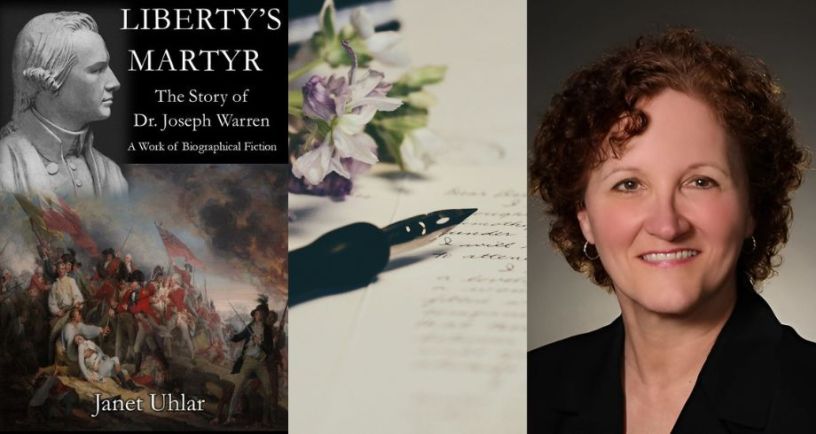
Dr. Joseph Warren’s story resonated with me as a nine-year-old. At the time I was introduced to him in Johnny Tremain, I was recovering from surgery. Esther Forbses’ presentation of this kind, courageous doctor was a comfort to me at the time. My further research on him revealed a truly extraordinary hero. Liberty’s Martyr: The Story of Dr. Joseph Warren was first published in 2001 with a second run in 2009. It was updated and released in July 2025. The subject of my second book, Freedom’s Cost: The Story of General Nathanael Greene was introduced when researching Warren. Joseph Warren died at the Battle of Bunker Hill, very early in the American Revolution. It was as though Warren passed his torch to Greene. And Greene’s story was as fascinating as Warren’s. These men were selfless, courageous, intelligent, and of high moral character.
What is your process in terms of research and bringing historical characters to life?
The research never ends (that’s why I have updated both books!) The story is already laid out for me in the historical documentation through their own writings, historical events they took part in, remarks of family, friends, enemies—all of this together reveals them as living, breathing individuals.
What is your method to integrate fictional characters and situations into the historical setting?
All main characters are true people. If a fictional character is brought into the story, it is brief and without identity. They fill in minor roles (someone delivering a message for instance).
If you had the chance to convey a message to your favorite historical characters, what would it be?
I would thank them for the enormous sacrifices they made to establish this nation as a Republic and for pouring out their blood for the millions yet unborn who would bask in the freedom’s they died to obtain. I would apologize for the lack of knowledge and ingratitude in so many Americans today who take these Liberties for granted.
What do you find more enjoyable/difficult: First drafts or editing/rewriting?
Editing and rewrite!
How have you gone about publicizing yourself and your works?
Ads in magazines, contact with organizations interested in the American Revolution, presentations wherever I can, social media, interviews.
What are some of the main themes/morals you would like readers to take away from your works?
The main themes and morals I would like the reader to take away from my books would be that of duty to God, family, and fellow citizens. I would like readers to be inspired and want to emulate the extreme courage of these individuals as well as their selflessness. These men and women weren’t fighting for riches, power, land, or resource—they were willing to sacrifice all they had and were for the ideal of Liberty. For this, the rich stood alongside the poor—each depending on the other for their very lives.
What is some advice you would give aspiring authors, especially those focusing on the historical fiction genre?
For aspiring authors looking at biographical-fiction I would say your work is needed! The outline of any work of biographical-fiction is already there and you have the honor, the responsibility of bringing to life the story of the individual you are drawn to. I would suggest to aspiring authors to find a subject you are drawn to; a subject you cannot get out of your mind—for you will become one with them forever! Don’t simply accept what has already been written. Visit sites. Imagine the moments. Dig, dig, and dig some more for information—and be accurate and responsible with the information you make part of the story. Historians often give a cold, stark overview of historical figures (even in biographies). Do more than that—spend enough time “with” your subject to know them, to feel them, to understand them. Only then can you truly bring them to life. Only then can you say they are your friend and you have the extreme privilege to introduce them to the world.
Author Website and Contact Details:
https://www.facebook.com/JanetUhlarAmericanRevolutionBooks/
More Details About the Author:
Author, lecturer, and screenplay writer, Janet’s genre is rarely seen. She is the author of two books on forgotten heroes of the American Revolution: Liberty’s Martyr: The Story of Dr. Joseph Warren, and Freedom’s Cost: The Story of General Nathanael Greene.
Her passion for the American Revolution is evident. In her writing, Janet presents biography through the living, breathing form of biographical fiction. The characters lived; the events occurred. The dialogue carries the stories. Janet firmly believes that when the private lives and unique personalities of historical figures are presented, and the dynamics between these characters brought out, history becomes much more than cold black print on a stark white page. History takes on a life of its own, with true flesh and blood individuals whose acts of courage, indifference, or cowardice shaped the world we live in today.
Janet supervised the Joseph Warren Sash Project, served on the Board of Trustees of the Nathanael Greene Homestead, and on the advisory board of the Mulberry Grove Foundation (General Greene’s home in Savannah, GA). Her lecture on General Nathanael Greene which presented his omitted vital role by historians in saving the Continental Army at Valley Forge inspired the Nathanael Greene Monument Project by the General Society of the Sons of the Revolution of which she took an active part. A full-size bronze statue of General Greene was created and placed at Valley Forge in 2015 (up until that time, Greene was not even mentioned on the website of the Valley Forge National Historical Park!) Janet has boldly refuted defamatory narrative created by contemporary authors, with no substantial documentation, against Joseph Warren and Nathanael Greene’s wife Catherine. She continues to research overlooked documentation on Warren and Greene and is involved in various historical preservation activities as well as in the research and challenge of falsehoods in historical narrative.
Janet has spoken extensively and to a wide variety of audiences, including:
– State of Rhode Island’s dedication of the General Nathanael Greene Bridge
– Bunker Hill National Historical Park
– Adams National Historical Park
– USS Constitution
– Rhode Island Historical Association
– Rhode Island Genealogical Society
– Triennial of the General Society of the Sons of the Revolution (SAR)
– Congress of the National Society of New England Women
– Northeast Regional Conference on the Social Studies
– Friends of Valley Forge
– Descendants of Washington’s Army at Valley Forge
– Commemoration of the Crossing of the Dan River
– SAR New England celebration of the Victory at Yorktown
– Battle of Rhode Island Association
– Rev250 Boston
– SAR, DAR (Daughters of the American Revolution), SR (Sons of the Revolution) chapters throughout the country
– Masonic lodges throughout the country
– Academy of Lifelong Learning, Cape Cod Community College (six-week course on the American Revolution)
 Fellowship & Fairydust