
BY G. CONNOR SALTER
From the 1960s through the late 1970s, Rankin/Bass Productions produced many memorable animated Christmas specials. A good handful of them, particularly Rudolph the Red-Nosed Reindeer and Frosty the Snowman, have become iconic.
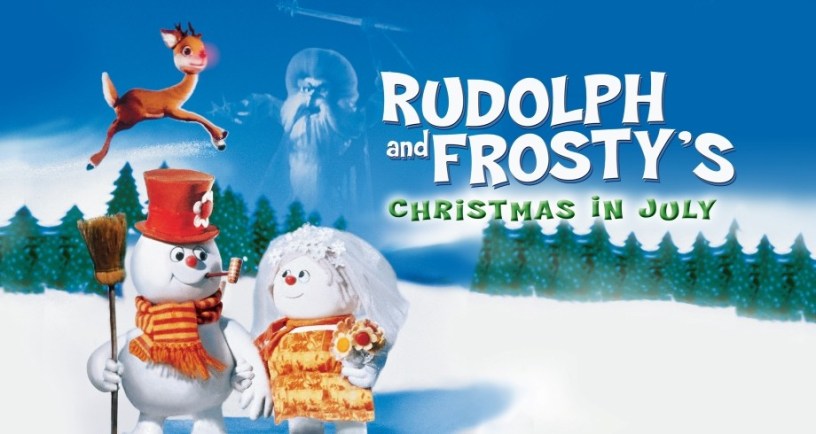
Rudolph and Frosty’s Christmas in July, one of the last in the series (released in 1979), is rarely rated highly. It has some great moments, especially near the end when Rudolph and Frosty consider how much they will sacrifice to help each other. But most fans and reviewers find it flawed, especially in a post-Marvel world where audiences expect more from a sequel connecting disparate stories together. Vox contributor Emily St. James calls it a contrived “Avengers-style team-up.” Given how the character designs shifted a little with each special (Frosty looks a bit different from Frosty the Snowman to Frosty’s Winterland, then very different as a stop-motion character in Rudolph and Frosty’s Christmas in July), perhaps any attempt to treat the specials as a connected storyline would fail. These stories about Frosty, Rudolph, Santa, and others were more Twilight Zone than Avengers, more episodes in an anthology than entries in a cinematic universe.
However, the more interesting flaw with Rudolph and Frosty’s Christmas in July is not how much it feels like a badly-planned Marvel movie, but how much it resembles a badly-planned Tolkien movie.
The plot, for those unfamiliar, is a sequel to at least four (perhaps five) of the earlier Christmas specials, going all the way back to the first one (Rudolph the Red-Nosed Reindeer). In those adventures, Frosty (and later his wife Crystal) ended up at the North Pole, home of Santa Claus (Santa’s backstory covered in Santa Claus is Comin’ to Town, expanded in A Year Without a Santa Claus). Rudolph becomes Santa’s rescuer not just on “one foggy Christmas eve,” but also on one New Year’s Eve when he rescues a runaway magic child connected to Father Time (Rudolph’s Shiny New Year). Sometime later, Rudolph befriends the Snowman family (now including Frosty’s offspring, Milly and Chilly). When Milton, an ice cream seller who keeps his stock at the North Pole, needs help raising money for a bankrupt circus, Rudolph and Frosty offer to make a celebrity appearance at the Fourth of July festivities. Little do they know the snow sorcerer Winterbolt has been conniving to steal Rudolph’s magic so he can control the North Pole.
How Winterbolt knows about Rudolph and Frosty despite never appearing in the earlier stories is established via flashbacks to the earlier specials (narrated by Winterbolt’s assistant, the Genie of the Ice Scepter) and some efficient retconning. Rudolph’s magic nose turns out to be magic derived from Lady Boreal, a harbinger of good magic who kept Winterbolt at bay. Winterbolt turns out to be the one behind that famous winter storm that required Rudolph’s nose to lead Santa’s sleigh. As one might expect, this attempt to stitch everything together offers fun scenes, but they do not add up to a great story. Especially since the main adventure (Rudolph and Frosty traveling to a circus for the Fourth of July) follows a cliché seen in other 1970s entertainment like The Star Wars Holiday Special: when in doubt, send everyone on a contrived road trip/holiday vacation.
The plot clichés may be rooted in the writer working outside his comfort zone. Romeo Muller (the writer behind nearly all of the Rankin/Bass projects) excelled at short specials. He did write a few entertaining 60-minute stories (for example, Mad Monster Party?), but even his best long-form projects feel like sketch collections more than features. His adaptation of The Hobbit (1977) may be the exception, and it happens to be the one case where he had a children’s novel to work from, not just a holiday jingle or children’s storybook.
However, many of these script issues may have worked out if not for a larger problem: Rudolph and Frosty’s Christmas in July feels stretched between two kinds of fantasy stories its makers were exploring.
As mentioned earlier (and as I’ve discussed in more detail for The Tolkienist), Rankin/Bass adapted two Tolkien stories: The Hobbit in 1977 and The Return of the King in 1980. These projects shared the same creative team (Rankin and Bass directing and producing, Muller writing the script) as the Christmas specials. Which may explain why Rudolph and Frosty’s Christmas in July, released in between those projects, feels a bit like Peter Jackson’s Hobbit trilogy: an attempt to bridge two Tolkien stories whose tones do not mesh well.
The circus plotline and the material based on previous specials feels quaint, like a children’s storybook or fable. The characters (Rudolph, Frosty, Milton, and his circus pals) have concerns and even tragic backstories. But their concerns (fitting in, not being melted by the July sun, making money to save a friend’s job) are intimate and met without much drama. No grand agendas, no incredible powers, no countries at stake. These are hobbit-sized stakes and hobbit-sized personalities.
Winterbolt is something else. Earlier Rankin/Bass specials had evil magicians—the petty Professor Hinkle in Frosty the Snowman, the more frightening Winter Warlock in Santa Claus is Comin’ to Town. The Winter Warlock had great power, ruling a mountain covered with moving trees that did his bidding. But even controlling a mountain is limited power. The Winter Warlock is not essentially much stronger than the Grimm Brothers’ witch controlling a forest. In contrast, Winterbolt once controlled the Arctic Circle. It takes the spirit of the Northern Lights itself to stop him. The character design (flowing robes and a staff) underlines the idea that Winterbolt is a Saruman-class sorcerer. Given that he has recently awoke from hibernation, he may even evoke Sauron, a dark figure returning after everyone thought him defeated. His helpers are equally serious: the Genie of the Ice Scepter evokes the majestic talking mirror in Snow White and the Seven Dwarves, and Winterbolt’s snow dragons have a gravitas that Smaug never had in the Rankin/Bass Hobbit. Then there are Galadriel overtones as Lady Boreal passes her magic along to Rudolph with a solemn warning (think Frodo receiving a vial of starlight), and Gandalf overtones as Santa strives to arrive on time to rescue his friends from evil. It all feels Tolkienesque, specifically Tolkien when he was writing The Lord of the Rings or The Silmarillion. A tale of grand scale.
These epic moments are interesting in isolation. In fact, they are more compelling than anything in the Rankin/Bass Return of the King (best known today for a scene involving singing orcs with synthesizer music). Still, the epic never quite gels with the small-scale, much like how the best moments in Jackson’s Hobbit trilogy (the dinner at Bilbo’s home, the dwarf squabbles) never mesh with his attempts to produce an epic tone (elves and prophecies).
There is one moment where the two tones do come together. Near the end, Winterbolt’s schemes lead Rudolph to choose between losing his powers and letting Frosty melt. When Rudolph has resigned to his fate, Frosty decides to give up his own magic instead. As usually happens in a fairytale, evil does get vanquished in the end, and everyone lives happily ever after. Even then, the image of Rudolph letting his magic recede and Frosty taking off his hat lingers long after the rest of the film is forgotten. As Thorin Oakenshield says to Bilbo in The Hobbit, it just might be those who value their friends over wealth or power who make the world better.
 Fellowship & Fairydust