
BY MICHAEL ANTHONY RE
It was 1935, the autumn light long and hesitant. People passed on the street below, carrying on with lives that seemed both urgent and trivial. Somewhere warm, somewhere summer, somewhere long ago.
He allowed himself a rare indulgence and thought of her. Not a clear thought, not a fully formed memory, but a flicker, a trace, like the afterimage of a flame. He had not spoken her name aloud in years. No one else could see her in the way he did.
He had called her his “imaginary friend,” because the world had felt too fragile to contain her, and it seemed as if she had been conjured only for him.
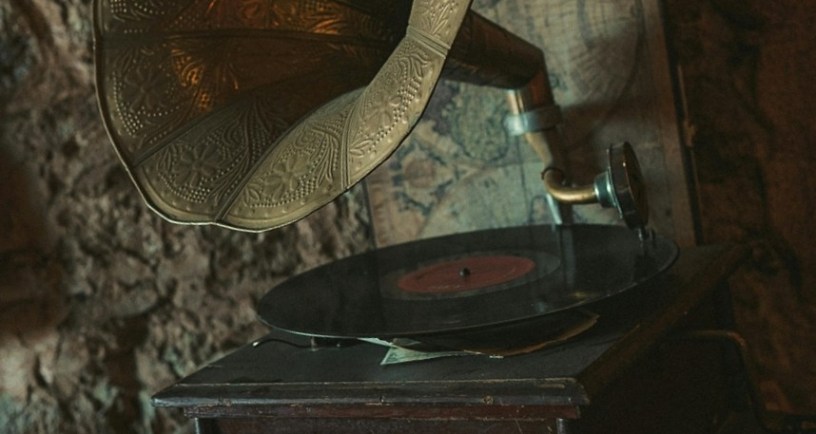
The phonograph spun slowly in the corner, a brass horn catching the slanting light like a small sun. The record was worn, the grooves scratched and uneven, but the music didn’t care. “Come Josephine in My Flying Machine…”
The voice drifted through the room like a half-forgotten dream, playful, lilting, and just a little sad. Dust floated in the sunlight, turning the air golden and heavy.
He lay on the bed, one arm bent over his chest, hat tipped low over his face. His boots old, cracked, faithful, still clung to his feet. The air was warm, but his room was not; it held that stillness that only comes to places where time has stopped bothering to move.
The tune skipped, caught, then righted itself again. He stirred, not fully awake, but enough for memory to nudge. Somewhere, beneath the crackle of the record, a laugh once lived, her laugh, bright and teasing like clinking glass.
He blinked open his eyes. Afternoon light spilled across the floor in stripes, touching the corners of the room like a visitor who didn’t plan to stay.
With a sigh, he swung his legs over the side of the bed, the wooden floor groaning beneath his weight. His joints protested, but gently as if remembering, too. The song still played.
He shuffled toward the bathroom. The tap screeched when he turned it, then gave way to a thin trickle of water. He splashed his face, the chill biting his skin awake.
When he lifted his head, the mirror that met him cracked down one side, the glass clouded with age. His reflection stared back, softened by years and cigarette smoke. Behind him, faint in the background, the light caught on a small round disc resting on the dresser, his old discs from the great war. The war that faced the unknown.
He looked at it for a long moment.
Then the record skipped again, whispering, “Up she goes, up she goes…”
He closed his eyes. And somewhere inside him faint as the dust in the light, a memory stirred, stretching awake.
He dressed slowly, the way a man does when there’s no reason to hurry. A clean shirt from the chair, sleeves rolled up, a jacket from the hook by the door. He straightened it once, then gave up, smiling faintly at his own fussing.
The record had long gone silent, its last note stretched thin into dust. He wound the phonograph down, pocketed a few coins, and stepped out into the light.
The city greeted him with its usual indifferent hum of streetcars grinding along their tracks, laughter echoing from an open café door, the faint perfume of roasted peanuts from a vendor on the corner. The wind carried it all in little waves, brushing his face, stirring something tender beneath his ribs.
He hadn’t planned on the movies; it was just where his feet decided to take him. The matinee marquee blinked lazily ahead, promising The Big Parade. He smiled at that.
The thought of her came the way sunlight filters through leaves scattered, trembling, impossible to hold still.
Auburn hair, always catching fire when the sun touched it. A freckle near her lip she pretended to hate. The way she’d walk a half-step ahead, turning back to grin at him as though she were afraid he might disappear if she didn’t keep looking.
He remembered her voice, too low, unhurried, like she was always half-laughing at the world. She had that way about her, to make every ordinary thing feel like the start of something.
He crossed the street slowly, the smell of rain still clinging to the air. The theater doors loomed open, and from inside, he could already hear the muffled thrum of the piano, the hush of people settling into their seats.
He paused there for a moment, on the threshold, caught between now and then, before stepping into the dim light and letting the past begin again.
Inside, the theater was half full. The air smelled of velvet, smoke, and old perfume, the kind of smell that clings to time itself.
He found a seat near the back, the place he always chose. It gave him room to breathe. The house lights dimmed, the pianist straightened his sheet music, and the reel began to spin.
Flicker, flicker, light trembled across the screen. Soldiers marched, lovers waved goodbye, banners fluttered in silence. The pianist’s hands moved gently, the melody soft and wistful.
“Over There.”
Not the bright, brass version they’d played in the streets back then, but a slower one, tender, almost apologetic.
On the screen, a girl turned toward a young soldier and the words flashed up: You’d look gorgeous in an officer’s uniform. He didn’t mean to react. But something in him flinched, a small, sharp breath, the kind you take when an old wound stirs. He saw her then, not the girl on the screen but the one from years before. Standing in the gazebo, white wood gleaming under the streetlight. Her hand had brushed his sleeve, her eyes shining with pure love. You’d look so handsome in a uniform, she’d whispered, and he’d believed her. The screen flickered again, soldiers marching, flags waving, but his eyes were somewhere else entirely. He blinked, and the tear came before he could hide it. It caught the light for a second, then fell, leaving no trace. He straightened his collar, trying to collect himself. The world had gone on without him, and all he could do now was sit quietly in the dark, watching the pieces of his life play out in black and white.
It was less of his mind wandering perhaps than his heart as Thomas closed his eyes and opened a picnic blanket next to a gazebo. It was spread across a meadow, the grass tickling their bare feet. He remembered the smell of wildflowers mingled with the faint sweetness of her hair. It was the feeling of being completely, irreversibly present with someone else that mattered. As if a world imagined just for him had been made. Leading up to this very moment Thomas looked deep into her eyes. He called her his imaginary friend because it was as if he imagined her, to laugh and to play and to love.
He said it softly, almost afraid the words would break the fragile moment. She smiled, and he felt her fingers curl around his with a light, reassuring warmth. It was not dramatic or sudden, just two hands meeting, holding, existing together. And somehow, it was everything.
A cool wet rain drop awakens Thomas. The streetlights cast halos in the misting air, puddles reflecting the glow like tiny mirrors scattered across the pavement. People moved past him in brief, bright flashes of laughter, umbrellas, the shuffle of shoes and he felt both entirely alone and strangely connected to it all.
He walked slowly, the weight of years in his bones, but lighter somehow than before. The melody from the phonograph hummed faintly in his mind, and with it, her laughter, soft, teasing, a reminder of something he could never hold, but would never lose.
At the corner, a street musician played a tinny version of an old marching tune. He paused, listening, and for a moment, the world seemed to tilt. He could almost see her dancing lightly on the sidewalk. He reached into his pocket and felt the cold disk of his dog tags against his palm. Not a weight to drag him down, but a small, steady reminder of who he had been, and the life that had moved him forward despite it all. He felt the edge of a coin, then pulled it out.
Across the street a bar sign flickered, half the bulbs burnt out so it read more like a suggestion than an invitation. Just a dim window and the shadow of someone moving inside.
He opened up the door as if to be embarking on a new adventure. An adventure in a dingy, lower eastside portal into another world. The door shut behind him with a dull thud, cutting off the wind. The air inside was warmer, but only barely—thick with the smell of old beer soaked into wood and something fried hours ago. Tobacco smoke hung low, not fresh, just lingering, like it had nowhere else to go as if it had always been there.
He rested his pinched hat carefully on the counter, palms flat on either side of it, like he was steadying himself. The wood felt cool through his sleeves. He could see his faint reflection in the back mirror behind the bottles.
The bartender drifted over without hurry.
“What’ll it be?” he asked.
The place didn’t feel friendly, but it didn’t feel hostile either. It felt like a room built for men who had run out of places to stand.
The bartender saw his blank look and asked, “What were you…before all this?”
The man asked in return, “What was I?”
The bartender’s voice wasn’t cruel, just tired. “I’m sick of hearing about what men were. Everybody in here was something once. Banker. Contractor. Big-shot salesman.” He tapped the bar. “But this ain’t a museum.”
“I didn’t come in here to brag,” the man said quietly.
“I know,” the bartender replied. “You came in to remember.”
“I built something,” the man said. He swallowed and added, “Thought that counted.”
“And now?” the bartender asked flatly.
“Now I…” the man trailed off and took another drink. Choking back the emotions of his self-awareness.
The bartender leaned on the counter, studying him. “You ain’t the only one.” The bartender poured a short glass and slid it over. “So I’ll ask you the same thing I ask all of ’em.”
“What’re you gonna be now?”
The question hung there, heavier than the smoke.
He exhaled, a quiet, long breath that felt like a surrender — not to sorrow, but to memory, to love, to the world as it was now. The city pulsed around him, bright and fleeting, and he let himself smile.
Tonight, he thought, letting the wind carry the thought across the empty streets, he would let the dust settle, and the light shine through. And in that small, suspended moment, he carried her with him, laughing softly, somewhere between then and now.
The sound of life, dust, light, memory, and music spun around him, he ventured.
 Fellowship & Fairydust