
BY G. CONNOR SALTER
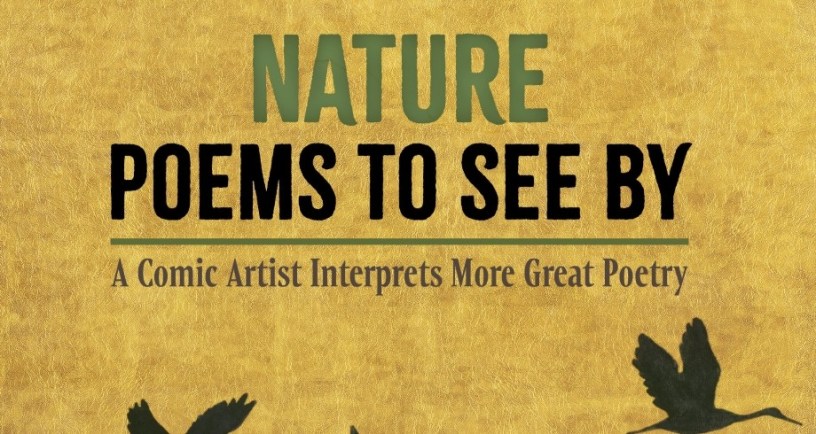
Nature Poems to See By: A Comic Artist Interprets More Great Poetry. Julian Peters. Plough Publishing House, March 24, 2026. Hardcover, 152 pages.
Plough Publishing House, a division of the Christian community the Bruderhof (founded by Anabaptist pastor Eberhard Arnold in the 1920s), might be best known for its quarterly magazine Plough. Or for its excellent reissues of Christian classics (Elizabeth Goudge’s biography of Francis of Assisi, Malcolm Muggeridge’s A Third Testament) and its compendiums of classic Christian writings by George MacDonald, Dorothy L. Sayers, and others.
Less well known are its occasional illustrated books and cartoon collections, always a cut above what readers expect. These works are usually inspirational, but never trite. For example, Joonas Sildre’s graphic novel Between Two Sounds, depicting musician Arvo Pärt’s journey to combine his Christianity with his music while facing Soviet persecution, works hard to make its melodramatic story about faith amid struggle into a compelling exploration of the subject’s talent as well as a Christians-versus-atheists story. Come Away Pelican, a reissue of a children’s board book by Don Freeman (author of the beloved Corduroy), is a simple but enchanting story that offers plenty of images the readers have seen before (summer vacation, children on the beach, making friends with animals) and weaves them into an engaging tale about bonding which is more than the sum of its parts.
Nature Poems to See By, a collection of illustrations by Julian Peters (sequel to his earlier Plough title Poems to See By: A Comic Artist Interprets Great Poetry), may seem at first like a more conventional book than past Plough titles. Peters offers six poems for each season, including many classics that appear in illustrated books marketed as inspirational literature, such as “God’s Grandeur” by Gerard Manley Hopkins, “I Wonder Lonely As a Cloud” by William Wordsworth or “Stopping by Woods on a Snowy Evening” by Robert Frost.
Regular customers at Christian bookstores have seen some of these elements—books with “nature” in the title, Victorian poems about faith, at least one Frost poem—elsewhere. Often books with pastel covers advertised during the holidays as great gifts for mothers. Fun books, but not always substantial books. Ones that (to paraphrase Karen Swallow Prior in The Evangelical Imagination) usually settle for being sentimental rather than beautiful.
Peters offers something beyond these cliches. His art style is rich and avoids idealizing his subjects. His illustrations are fun but not too cute. He often avoids cliches, such as when he illustrates Wordsworth’s “I Wander Lonely As a Cloud” in vivid blues and greens with a style almost evoking 1970s hippie art.
Peters’ 24 poems show an emphasis on hope, but not at the expense of good content. Yes, he offers some standard inspirational poems, but also many that readers won’t see in other collections, like “The Trees” by Philip Larkin and “Three Haikus About the Moon” by Matsuo Bashō, Masaoka Shiki and Ueda Chōshū. There are also poems that address finding darkness amid light, such as “Daybreak in Alabama” by Langston Hughes or “Truth” by Gwendolyn Books.
The combination of Peters’ well-crafted illustrations and his discerning range of poems produces a book that does more than encourage. As Prior observes, it is easy to offer writing that makes readers feel good for a moment, and a little sentimentality is not bad. But too much tends to do the same thing to the mind that junk food does to the stomach. Peters trusts his readers enough to offer something beautiful rather than cute.
A book that offers substance, and a book that will benefit from many re-readings.
 Fellowship & Fairydust