
BY MUHAMMAD NAFI AL-DIN SHARAB
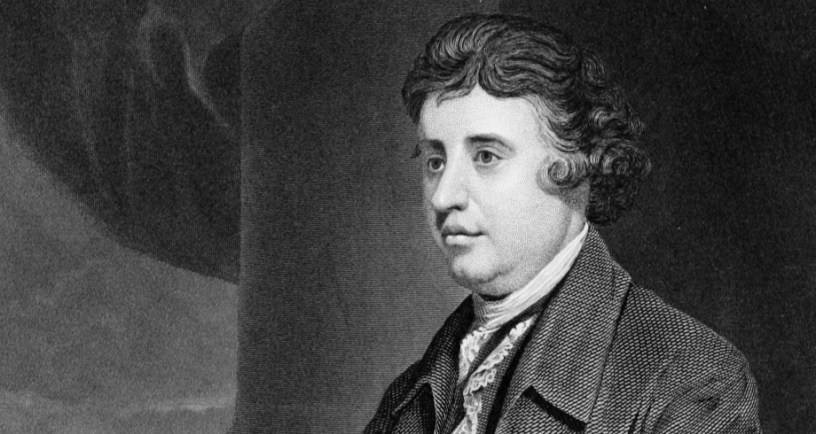
243 years ago, on the 1st of August 1782, Edmund Burke formally left the office of the Paymaster of the Forces, completing his first tenure. He had actually resigned earlier, on the 1st of July, due to the demise of the Marquess of Rockingham and his support for Charles James Fox instead of Lord Shelburne, the successor of Lord Rockingham. On July 1, 1782, the Father of Economics, Adam Smith, read that Burke had resigned as Paymaster General. He sent a quick note to his “dear friend,” saying, “I cannot avoid writing you a few lines to tell you how deeply I feel your affliction.” Smith told Burke that when he first heard of his resignation, “my first impulse was to run to your house,” but he had “restrained” himself for “fear of disturbing your sorrow.”
Edmund Burke was born on 12 January 1729 in Dublin, Ireland. People around the world remember him as the father of conservatism. Despite being sympathetic to the American Revolution, he became an outspoken critic of the French Revolution. The modern traditionalist conservative movement is based pretty much on his views. His book Reflections on the Revolution in France (1790) thus became very popular.
Burke was slow in forming opinions on the French Revolution. It was events in Autumn of 1789 where the French government confiscated the properties of church, made him think that how radical the revolution was. He decried the act, arguing that that the church’s role is “sacred” institution vital for moral and societal stability, not just a source of revenue. They also seized the estates of the aristocrats. arguing that property is a “sacred” right and its violation disrupts the “foundation of civil society.”
He criticised the absolute equality principle preached by the French, its disregard of natural differences in ability and social role of people was his prime concern. He considered families and local communities as “little platoons” since these are fundamental to social structure and the source to broader loyalty.
The French, sought to tear down all institutions and rebuild society on abstract ideals, an approach that bred violence, and tyranny. To us, these abstract ideals such as “liberty, equality and fraternity” might sound very appealing but Burke was right on some point since these were not practical since these policies were not used in governance historically. He ridicules the revolutionaries’ vision of a perfect society as a “monstrous fiction,” arguing that their pursuit of abstract perfection ignores the “fallible and feeble” nature of humanity.
The French revolutionaries rejected the motion of tradition and custom, this was appalled by Burke who argued that progress should build on the wisdom of past generations. He uses the metaphor of society as a “partnership” across generations, criticising the revolutionaries for breaking this contract by ignoring the “inheritances” of French history.
Burke was also a regionalist and opposed the centralisation of power, particularly by the Jacobins. He predicted that “despotic democracy” would emerge from the revolutionary assemblies. People realised it later in the Reign of Terror.
Burke viewed the American Revolution as a defence of established legal rights, unlike the French Revolution where tradition was radically broken. He saw the colonists’ demands as grounded in British constitutional principles. In Speech on Conciliation, he invoked Magna Carta and other charters to argue that the colonists’ demands for representation aligned with English legal traditions.
Burke opposed the unlimited sovereignty Westminster enjoyed by intervening on its colonial subjects. Burke challenged the notion of Parliament’s unlimited sovereignty over the colonies, arguing that legal authority must be tempered by justice and precedent. He believed that Parliament’s overreach, particularly in taxation, violated the legal boundaries of its authority. This reflected in his Speech on American Taxation, he criticised the Declaratory Act (1766), this act asserted Parliament’s absolute authority over the colonies, this was legally dubious because it ignored the practical and historical limits of governance, such as the need for consent. Again in Speech on Conciliation, Burke argued that legal governance required “mutual consent” and that Parliament’s failure to respect colonial legislatures violated the spirit of English law, since English law historically balanced central and local authority.
In the Indian subcontinent, he became famous for opposing then-Governor-General Warren Hastings. Burke had a keen interest in the Indian subcontinent. He concluded that the corruption of the government of India had to be resolved by removing patronage from the existing parties. His proposition was that India should be governed by independent commissioners in London. Unfortunately, his bill was defeated. This was the reason for his support to impeach Warren Hastings. He used to believe that Hastings was abusing his power and exploiting India for personal gain. Burke was baffled by the corruption and mismanagement in the British East India Company’s rule. He accused Hastings of oppressive policies, such as excessive taxation and mistreatment of Indian rulers and locals, which he argued violated justice and British principles. Burke’s moral stance was the reason to lead impeachment efforts against Hastings in Parliament, starting in 1786, to hold him accountable. It was less personal and more about Burke’s commitment to governing on an ethical manner.
Edmund Burke was respected by both his friends and opponents. The economist Adam Smith remarked that Burke was “the only man I ever knew who thinks on economic subjects exactly as I do, without any previous communications having passed between us.” William Hazlitt, a political opponent of Burke, regarded him as amongst his three favourite writers (the others being Junius and Rousseau) and made it “a test of the sense and candour of any one belonging to the opposite party, whether he allowed Burke to be a great man.”
Edmund Burke retired from the parliament in 20 June 1794, since he failed to convict Warren Hastings in a parliamentary impeachment. His only son Richard Burke was elected as the new MP of Malton, New Yorkshire to succeed senior Burke but unfortunately, he became ill and died. Edmund Burke’s last years were clouded by the demise of his son. This great man passed away on 9 July 1797.
Reference List
BBC, “Edmund Burke,” BBC History, https://www.bbc.co.uk/history/historic_figures/burke_edmund.shtml, accessed 1 October 2025.
Burke, Edmund, Reflections on the Revolution in France, ed. Conor Cruise O’Brien (London: Penguin Classics, 1986).
Burke, Edmund, The Writings and Speeches of Edmund Burke, Vol. III: Party, Parliament, and the American Crisis, 1774–1780, ed. Warren M. Elofson and John A. Woods (Oxford: Clarendon Press, 1996).
Lock, F.P., Burke’s Reflections on the Revolution in France (London: George Allen & Unwin, 1985).
Stewart, K., “The Professor and the Statesman: The Friendship of Adam Smith and Edmund Burke,” Adam Smith Works, 24 August 2020, https://www.adamsmithworks.org/speakings/the-professor-and-the-statesman-the-friendship-of-adam-smith-and-edmund-burke, accessed 25 September 2025.
West, E.G., Adam Smith (New York: Arlington House, 1969).
 Fellowship & Fairydust