
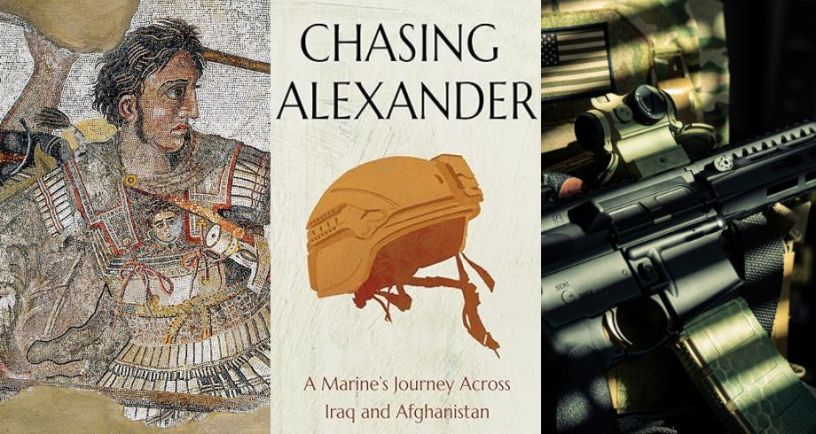
Title: Chasing Alexander: A Marine’s Journey Across Iraq and Afghanistan
Author: Christopher Martin
Publisher: Notional Books
Publication Date: September 28, 2021
ISBN: 9781737259817
Christopher Martin didn’t have any plans when he entered college. Then, while perusing the college library, he began reading the story of Alexander. Inspired by Alexander’s tales of conquest, he decided to enlist in the United States Marines. He describes the training period, joining his first team, and doing an unexpected tour in Afghanistan after his service in Iraq. Along the way, he considers what he’s learned about war from Alexander’s life and how to apply it to his own context.
In a Goodreads review about his book, Martin stated he wrote the book because “it seems like most recent military memoirs are only written by aspiring politicians or Medal of Honor winners. I wrote this book to show what the wars in Iraq and Afghanistan were like for regular Americans, without some kind of myth making agenda.” He makes an excellent point: military memoirs can become less about the warrior, more about promoting (or discrediting) the war itself.
Martin successfully gives an on-the-ground view of the Iraq and Afghanistan wars. He talks about his father being shocked that he was signing up for military service, but his father’s shock is more fear about his son seeing active duty in a recently started war than a comment about whether Iraq is a just war to get involved in. When Martin gets to Afghanistan, the closest he gets to a statement about the overall war is a discussion with a villager about how many problems the Taliban creates for the village compared to the problems that U.S. troops create. Beyond that, the book focuses on smaller conflicts—the subcultures that Marines build when living and working together, superiors poorly communicating and the consequences on the battlefield.
The recurring discussions about Alexander prove interesting. By connecting with Alexander, wanting to live what Alexander lived, it becomes part of that longstanding tradition of stories about men going to war to prove (perhaps find) themselves. It may be an inherent desire: Apocalypse Now screenwriter John Milius suggested that all young men want to prove themselves 0n the battlefield “if they are honest with themselves, whether it’s right or wrong or even sane, which is a debate that’s been going on since we left the caves.” Following in Alexander’s footsteps puts Martin as one of the many men who have looked at historic warriors, from Teddy Roosevelt to Napoleon, as inspirations for joining the military.
Mentioning Alexander as a model also proves interesting because there are times when Martin’s descriptions of his feelings suggest he is learning a pagan perspective on war. He describes feeling a thrill when he sees enemy forces fleeing, an angry, vengeful kind of feeling. This may be a common human feeling, but it’s arguably also a feeling that pre-Christian warriors like Alexander would encourage. Broadly speaking, the fact that Alexander was a pagan Greek general means that he belonged to a worldview that downplayed mercy for enemies. As C.S. Lewis put it in his essay “The Necessity of Chivalry,” the chivalric idea of being a fierce warrior and a kind man (at least to civilians) was a medieval, Christian idea. Certainly, we can debate how many medieval Christian soldiers lived out chivalric ideals, and how much Alexander embraced the ruthlessness he was expected to practice. Rachel Kausser’s recent book Alexander at the End of the World suggests that he was kinder in his last years than typically assumed, which led to his death. But if we’re talking about the ideals that different societies promoted, we can say that Martin’s lust for his enemies’ destruction fits far better with pagan warriors like Alexander than Christian warriors like Richard the Lionheart.
Ultimately, Martin doesn’t explore whether he’s becoming like Alexander (fond of carnage, unsure whether to become more ruthless) or what he gained by following Alexander’s footsteps. The book ends with him deciding not to sign on for more service once he’s met his obligations and can leave the Marines. In one memorable scene, Martin stops in the middle of running with his fellow Marines, reflecting on the fact he doesn’t feel the need to keep going, to keep proving himself. The shift implies he doesn’t feel the need to keep being like Alexander. Going to war becomes about proving himself, passing a male rite of passage, rather than the kind of lifelong warrior’s vision that motivated Alexander.
The shift raises some questions about how Martin feels about Alexander at the end of his experience. After feeling what Alexander felt many times, the thrill of knowing an enemy is being destroyed, how does he feel about war? After deciding he didn’t want to devote his life to war, what does he think motivated Alexander to keep going?
Martin never answers these questions, possibly because he doesn’t want to get into any “myth-making agenda.” Myth can mean propaganda, but it can also mean the stories we tell about life that speak to our inner desires. For mythologists like Joseph Campbell, the experience of being excited by stories about Alexander is the classic call to adventure—to the inner/outer journey of having new experiences and applying the freshly gained knowledge to our futures. If Martin had answered how he felt about Alexander at the end of his soldier’s journey, why going to war became a rite of passage more than a vocation, and what new knowledge he had gained that he would take home with him…. he would have to admit he hadn’t escaped myth. He’d taken the hero’s journey, an older kind of myth-making than the propaganda tales that politicians sculpt about recent history.
Martin’s desire to subvert a typical military memoir format, to offer lessons learned or embrace how mythic going to war can be, may leave Chasing Alexander a little unsatisfactory. However, it’s worth reading even without a great ending. His writing is excellent, pulling readers directly into each scene, never under- or overexplaining things. He offers some vivid battle scenes with minimal gore, but plenty of suspense. A fascinating look at one soldier’s journey.
Trigger Warnings: This book describes real-life events in a war zone from a first-person perspective, including several firefights. Readers with combat trauma should only read with caution. The hero has no sexual relations, but there are several scenes of other soldiers having crass discussions about their love lives.
 Fellowship & Fairydust