
BY LEAH FISHER
The question of man’s responsibility for man is one as old as sin. How much responsibility must we bear for the life and wellbeing of another person? This question takes form as early as Genesis 3, but it comes fully to light in Genesis 4 when, standing before God, Cain attempts to acquit himself of any responsibility for his brother’s welfare.
And the LORD said to Cain, “Where is your brother Abel?”
“I do not know!” he answered. “Am I my brother’s keeper?”
Genesis 4:9, Berean Standard Bible
When God answers Cain, He tells him to “Listen!” Why? Because, “Your brother’s blood cries out to Me [God] from the ground.” We are fortunate that God informs us in the Book of Hebrews that the blood of Jesus Christ “speaks a better word than the blood of Abel” (Heb. 12:24 BNB).
In line with this concept of blood crying out, Dietrich Bonhoeffer, who was a lover of the Psalms, spoke at different times of the idea that innocence itself cries out for justice. This was a belief which he expressed overtly in his book Ethics, when he spoke of the guilt of a church which “did not cry out” at a time when “the blood of the innocent was crying aloud to heaven.”[1] As a theologian, it is doubtless that Bonhoeffer remembered Abel when penning that remark, but it is probable that he remembered someone else, too: a lawyer who, like Cain, had sought to absolve himself of some portion of his earthly responsibility and asked the age-old question, “Who is my neighbor?”
Christ’s answer to the man was what is now known as the Parable of the Good Samaritan (Luke 10:25-37), a story which hardly leaves room for moral ambiguity and, also, affords us a great deal of insight into God’s view on the matter of man’s responsibility towards man, or, if you prefer, the people God puts in our path. As true as it is that the parable reflects the work of Christ, it is equally accurate to qualify it as speaking of the work of the Christian, since the Christian follows Christ and joins Him in His work. What’s more, we ought not to lose sight of the fact that Jesus tells this parable in answer to a question asking what it is to fulfill God’s command that man should love his neighbor. Therefore, the story is certainly directed in action towards us.
Surely, Christ is the ultimate case of loving one’s neighbor. He is the incarnation of love, the Glorious One who put on flesh and laid his glory aside, the Sinless One who became sin for our sake, the God who came because of love (1 John 4:8, Phil. 2:7, 2 Cor. 5:21, John 3:16). But then perhaps that is why He left us with His “new commandment”: that we should love one another as He has loved us (John 13:34). So, again, we are not relieved of our duty to our fellow man. To the contrary, the Christian is pressed into greater service by his Master.
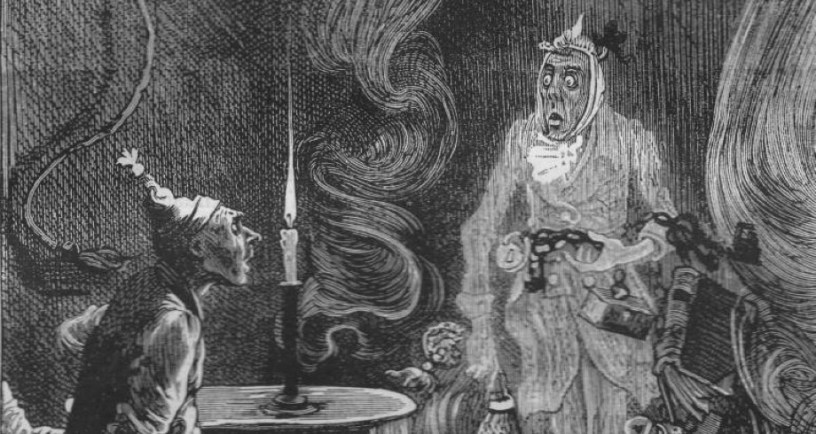
Now, with this in mind, I ask you to direct your thoughts to the ghost of Jacob Marley, through whom Dickens answered a question which was both yet to be asked and asked by so many before the time:
“Business!” cried the Ghost, wringing its hands again. “Mankind was my business. The common welfare was my business; charity, mercy, forbearance, and benevolence, were, all, my business. The dealings of my trade were but a drop of water in the comprehensive ocean of my business!” …
“You are fettered,” said Scrooge, trembling. “Tell me why?”
“I wear the chain I forged in life,” replied the Ghost. “I made it link by link, and yard by yard; I girded it on of my own free will, and of my own free will I wore it. Is its pattern strange to you?”
Charles Dickens, A Christmas Carol[2]
Business, business! What is our business? Too often we forge our chains by doing nothing at all. We make them heavy with guilt, because we say that it isn’t our business and we remain unaffected. The priest passed by the dying man, because it was not his business. The Levite, likewise, because it was not his business. But what business was it of God’s to pay humanity’s debt and suffer with us? What business was it of God’s to save us from our sin and anguish? What business of His was it to be counted guilty for us and deliver us from death at the expense of His life? That is why the Christian knows with Marley’s ghost that mankind is our business! The common welfare, charity, mercy, forbearance, and benevolence — all are our business, and what the world sees as our business is but a drop in the ocean of our business!
Who but a Christian would know the great requirement of God, that we should not only love our neighbor but that we should love as He has loved? And who could understand it when they see this work that’s done so selflessly, this involvement of one in that which is not his business? It is a puzzle to a man who sees it, a peculiar thing to a world which, like Scrooge, sees only the drop. And, so, a puzzled world may ask us why we do not forge our chains with them. To them, we are ungrateful for the wealth and status we were given, for the happiness of heart. We paid no honor to their idols, and we turned it all away, seemingly without explanation.
It is in comfort that chains are forged and in surrender that they are broken. But this business of ours that breaks these chains is not always kind to us in life. It is not always celebrated. A price is paid, as by the Good Samaritan, who gives of his own substance for the other man’s good. And sometimes we are like the prophets, providing a faithful witness at our own peril. Sometimes, we become the martyrs, enduring trials of “cruel mockings, scourgings, and bonds of imprisonment”, being “tortured, not accepting deliverance, that [we] might obtain a better resurrection” (Heb. 11:35-38, BNB). In the same breath that He speaks of those who through faith “subdued kingdoms, wrought righteousness, obtained promises, [and] stopped the mouths of lions,” God also remembers those who were stoned, sawn asunder, tempted, and slain… “being destitute, afflicted, tormented” and says that of them, “the world was not worthy”.
But I said that Dickens answered a question yet to be asked, and so I will direct your thoughts on business back again to Germany, to a time when the blood of millions cried out to Heaven from the ground where it was spilt. In days of war and holocaust, persecution and contempt, when a heavy cloud of darkness covered over the land, the lawyer’s question to Christ echoed in the bloodstained streets. But for those who knew what evaded Marley in life, the cry rang out in their hearts and actions: “Mankind is my business!” They made the common welfare, despite their better judgement, become their business, because they knew that it was so. Charity, mercy, forbearance, and benevolence became the hallmarks of their trade as they tended to the ocean of their business.
In these days, on these streets, we meet a man in prison. His are the children that assist an elderly man, forced to sweep the filth-covered street, and when the policeman complains, it is his wife who says, “This is how I train my children.” His crime is having made mankind his business. Another lawyer, like the one whom Jesus met, but this one having heard the words and committed them to heart. An accomplished attorney, appointed as a judge to the highest court, possessing a life worthy of his own happiness, yet unable to enjoy it in the knowledge of the suffering of a stranger, Hans von Dohnanyi writes as a prisoner for the common welfare.
“Maybe Maass was wholly right: with what was given, what you are to me and the children and what I have outwardly achieved, I could have been the happiest man under God’s sun. Why this self-occupation with the things of the general public — but these are thoughts which leave again.”
Hans von Dohnanyi, Letter to His Wife, March 5, 1945
And here we find the question: “Why?”. Sometimes, as human beings, we look back at the life that we burned on the altar of God’s service, and that mistrustful question begins to form itself on our lips while we watch the smoke still billowing up, up, up… until everything’s up in smoke, because it’s all burned. The accusatory thought comes: “Why? — Why have you chosen this over everything?” We begin to wonder why we gave up all that we loved, everything the world holds dear, to occupy ourselves with things that weren’t really our business; but, in the end, these thoughts disperse, because in our heart of hearts we know the truth: it really is our business.
“He has shown you, O man, what is good; and what does the Lord require of you, but to do justly, and to love mercy, and to walk humbly with your God?”
Micah 6:8, BNB
Footnotes
[1] Dietrich Bonhoeffer, Ethics, Touchstone, 1995, 113 [See “Guilt, Justification, and Renewal” in other translations].
[2] Charles Dickens, A Christmas Carol: In Prose, Being a Ghost Story of Christmas, Bradbury & Evans, 1858, 18, 20
 Fellowship & Fairydust