
BY G. CONNOR SALTER
Jeffrey Overstreet has written about film from a religious perspective for two decades, including working as a senior film critic at Christianity Today and many contributions to Image, Paste, and Bright Wall Dark Room. He teaches English at Seattle Pacific University, and received the SPU Undergraduate Professor of the Year award in 2024. He also writes fantasy, beloved by many readers for writing the Auralia Thread tetralogy.
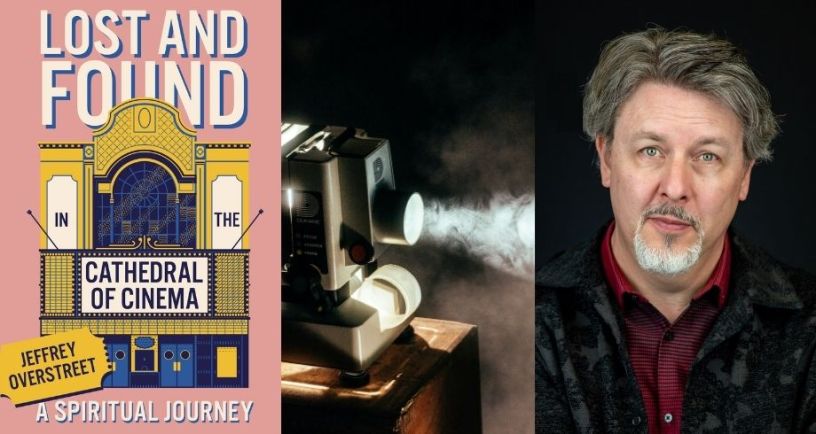
In 2007, Overstreet published Through a Screen Darkly, a look at some of his favorite films combined with reflections on his evolving relationship with film. This year, he returns to discussing film in a new book. Lost & Found in the Cathedral of Cinema: A Spiritual Journey takes a deeper look at Overstreet’s journey from a religious background that treated culture with suspicion to finding an approach that loved culture as God-created work that can be enjoyed redemptively.
Interview Questions
Thank you for taking the time to do an interview, Jeffrey. First, you mention on your website that you began this book 11 years ago. How does it feel to have it finished?
I’ve been waking up every day with a compulsion to work on this book since 2014. It’s going to take a while to change that! The truth of its arrival hasn’t really sunk in yet.
But I don’t really think of the book as “finished.” I’m more inclined to say that the “Open” sign in the window is finally blinking. Think of the book’s publication as the ribbon-cutting for a new park or a new museum, one in which I invite readers to approach amazing works of art, study them, and reflect on what they might mean. I share my own perspectives on how they’re changing my life and how the truths they reveal are setting me free from fears and from false teaching. And now, I hope the next phase of the project begins: Readers share their own testimonies about revelatory encounters with art.
As the title of the book implies, I think the best metaphor for the world of cinema is a cathedral, one in which we can encounter divine and formative revelation. If I may nod back to my first book about film, this is an invitation to glimpse what some call the kingdom of God through a screen darkly. In my experience, the mystery and beauty of great art can make that happen.
The book will not feel finished to me until I find it stirring up conversations. And I hope that goes on and on, postponing any sense of “completion.” I’m still hearing from readers who discover Through a Screen Darkly, even though it’s 20 years old (and out of print!)—so I know it’s possible.If this book inspires readers to spend time with and talk about the films I’m highlighting here, then I’ll inevitably learn more about both those movies I love and the readers themselves. That’s what I love about teaching classes about the same subject—my appreciation of the films has grown, and I’ve discovered so many kindred spirits!
I also hope that readers will, in turn, recommend even more films for me to discover and write about. If that happens, maybe I’ll write a sequel.
You mentioned in a website post about the book that it became much longer than you expected, and that you had to cut a few sections. What was your guiding philosophy on what to include and what to cut?
When I turned in my badge after about ten years of writing at Christianity Today, it was because I was finding the routine format of film reviews too constricting. In order to express what I was experiencing with movies—both movies I loved and movies I wished I’d never seen—I needed to discover new ways of writing about them. For a few years, I wrote a column for the extraordinary literary arts journal Image, and began experimenting with a hybrid of memoir and film criticism. Then, about 2012, as Through a Screen Darkly and my fantasy novels brought about a steady schedule of speaking engagements, I began to hear from audiences that I was born to teach creative writing or film studies. That sounded exciting, but I needed a terminal degree. So, 20 years after graduating from Seattle Pacific, I enrolled in their MFA in Creative Writing program. And I was, as the Scripture says, “transformed by the renewing of my mind.”
In that program, I began writing ambitious personal essays about film that have now become chapters of this book. Under the guidance of great mentors—particularly Lauren Winner and Paula Huston—I began to see the vision for this book. It would be about how, as a child, I had been conditioned, within evangelical circles, to fear the world and commit to a judgmental and separatist branch of Christian culture. But then, as I succumbed to the temptation to pursue “worldly” movies and music that my childhood church culture had labeled as secular and toxic, I discovered that the beauty and truth I found there affirmed the teaching of Jesus and inspired me to love the world rather than condemn it and withdraw from it.
As I was studying and writing, Paula Huston responded to an early draft with a challenge that stuck with me. I don’t have the exact words, but I’ll paraphrase: We have a whole genre now of post-evangelical memoirs. Writers testify about how they woke up to corruption and distortion within the culture and teaching of American evangelical churches. These tend to be angry testimonies, detailing everything that went wrong, and how the writers escaped from the horrors of religion. “But I’m thinking,” she said, “that you might write a memoir about how God used art to help you separate the false from the true, and how this set you free to find a fuller, more joyful faith. This could be a celebration of what art has revealed as truly sacred, even as you testify truthfully about where Christian culture so often goes wrong.”
So, I turned from writing about film to “justify the ways of art to fearful Christians”—that was the mission of Through a Screen Darkly—to bearing witness about how God met me at the movies, and how I discovered a more fulfilling experience of faith through particular images, narratives, and mysteries.
In a lot of those essays, the needle tilted too far into personal storytelling. In others, it tilted too far into a more academic form of film criticism. For example, the most ambitious of those essays is a celebration of Krzysztof Kieślowski’s film Three Colors: Blue. It just didn’t have the right balance for this book. That ended up published in an anthology called Film as an Expression of Spirituality: The Art and Faith Top 100 Films (edited by Kenneth R. Morefield). What broke my heart the most, though, was to have to leave out a whole chapter on the early, personal films of Lee Isaac Chung; a chapter about the Dardenne brothers; and others on the films The Gleaners and I, Certified Copy, and The Fits.
We’ll see. If Lost and Found in the Cathedral of Cinema sells enough copies, maybe I can write that book next.
The summary of Lost and Found in the Cathedral of Cinema alludes to you growing up in an evangelical background that often treated movies as worldly. What was the general attitude about art?
I wrote a lot about that in Through a Screen Darkly. In short, I grew up with a form of “Christian film criticism” that basically existed to offer parents a short synopsis of the film and then a long, detailed catalog of all the things that might endanger their children.
That’s a terrible way to treat art. And it engenders in a lot of children a harmful guilt about their attraction to what are, in most cases, good things. It conditions them to fear, rather than to love, the world outside of Christian culture. I’ve known so many who grew up and abandoned church altogether because they found evangelicals’ false phobias about art and culture so unfounded and embittering.
I also grew up being conditioned to believe in a false and incredibly harmful binary: “Christian art” = good; “worldly art” = bad, or at least very dangerous. On that assumption, a whole industry of so-called “criticism” has festered, driven by fear, ignorance, and an inclination toward condemnation. It shows a disinterest in what art is, how art works. Beauty, truth, excellence—wherever they are found, they are testifying about God, whatever the artists might intend or claim about their work.
These are the facts, thank God: My faith has grown so much more in the light of so-called “worldly art”—the beautiful, mysterious, imaginative stuff that my church culture treated as toxic—than under the influence of “evangelical art,” which is overwhelmingly characterized by mediocrity, narrow-minded proselytizing, and derivative artistry.
(That last bit is ironic, right? Warn us about the art of the world, but then invest in cheap imitations of whatever was popular out there a few years ago, and stamp it with a tidy lesson about Jesus. Where’s the integrity in that? And worse, the “lessons” of evangelical art are so often contrary to anything Jesus actually said or did.)
What were some movies or books that helped you develop a different vision of creativity as you grew?
That’s what so much of this book is about.
I cannot answer that question without first celebrating a book by Madeleine L’Engle called Walking on Water: Reflections on Art and Faith. That book opened my eyes in my high school years. It opened them further in college. And it remains at the heart of any story I tell about my liberation from fear-based fundamentalism and the prevalent, narrow-minded branches of evangelicalism.
I can point to other great minds—some explicitly Christian, others full of wisdom that aligns with the revelation of Christ. Some are predictable names: Chesterton, Lewis, Tolkien, Flannery O’Connor, Thomas Merton. Others have been personal spiritual mentors: Luci Shaw, Gregory Wolfe, Eugene Peterson, Scott Cairns, David Dark. Former teachers, who I write about in this book: Michael Demkowicz, Luke Reinsma. Others are musicians: Sam Phillips, Linford Detweiler and Karin Berquist of Over the Rhine, Joe Henry. And then there are the filmmakers, many of whom I celebrate in this book: Peter Weir, Krzysztof Kieślowski, Hayao Miyazaki, Abbas Kiarostami, Spike Lee, Terrence Malick, Wes Anderson, Tomm Moore. To name a few.
But if I go back to the beginning, well—there’s an open letter to Jim Henson in this book thanking him for a profoundly theological work I encountered at the age of eight. It’s called The Muppet Movie. Anybody who knows me learns quickly that I’m positively evangelical about that film.
Justin Chang complimented your writing in his endorsement for Lost and Found in the Cathedral of Cinema, observing that it’s not easy to find writers who combine deep knowledge of film with a passion for divine beauty. Did any particular writers help you model this approach?
I name quite a few film critics in the Acknowledgments—or what I call “Closing Credits”—at the back of the book. But the closest thing I’ve seen to Lost and Found in the Cathedral of Cinema is a book I discovered while I was revising this one: Karen Swallow Prior’s memoir Booked, which approaches literature the way I approach movies here. (In fact, I was distraught when I opened Booked and found her using the metaphor of a cathedral in the opening paragraphs. I thought I was doing something original!)
I’ll highlight one writer in particular: Lauren Wilford. When she was a student at Seattle Pacific, Lauren’s academic writing professor urged me to meet with her and throw whatever fuel I could on the fire of her creative writing. Almost twice her age, I was so bowled over by her perspectives on art. The film essays she’s written since then are wise, they’re personal, they’re ambitious. Her essay on Hitchcock’s Vertigo, called “Possessed: Vertigo Through Her Eyes,” really blew my mind. It was published at Bright Wall / Dark Room (where she has since served as an editor) and then re-published at RogerEbert.com. Her essay on My Neighbor Totoro is so strong, it’s included in the supplementary materials for Disney’s 30th anniversary Blu-ray of that film. She has a great piece on the art of adaptation too, an essay that deals with Aronofsky’s Noah. She and her husband Ryan Stevenson co-wrote a book on Wes Anderson’s Isle of Dogs that’s like a whole year of film-school in one volume. Selfishly, I wish she would write and publish more, but I trust that she’s up to great things.
And speaking of Bright Wall / Dark Room—that’s a singular, outstanding website of creative, personal, long-form film criticism. It’s a wonder. I hope it finds a bigger, more appreciative audience and lasts for a hundred years.
Your earlier book on film, Through A Screen Darkly, offered several memoir-style references to your life, such as comparing your (more positive) experience attending a Christian school to the darkly comic portrait of Christian schools in the 2004 film Saved! Did you revisit any old memories as you were working on this new book?
I kept my anecdotes fairly brief in that first book. Here, I’m diving deep into a river of memories that run from my earliest memories to the present. One of my favorite parts of the book is a story about what happened when I ate in a Chinese restaurant for the first time, and how that is related to my passion for international cinema. That meant I had to revisit memories of a painful breakup, but I ended up calling my high school girlfriend to get her permission to share the story. And it was a strangely joyful reunion!
Certain prominent figures show up in both books—particularly my high school English teacher Michael Demkowiciz, who is also an art photographer. Here, I devote several pages to his teaching and influence. I wish I could bless generations of young evangelicals with the experience of his life-changing classes. He became quite a Gandalf figure to my anxious, uncertain Frodo. (If I’m honest, I’m much more of a Pippin than a Frodo.)
Through A Screen Darkly offers some engaging anecdotes about your experience reviewing fantasy movies, particularly seeing The Lord of the Rings trilogy when it first appeared. What are some other fantasy films that have affected you?
In the book, I give a lot of pages to Disney’s The Many Adventures of Winnie the Pooh, to Martin Rosen’s Watership Down, and to Tomm Moore’s The Secret of Kells. (I wanted to include a chapter on The Dark Crystal.) The Secret of Kells always feels to me like an allegorical re-imagining of my own life. Due to Moore’s extraordinary generosity, I’ve had several soul-searching conversations with him about imagination, animation, mythology, and faith. I love all of his films. If you asked me what film I’m most looking forward to in the next few years, it’s his new one: Kindred Spirits. We need films about cross-cultural empathy and understanding more than ever now, and Tomm Moore has a passion and a gift for just that.
Fantasy, as a genre, suffers from so much derivative storytelling. It’s difficult to find things I find fresh and meaningful. It’s not a big-screen feature, but the animated series Over the Garden Wall is one of the most beautiful works of fantasy I’ve seen in animation. It feels profoundly wise and yet it’s also hilarious. I’ve been keeping annual lists of my favorite films—and obsessively revising them as years pass—since I was a teenager. In 2021, I found myself unable to pick a favorite for the very first time: I had to call it a three-way tie. One of those three was David Lowery’s The Green Knight, which is one of the richest, most innovative fantasy films since Peter Jackson’s The Lord of the Rings. And I give special attention at the end of this book to my favorite film of 2022: Marcel the Shell with Shoes On.
Sometime ago, I interviewed another fantasy author in the Chrysostom Society, Matthew Dickerson, and he talked about the need for a community of Christian artists supporting each other. How has Christian community helped you grow as a storyteller?
Matthew Dickerson is like a brother to me. Anne and I are grateful to be fellow members of the Chrysostom Society, and I am so thankful that we found him and his wife Deborah in that gathering of writers. Kindred spirits, truly. Matthew is prolific in a variety of genres. And yes, he’s passionate about community.
But to answer your questions, I’d have to make a distinction. Community is not always a good thing. I have had a wide variety of experiences in Christian communities. They are as capable of reinforcing problems as they are capable of meaningful, productive influence.
Where communities are committed to excellence, truth-telling, inclusion, and generosity, and where participants strengthen one another to then go out stronger and wiser to do good work—those are the kinds of communities in which I see the kingdom of God reflected, and where I find God doing extraordinary things.
But if you look at a community and you see a kind of monoculture—whether that has to do with race, color, gender, church denomination, generational distinctions, or the styles and genres of art favored there—you’re likely to find exclusionary policies, explicit or unspoken, that reinforce the worst assumptions that people have about Christianity. These do such harm to the redeeming work of the Gospel in the world.
Again, that’s why I’m grateful for the rich, flourishing culture I found in my undergraduate arts programs at Seattle Pacific University, and above all, in their MFA in Creative Writing program. Every day, I grieve over the severe cuts that have recently erased, or at least greatly diminished, those programs and those communities. I understand that times are tough, and that other disciplines make more money. But the arts and humanities are arenas in which imaginations are inspired and shaped, and that’s where Christian faith finds its most incarnational and visionary expression. The arts scare a lot of people who have their eyes on financial bottom lines, or who are still blinded by the fear-driven agendas rampant in evangelical culture. But Christian organizations that devalue the imagination are calling their integrity into question.
I’ve dedicated Lost and Found in the Cathedral of Cinema to the memory of communities like those few in which I’ve experienced extravagant Christian freedom, love, and imagination. And I hope it might awaken a few readers to the potential and essentiality of such endeavors. The world needs them. I need them. The great Eugene Peterson himself told me, “The people who have influenced me most as a pastor haven’t been the theologians—they’ve been the artists.” And it was no less an artist than Dostoevsky who wrote, “Beauty will save the world.” I can tell you, without a doubt, that beauty has saved my faith. Which means it has saved my life.
You’ve written about this book coming out of a period of difficulty, from family changes to loss of academic programs that shaped you as a writer, and of course all the upheavals that affected the nation as a whole. What are some movies that have helped you to grieve?
The closing chapter of the book explores recent seasons of grief and how The Tree of Life and Marcel the Shell with Shoes On have been meaningful meditations for me.
If I ever write a follow-up, I hope to devote a chapter to Scorsese’s adaptation of Endo’s novel Silence. That book gives me a vocabulary for navigating days of rampant evil and catastrophic loss. And while no film could provide an equivalent to the experience of reading it, Scorsese’s adaptation is still remarkable.
But here, in 2026, we have to reckon with the fact that many in this nation’s leadership, all the way to the top, have been deeply involved in a secretive global network of sexual abuse, trafficking and raping women and children. And we have to reckon with the horror that these conspirators have tremendous support from evangelicals. I am so grateful for Sarah Polley’s 2022 adaptation of Miriam Toews’s novel Women Talking. It holds up a mirror to American evangelical society and its systemic misogyny, even as it celebrated the liberating power of the Gospel. And my favorite film of 2025 came from Zambian director Rungano Nyoni. I hope moviegoers all over the world discover it. It’s called On Becoming a Guinea Fowl. It may not appeal to average moviegoers, but the world would be a better place if we gathered around these two films, meditated on the realities they expose, and then moved through grief together in conversation and reflection.
That is, alas, the missing piece of the artistic experience in most of American culture. If we aren’t ruminating and reflecting on what we watch—in conversation, in revisiting the art, in writing about it, in reading widely about it—then it’s like we’ve been served a feast and only had a fleeting taste of each dish. Our hearts and minds crave nourishment. Back to your first question about being “finished”: Art doesn’t really get started until we start talking about it with an openness to revelation, revelation that will humble, challenge, and change us.
Lost & Found in the Cathedral of Cinema: A Spiritual Journey is available from Broadleaf Books and all major book retail sites. More details about Jeffrey Overstreet’s work, including his film criticism, can be found on his website.
 Fellowship & Fairydust