
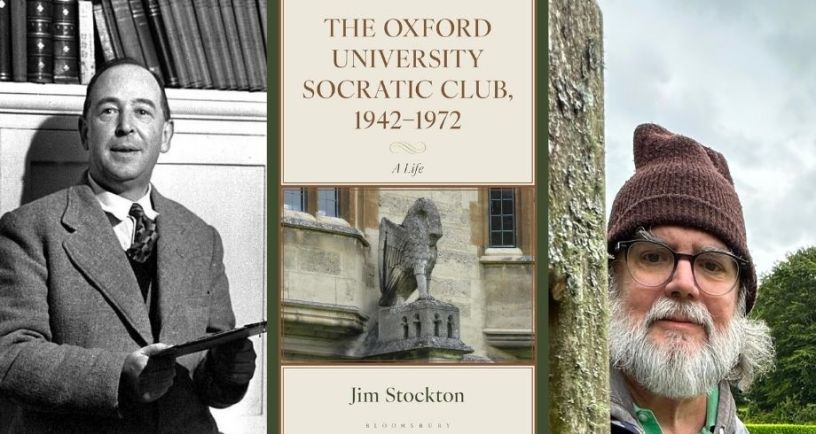
Jim Stockton is an emeritus lecturer in philosophy at Boise State University who has published multiple papers times on the history of philosophy. His essays discussing the Inklings have appeared in Mythlore, Inklings Forever, and several co-authored essays in the Journal of Inklings Studies. Much of his work has focused on the Oxford University Socratic Club, a debate group which met regularly from 1942 to 1969, officially ending in 1972. Many esteemed philosophers participated in the club’s debates, from Antony Flew to G.E.M. Anscombe. For Inklings fans, the Socratic Club is especially interesting because Lewis was its first president and faculty advisor, often participating in club debates. These discussions played a role in shaping Lewis’ apologetics, including a noted 1948 debate with Anscombe which sometimes has been described as discouraging Lewis’ writing career.
Stockton explored the group in detail in his new book, The Oxford University Socratic Club, 1942–1972: A Life, from Bloomsbury Academic.
Interview Questions
How did you first become interested in C.S. Lewis?
During the summer of 1979, while working in Yellowstone National Park, I read The Screwtape Letters. This was quickly followed by Mere Christianity and the Narnia series. Over the next few years I read more of Lewis’s work, including The Allegory of Love, The Discarded Image, and quite a few of his essays.
Did you become aware of the Socratic Club because you were interested in Lewis, or the other way around?
In 2007 three English majors, who were preparing to start Grad school in the Fall, asked me to teach a course on Lewis and philosophy in—the following summer session. While prepping for the class, I read several Lewis biographies, including Roger Lancelyn Green and Walter Hooper’s 1974 C.S. Lewis: A Biography, and the 1979 James Como edited C.S. Lewis at the Breakfast Table, which included Hooper’s “Oxford’s Bonny Fighter,” a lengthy article on the club’s early history. That summer I lectured on the club’s history, its role in 20th century philosophy, and the Anscombe-Lewis debate. I would teach several other classes that were either on Lewis and philosophy, or had a section dedicated to Lewis’s work, such as my class on Philosophy, Fantasy, and Film.
Was Lewis already writing apologetics material when the Socratic Club started?
Yes. His major apologetic works prior to the establishment of the Socratic were The Problem of Pain in 1940, and the publication of thirty-one Screwtape Letters in the Anglican weekly, The Guardian, from May to November of 1941. The book format was published in early 1942. He was also becoming a popular speaker on BBC radio and had given several sermons and talks wherein he shared his faith. By the club’s first meeting in January of 1942, Lewis was an established local celebrity.
Were any other members of the Inklings involved in the Socratic Club?
Yes.
Owen Barfield presented “The Nature of Meaning,” on 2/11/1952.
Colin Hardie read a paper on “The Oedipus Myth,” on 5/26/1947, and “The Judgment of Paris,” 5/21/1951.
Robert E. Havard opened the first meeting with, “Won’t Mankind outgrow Christianity in the face of the advance of science and modern ideologies?” on 1/26/1942.
Mathew Gervase presented “Christian and non-Christian Mysticism on 6/4/1945; “The Spirit of Religious Tolerance,” on 5/22/1950; and “Mysticism,” on 5/7/1956.
Charles Williams shared “Are there any valid objections to free-love?” on 3/2/1942.
On 2/17/1964 Owen Barfield, Colin Hardie, and Austin Farrer led an open meeting “In Memoriam C.S. Lewis.”
Over the years, you have given presentations on the Socratic Club at Boise State University in 2012 and Gonzaga State University in 2024, not to mention essays on the group for Mythlore and in the Journal of Inklings Studies (the latter co-written with Benjamin J.B. Lipscomb). What made you decide to take the next big step and write a book on the subject?
My goal was to tell the story of the club, and in particular the role that Oxford philosophy, and philosophers, had in its thirty-year history. Although Lewis receives more attention than any one person, my book isn’t a Lewis biography.
Many biographies have discussed how World War II created the context for Lewis’ work as an apologist—giving clear religious content for people concerned about the big questions during wartime. How much did World War II inform the creation of the Socratic Club?
The club’s success was tied to the patriotism and religious awakening that occurred in Britain, and elsewhere, after the war began. For Stella Aldwinckle, Lewis, and many of the young women who were the foundation of the club’s early years, 1942 to 1945 were the best years. Christianity was proudly championed and presented as an answer to the harsh realities of the time. This is seen in the presentations given, the popularity of the club, and in two Socratic Weekend conferences (in 1943 and 1945), that were faith retreats with near to all of the attendees being undergraduate women. This early success paved the way for future accomplishment.
What were some things that surprised you as you researched the Socratic Club?
The first surprise was the overwhelming numbers associated with the club’s history. The club held, at a minimum, 476 meetings, featuring 327 participants. Many of the participants were widely recognized philosophers and scholars. Moreover, many of their papers were published in one, or more, of the club’s five Socratic Digests, and other publications. The second surprise was how well the club was received. While it had its low points, throughout most of the years it remained very popular. Next, was how dedicated the club’s founder, Chaplain Stella Aldwinckle, was in using the club as a means of evangelical engagement and ecumenical messaging.
Many people know Lewis wrote about Christianity, but few people realize he was also an active public speaker—giving sermons to Royal Air Force troops and at churches. What kind of public speaker was he?
From what I’ve read, he was considered one of Oxford’s best lecturers and was very popular. His enthusiasm when supporting an argument was very passionate, and it was noted by many that he had a wonderful voice.
Several books on Lewis have mentioned Oxford colleagues looking askance at his writing about Christian topics. For example, in 1951, Lewis was nominated for the Professor of Poetry position and Lewis’ brother recalls one voter saying he couldn’t possibly vote for someone who wrote The Screwtape Letters. How did the rest of the Oxford faculty respond to the Socratic Club?
I believe the best answer is that most of Oxford faculty saw the club as part of the expected fabric of Oxford’s scholarly and social scene. Religious clubs have always been a part of Oxford campus life (today we have The Oxford C.S. Lewis Society and the Socratic Society as examples of scholarly societies similar to the original Socratic Club). There is also a rich, centuries old, history of Britain’s academic and public debating clubs and speaker’s societies that paved the way for clubs such as the Socratic.
Unless I am mistaken, this is the first academic book devoted entirely to the Socratic Club. The group gets mentioned in many books about Lewis and the Inklings, but usually in side commentary. Any thoughts on why it has taken so long for someone to write a full treatment about the group?
The minutes and other materials related to the club’s history were scattered all over the place. It took me nine weeks in Oxford, several visits to the Wade Center, numerous inter-library loans, and almost ten years to gather everything that I felt was needed to write the club’s history. It is fair to say that Lewis’s engagement with the Socratic is a minor aspect of his biography, whereas coupling Lewis’s biography with other topics or activities, such as Lewis and the BBC, or Lewis and Modernism, is much richer.
Some readers may be surprised that the Socratic Club often featured Christians debating each other about religious topics, sometimes with one person taking an atheist’s position to create a debate context. Why weren’t there more atheists who participated in debates?
There are several points to consider. First, there weren’t as many atheists at Oxford as some have suggested. Moreover, being an atheist during the war years was not a popular position to announce. For example, many faculty members were sent to Army Intelligence, where they had to answer to senior officers who were, for the most part, conservative and Christian. Keeping quiet about one’s atheism during the war was the wiser path to follow. After the war there are more atheists at club meetings, and more atheist arguments are heard.
Many books about Lewis mention his 1948 debate with Anscombe. For those unfamiliar, what did they debate?
As I’ve pointed out in earlier publications, it wasn’t so much a debate as it was a correction of several of Lewis’s claims made in Chapter III of his 1947 book, Miracles. At the beginning of her paper (which she read to the club), Anscombe states, “I want to discuss your argument that what you call ‘naturalism’ is self-refuting because it is inconsistent with a belief in the validity of reason. With this argument you propose to destroy ‘naturalism’ and hence remove the determinist objection to miracles.” She then points out that Lewis’s demand that Naturalism “fully explain” how everything came into existence before dismissing religious beliefs and explanations is impossible, in that there is no such thing as the type of full explanation that Lewis is demanding. Anscombe also points out that Lewis’s use of the phrase the “validity of rational thought” is a troubling. As she wrote in her paper, “You can talk about the validity of a piece of reasoning, and sometimes about the validity of a kind of reasoning; but if you say you believe in the validity of reasoning itself, what do you mean? Isn’t this a question about the validity of reasoning a question about the validity of valid reasoning?” There are more objections (which I address in the sixth chapter), that collectively point out that that Lewis should have been more cautious when using specific terms and phrases.
Following Lewis losing the debate with Anscombe, he revised material in his book Miracles based on Anscombe’s feedback. Some scholars suggest that the defeat shook him up so much that he moved away from writing apologetics. What is your view of the matter?
Lewis revised Miracles in 1959–1960 in preparation of the 1960 Fontana paperback edition. Some of the revisions were in response to Anscombe’s paper, but they did little to strengthen his argument. However, it does show that Lewis took to heart some of Anscombe’s concerns, which she recognized in the years that followed. Unfortunately, Lewis didn’t recognize Anscombe’s contribution in 1960 edition, which is the traditional practice. Why is a bit of a mystery. As for the claim that Lewis was so crushed by Anscombe’s critique that he gave up apologetics (and turned to writing the Narnia books as an escape), is inaccurate nonsense. Lewis would publish more apologetic works, and he wasn’t as emotionally rattled as some have claimed.
The Socratic Club ceased operations ceased operations in 1972, but it attracted a range of students, sowing a lot of seeds. What are some later effects of its work?
The greatest effect of the club can be found in the numerous C.S. Lewis Societies and scholarly organizations which have adopted the spirit of the club. I believe a lengthy article on these clubs and societies would be very intriguing. In early drafts of the book I looked at the history of those papers shared at club meetings by younger faculty who went on to become some of the most renowned theologians and philosophers of the twentieth century (Austin Farrer, C.S. Lewis, H.H. Price, Bernard Williams, Antony Flew, Richard Hare, Iris Murdoch, Eric Mascall, Basil Mitchell, Elizabeth Anscombe, Alasdair MacIntyre, Philippa Foot, Ian Crombie . . . and many others), and how many of these ‘Socratic Club’ papers are now canonical readings. Sadly, it was one of many aspects of the club’s history I had to put aside to develop or more concise text.
You’ve worked with Charlie W. Starr to publish correspondence between Lewis and other Socratic Club member, C.T. Onions. You’ve also written about the Club’s founder, Stella Aldwinckle. Who are some other Socratic Club figures you would like to see researched more thoroughly?
The prior answer covers quite a few, but in relation to C.S. Lewis I would suggest looking at his friendships with H.H. Price, Eric Mascall, Ian Crombie, Austin Farrer, and Gilbert Ryle. There are plenty of threads one can follow that tell us more about Lewis, and many of the other participants. I like to think my book does a good job of sharing this, and much more.
The Oxford University Socratic Club, 1942–1972: A Life is available from all major book retailers.
 Fellowship & Fairydust