
BY G. CONNOR SALTER
“Inklings Scholar Interview: David Bratman”
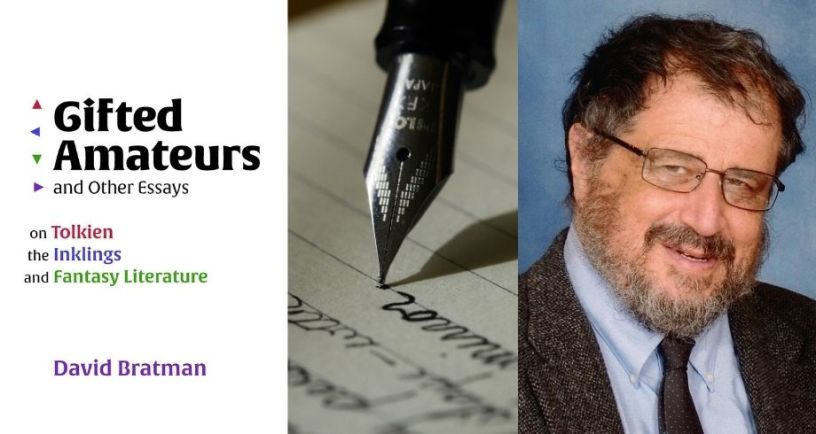
David Bratman is a retired academic librarian who has worked at many institutions, including Stanford University, San Jose State University, and Santa Clara University. His writing has covering everything from travel reflections on The Eagle and Child pub to reviews of California symphonies. To people who read and study the Inklings, he is best known for his decades of writing about the Inklings or surveying recent Inklings scholarship, including substantial periods editing Mythprint and Tolkien Studies: An Annual Scholarly Review. Many of these pieces were collected in 2023 into the book Gifted Amateurs and Other Essays: On Tolkien, the Inklings, and Fantasy Literature.
His other work for books on the Inklings has included multiple entries in The J.R.R. Tolkien Encyclopedia edited by Michael D.C. Drout, an appendix on the Inklings included in The Company They Keep: C.S. Lewis and J.R.R. Tolkien as Writers in Community by Diana Pavlac Glyer, and essays included in the collections Tolkien’s Legendarium: Essays on The History of Middle-earth edited by Verlyn Flieger and Carl F. Hostetter, Tolkien on Film: Essays on Peter Jackson’s The Lord of the Rings edited by Janet Brennan Croft, and The Lord of the Rings 1954–2004: Scholarship in Honor of Richard E. Blackwelder edited by Wayne G. Hammond and Christina Scull.
He was kind enough to answer a few questions about his work.
Interview Questions
How did you first hear about the Inklings?
I first heard of an Inkling from my teacher when I was 11. She had the fortunate habit of reading aloud to us the successive chapters of children’s books in the afternoons, and one of the books we got through that year was Tolkien’s The Hobbit. I was enchanted by the book, by the breadth and depth of the created world as much as the storytelling. As she had told us that there were three sequels (that was the way she put it), after a little more nudging I packed up some money from my allowance, visited a nearby bookstore and bought all four volumes. I was as enchanted by The Lord of the Rings as I had been by The Hobbit if not more so. Besides repeated re-readings, I sought out such material on Tolkien as I could find. But this was the late 1960s and early 1970s, and there was very little on Tolkien to be read.
Nor could I find anyone who had read the books and was interested in discussing them until I found and joined The Mythopoeic Society at just about the time I turned 18. It was equally devoted to C.S. Lewis and Charles Williams as it was to Tolkien. I was barely aware of Lewis and had never heard of Williams, but I quickly repaired my ignorance by reading as much of them as I could and also seeking out material about them. I found Williams difficult, but there were things by him I enjoyed. And although I was not (and never have been) a Christian, I found in Lewis an active enquiring mind with which I enjoyed engaging.
I first learned of the Inklings as a group from Roger Lancelyn Green and Walter Hooper’s biography of Lewis, which had been published in 1974 and which I read a year or so later. It had a chapter devoted to the role of the Inklings in Lewis’s life. There was no roster, but I compiled a list of members from its descriptions, a list that largely overlapped the one in Humphrey Carpenter’s The Inklings which appeared in 1978, and set to learning more about their lives and works as well. The context in which Lewis and Tolkien worked was my driving intellectual interest here.
How did you shift from reading about the Inklings to writing about the Inklings?
I became editor of the Mythopoeic Society’s newsletter, Mythprint, in 1980 and kept the job until 1995. This was the period during which much of Tolkien’s most basic posthumous material – from Unfinished Tales and the Letters through most of the History of Middle-earth – was published. When you’re editing a small newsletter, the easiest way to get material is to write it yourself, so I reviewed all of these books. When the History of Middle-earth was completed, it occurred to me to offer a guide to people who might want to find the highlights of these massive volumes without reading them all as I had, so I gave a paper presenting this at Mythcon in 1998. Afterwards, Carl F. Hostetter told me that this was exactly what he wanted me to write up for his and Verlyn Flieger’s planned Festschrift for Christopher Tolkien, and it was published as “The Literary Value of The History of Middle-earth” in that volume, Tolkien’s Legendarium, in 2000. Along with “Top Ten Rejected Plot Twists from The Lord of the Rings,” which was drawn from the same well of reading (I gave it at Mythcon the following year and it was published in Mythlore; both papers are in my collection Gifted Amateurs), this was my start in Inklings scholarship and brought me to the attention of the Tolkien scholarly community.
But there was more. Reading about the Inklings brought to my attention both the complexity of their timeline and how little was known about it, so in the early 1990s I began compiling all the available primary and secondary evidence for what they did as a group. I never published the massive collection, because it was mostly quotations, and to my regret I haven’t kept it up as new material has become available, but I’ve used it as source material for several articles on the history of the Inklings and their members. During research on this at the Wade Center in 1995, I also discovered that the Wade held copies of all of Williams’s Masques of Amen House, which I’d been eager to read since first learning of them from reading Alice Mary Hadfield’s Introduction to Charles Williams twenty years earlier. And that led to the publication of my first book, a collection and annotated description of The Masques of Amen House, in 2000.
How have scholarship communities like the Mythopoeic Society or the various Tolkien societies informed your work as an Inklings scholar?
By offering feedback and an audience, and forums for publication. These have been invaluable, and I doubt I would have done anywhere near this amount of work without them. Tolkien said that the Inklings didn’t influence his work in the normal sense of that word; what they offered was encouragement, and I could say the same of these societies. I published both my books with the Mythopoeic Press, because they understood instinctively the value of what I was proposing, and I didn’t have to sell myself to them, a process I loathe. I particularly cherish the help of Leslie Donovan, publisher of the Mythopoeic Press in recent years. It was her committee’s choice of me as Guest of Honor for what became the 2022 Mythcon that gave me the audacity to propose a collection of my essays for publication (Guests of Honor ought to have a book, and except for The Masques of Amen House, which I edited but didn’t write, I didn’t have one), and her instant acceptance of my proposal gave me the courage and energy to go ahead with what became my book GiftedAmateurs.
Recently, I was talking with a retired librarian, Catherine Madsen, about her scholarship journey and the strengths as well as the struggles of being a scholar but not a professor. What are some ways that being an academic librarian has shaped your scholarship?
Two things, mostly: training in scholarly library research, and access to the material. Some scholarly libraries welcome independent researchers, but others are extremely shirty about providing access. If you actually work at the libraries, which I did for some years, life is much easier. I remember particularly my period at the Hoover Institution at Stanford, where venturing up into the cramped, dark, and musty stacks – not accessible to patrons, and a good thing too – was part of my job. Hoover’s collection included a vast amount of material on World War I. This was while I was working on my biographical article on Hugo Dyson of the Inklings. I grabbed the published history of his WW1 regiment from the Hoover stacks, and that was a useful source for the article, as was the British Army List serial, which I also got at Hoover.
You wrote a detailed piece for the Mythopoeic Society’s website summarizing where and when the Inklings held meetings to share their writings, where and when the related group met to have drinks at the Eagle and Child, and a meticulous list of who attended both groups. I have seen some scholars go further and ask whether it is important to emphasize a related circle, the people who went with Lewis on walking tours. How do you feel about debates to determine “the canonical Inklings”?
One thing I’ve had to say over and over again is that there is no such thing as “the canonical Inklings.” The list of 19 men that Humphrey Carpenter put in his appendix to The Inklings, and which I copied for the appendix to Diana Pavlac Glyer’s The Company They Keep, is not a formal roster. The Inklings were an informal club, not a formal society, and while people could be deliberately and consciously invited, it had no formal membership. The 19 names are those which Carpenter found in available sources as persons who attended meetings in a regular capacity, i.e. not as guests. He may have been mistaken about one or two of them – whether J.A.W. Bennett was a member or a guest seems questionable, and Owen Barfield didn’t consider himself a regular member because of the infrequency with which he could attend – and there could have been others not identified in the highly fragmentary surviving records. The tendency of some scholars to treat the 19 as a formal and complete list of Inklings is highly irksome.
Whether the Eagle and Child gatherings were Inklings meetings at all is also questionable. Some people, including whoever wrote the plaque hanging in the pub in later days, got the pub gatherings and the evening Inklings meetings totally confused and say that the Inklings read their manuscripts in the pub. They did not; the pub meetings were for general conversation. Sometimes Warren Lewis or others reporting on the pub meetings called them Inklings gatherings, but just as often they did not (and even evening Inklings were not always called that in surviving records, which emphasizes both the informality of the group and the difficulty of deciding what counts as an Inklings meeting). Though most, if not all, of the regular evening Inklings people attended pub meetings, many of the pub regulars didn’t even know of the evening club, which again emphasizes how much it was a separate group.
As for the Cretaceous Perambulators, which is what the walking group called themselves, they were a separate group of Lewis’s friends, of earlier vintage than most of the Inklings. Though they included Barfield, and a few of the other Inklings walked with them on occasion, they’re a quite separate group. Though a couple of them besides Barfield and Lewis wrote books, they were not as a group academically-minded, and I’ve never found them of as much interest.
Who is your favorite lesser-known member of the Inklings?
Oh, I can’t give a simple answer to a question like that. What I like about the Inklings is their diversity, so I like them in connection with each other. I can say that I published separate full articles on two Inklings, Hugo Dyson and R.B. McCallum, but I chose those partly because they were interesting personalities rather than for their writings (Dyson indeed wrote very little). What some of the lesser-known Inklings have done for me is direct me to further reading. On those grounds, I have two favorites. One is McCallum, whose political science books include a study of The British General Election of 1945. I learned that this was merely the first of a long series of British general election studies by other hands. I read several of these, and they helped generate a continuing interest in British politics. The other is John Wain. Although he is far removed from the rest of the Inklings in aesthetics, I found some of his novels interesting, and I was moved to explore his friends and contemporaries – a generation younger than most of the Inklings – Kingsley Amis and Philip Larkin, better-regarded as authors than Wain himself, and whom I’ve found rewarding reading and interesting, if sometimes repulsive, personalities.
Tolkien and Lewis scholarship appear to have kept growing and growing for decades, while research on Charles Williams and Owen Barfield has progressed much more slowly. Do you think that is simply because Lewis and Tolkien scholarship has grown so much faster than scholarship on most of their peers, or are there barriers to studying Willims and Barfield?
If we say that Tolkien and Lewis scholarship has been growing while Williams and Barfield scholarship has not so much, we must ask why, and that takes us back to the question of barriers to studying that latter two. To which I must reply, of course there are. Few would deny that Williams is a difficult author: even the Inklings chided him for obscurity. Whether he’s also simply not as good an author as Tolkien or Lewis is something I’m not equipped to decide; some of his more virulent partisans insist he’s much better. As for Barfield, he’s primarily a philosopher rather than a fiction writer, and accordingly is never going to be of as wide an appeal. Such fiction as he did write is philosophy with a fictional coating to an extent far beyond what Lewis did, even though he’s often accused of being a polemicist. That’s a legitimate way of writing, but is never going to be as widely read. Of course, popularity is not the only driver of scholarly esteem, else there’d be a lot more studies of Terry Pratchett, but popularity and depth together are what Tolkien and Lewis offer that few others have. Williams and Barfield also have the depth, but though they’re less studied, it’s not as if they’re totally ignored scholastically.
When Peter Jackson’s trilogy appeared, you were quoted in The New York Times as saying, “I felt as if I were seeing two films at once… One in the visuals, which was faithful and true to Tolkien, and another in the script and in the general tone and style, which was so unfaithful as to be a travesty.” What were some things about the tone that you felt did not fit Tolkien’s world?
I wrote an entire article on this, “Summa Jacksonica,” in the book Tolkien on Film, edited by Janet Brennan Croft (Mythopoeic Press, 2004). But here I’d like to get into, at some length, a point I didn’t emphasize in the article, but which I’ve come to think is the most important: Jackson’s lack of faith in Tolkien’s characters. And I’d like to focus on Faramir.
Jackson’s Faramir, completely unlike his book counterpart, tries to arrest Frodo and Sam and take the Ring to Minas Tirith, and then inexplicably changes his mind and lets them go. Jackson’s commentary track remarks on this are the final proof that he and his colleagues did not understand or appreciate Tolkien’s book. To change a plot point because you consider it necessary for the adaptation is one thing; to change it because you can’t figure out why the author wrote it that way is another.
What Jackson said is that, if the Ring is so powerful and seductive, it doesn’t make sense for Faramir to avoid succumbing to its seduction. We lose a sense of the Ring’s power, he says. Tolkien really fell down on that point and we can’t figure out why, he says.
Jackson didn’t read the book very closely, did he? Faramir himself answers this question, when he says, “I am wise enough to know that there are some perils from which a man must flee.” His reaction doesn’t diminish the Ring’s power, it underlines it. Here’s a weapon that could by itself win the war, a war which at this point the good guys are losing badly. And yet any good characters who have the power to wield the Ring adequately won’t touch the thing. I think that avoidance conveys the danger of the Ring a lot more vividly than an endless series of Boromirs and Gollums falling victim to its lure would.
Faramir’s lapse in the movie, for momentary lapse is what it turns out to be in the storyline, is illustrative of a continuing theme which is the movies’ greatest continuing flaw. The good characters keep suffering failures of nerve. Faramir seizing the Ring, Gandalf socking Denethor in the teeth, the Rohirrim fleeing away from Saruman, Aragorn fearing he’s too weak to be king, Frodo abandoning Sam in the wilderness because he no longer trusts him, Legolas having a nervous breakdown at the Battle of Helm’s Deep (I bet most have forgotten that, but it’s there), are all ridiculous and superfluous additions that seem to be serving the purpose of “humanizing” the characters by showing them as having weaknesses.
Jackson has missed the point and the structure of Tolkien’s story. Gandalf and Aragorn, let alone Faramir and Legolas, are not the protagonists or heroes of Tolkien’s story. The four hobbits are, or more accurately including Frodo in the first half: by Book 4, Frodo’s burden has translated him beyond hobbit-kind, which is why so much of the viewpoint then focuses on Sam. It’s the hobbits who suffer failures of nerve in the book: see Sam fretting over what to do at Cirith Ungol, or Merry going nerveless at facing the Nazgûl – which he does twice, by the way; I bet most have forgotten that too. Faramir and the others have already gone through any crisis of self-faith they’re going to have before we meet them; and they’ve come out stronger for it. Their purpose in the story, from a structural viewpoint, is not to be the heroes but to provide noble figures, above quotidian heroism, for the hobbits to look up to and try to emulate. In the end the hobbits succeed at this (much of it shown in the Scouring, and where’s that in the movie?). We need this kind of nobility to look up to; that Tolkien has it while authors like George R.R. Martin do not is a key to the continuing esteem in which Tolkien is held. To excise this theme is to lose the moral heart of Tolkien’s story.
There’s further the problem of the half-hearted way Jackson pursues this. He wants to make his Faramir do something that Faramir would never do, arrest Frodo and seize the Ring. But because Tolkien would never have Faramir do this, including it changes the story utterly. But Jackson doesn’t want to change the story, he wants to stick to Tolkien’s outline as best he can. So he allows the story to run off the rails briefly, and then he has to wrest it back on to the rails by main force in order to continue with Tolkien’s outline. That’s Jackson’s external or movie-making reason for Faramir’s lapse being only momentary, but he fails to come up with an internal reason to make the storyline work, so that’s why his Faramir’s change of mind is so inexplicable.[1]
Can you think of any particular fantasy movies that capture the tone of the material well?
Sure. To my mind, the fantasy movie adaptation which best preserves the spirit of the book, especially in the ways it changes the book’s story, is The Princess Bride. That the script was written by the author of the original novel is undoubtably a reason for this. The movie of The Last Unicorn, despite the cheap animation, is also pretty good for the same reason. I also liked the BBC’s 2000 adaptation of Peake’s Gormenghast novels. It was not exactly my vision of the story, but within the limits of screen adaptation it was unquestionably true to Peake’s vision, and I was content.
Reading your website’s list of your publications, I noticed you have written several pieces on Mervyn Peake, poet and author of the Gormenghast trilogy. Peake is often described as Tolkien’s contemporary who never achieved the same fame, but might be as good or better as a writer. Any thoughts on why Peake’s fantasy writings do not have the status of The Lord of the Rings?
This is not a criticism of Peake, just an observation, but I think the difference in popularity, though not in critical esteem (if there is one), may be largely due to Peake lacking anything like hobbits. The hobbits as mediators are one of the secrets to the success of The Lord of the Rings. A story of the War of the Ring without the hobbits as a viewpoint to lead us into it would probably not have been so successful, despite Tolkien’s skill at writing exciting battle scenes. In Peake’s case, Gormenghast Castle is presented with exposition but without mediation, and it’s not until some way into Titus Groan that it becomes clear that, despite the book’s title, Steerpike is the protagonist, and he’s the opposite of a sympathetic character. This is an exciting and audacious way to write a novel, but it’s not going to be as popular.
You’ve been writing about Tolkien since 1977, from early publications in Science Fiction Collector to chapters in widely respected books on the Inklings. What have been some of the most surprising changes you have seen in Tolkien scholarship?
Firstly, the increased volume in Tolkien studies. In 1977 there was only a small shelf of books about Tolkien, and it was easy to have read them all. As late as 1988, I wrote an article surveying every book that had ever been published about Tolkien. By the time of the flurry of interest in the Jackson films, the volume had increased tremendously, and I was only able to keep up because most of my scholarly attention was devoted to writing “The Year’s Work in Tolkien Studies.” After I gave up writing that entirely by myself, I started to fall behind. Now there are a dozen or more scholarly books being published every year, several journals devoted exclusively to Tolkien studies and more largely concerned with Tolkien, and more. The notion that there wasn’t much more to say about The Lord of the Rings than “I really like that passage,” was already nonsense when Lin Carter promulgated it in the 1970s, and has only become spectacularly more so since.
Secondly, the rise, just in the last few years, of serious critical analysis of Tolkien, and by “critical” I mean not “scholarly” but “negative.” That there are aspects of Tolkien’s work that are disturbingly sexist or racist can no longer be denied, and these and other problems have been finely analyzed by a variety of scholars. These aspects exist alongside other passages that are startlingly anti-sexist and anti-racist, which is sometimes acknowledged; what is always acknowledged is that Tolkien is worth studying and worth analyzing, and not just to be dropped in the memory hole because he does not always meet our contemporary standards.
What are some things you would like to see other Tolkien scholars explore?
I proposed some of those in my Mythcon Guest of Honor speech in 2022, which consisted of fragments of ideas that I hadn’t been able fully to explore, and that I hope others will: the burgeoning vs. the contracting of Tolkien’s imagination over time; the role of the legendarium, i.e. the existing world of the Silmarillion, in the writing of The Hobbit; why did Edmund Wilson so deeply misunderstand The Lord of the Rings, and what does that say about other writers who have misunderstood it; why is Éowyn’s love for Faramir so often read as a woman giving up her calling to get married when that’s not what Tolkien wrote? I have suggestions for answers to these questions, and I offered those answers in my speech, but I would like to see other scholars explore them.
[1] Parts of this response are adapted from a blog post, “Yes, again again,” Kalimac’s Corner, December 2021, https://kalimac.blogspot.com/2021/12/yes-again-again.html.
 Fellowship & Fairydust