
BY THE TRAVELING TROUBADOUR
Introduction
The Borough of Fort Lee, New Jersey, is historically significant on multiple levels and notable for its storied tapestry interwoven with remnants of nature’s wonders and a most interesting and patriotic past. The Church of the Madonna is one of its original treasures. This prominent and dignified stone structure stands alone at the highest geographical point of the western ridge of the Palisades. It represents the oldest Catholic Parish in the County of Bergen. The parcel of property on which its foundation was laid was one of the area’s first land grants, given by British Army Major John Berry fifty years prior to the American Revolution in 1726.
The “Chapel on the Hill,” as it fondly became known over the years, was among the many beautiful and aesthetically appealing European influenced representations of Catholicism in America. They proliferated in the post-war era with the gradual influx of nationalities coming to the New World. Our nation’s religious and cultural fabric was sown with these various threads of diversity, and the Madonna Church was a prime example of the universality within a congregation under one roof and one God. It possesses a captivating presence and simple nobleness with its lofty steeple and belfry that chimes through the air and is crowned with a distinctive golden cross that reflects in the sun and appears as a lighthouse and a beacon of faith. It is an iconic landmark visible for many of the surrounding miles and honored on the National Register of Historic Places for its exceptional sculptural architecture.
This intimately quaint and charming ecclesiastical gem comprises blended styles of Gothic Revival, classic European, Italian Baroque, and English colonial. It is built like a medieval Romanesque fortress with arched doors and windows, three foot thick walls, and reinforcing stone buttresses to withstand weather patterns that are especially fierce on those elevated heights. It is composed of chiseled igneous volcanic basalt rock and dark augite that was quarried from the bordering cliffs of the palisades, giving it a salt-and-pepper-like appearance. As you enter into its interior you’ll first be struck deeply with a framed image of Christ’s sacred head with a crown of thorns as he seems to gaze into the depths of your soul with eternal love. Then you’ll approach a heavenly setting with a simple yet profound elegance that is spiritually inspired. It is comprised of an Italianesque carved relief Carara marble altar at its center with matching angels on each side.
There is a golden tabernacle door and an antique crucifix above with original frescoes of the life of Mary, Most Holy. The rare luminous stained glass memorial windows reflect an array of colors unto the curved walnut pews and a spiral staircase leading to the organ’s loft with its row of golden pipes, where one can view the alpine designed rafters and classic hanging wrought iron chandeliers. There are life-like statues with scarlet votive candles lit for the living and the dearly departed souls, plaster Stations of the Cross, and pure white beeswax candles with dancing flames in polished brass candelabras. It is crowned with a timeless image of a Renaissance masterpiece entitled “The Sitting Madonna” by Raphael in an ornate gilded Baroque frame, in honor of the Patroness of the Chapel on the Hill.
The Picturesque Palisades
The town is located on the farthest North Eastern Ridge of “The Garden State,” sitting atop of one of the Creator’s awe-inspiring wonders, “The Picturesque Palisades. A Natural National Landmark, they are a line of ancient, majestic cliffs which appear like a row of impenetrable fortresses, stretching for some twenty miles and measuring over 500 feet at their highest crest. They have been standing as silent sentries since time immemorial, carved out of the rocky terrain during the Ice Age two hundred million years or so ago (give or take a few millennia). Their scenic splendor along with the mile-wide serpentine Hudson River that runs at their base, make for an extraordinarily striking combination, with a vivid view that lends to a most breathtaking topography. They are partially enveloped by lush greenery of countless wooded varieties, softening and framing the coarse cliffs’ rugged composition. The heavenward climbing trees are a spectacular sight to behold when their foliage is enhanced and embellished in a kaleidoscope of resplendent colors at their autumnal peak.
The first European to set eyes on the magnificent sight in 1524 was the Florentine explorer Giovanni da Verrazzano. He entered into the mouth of the Hudson and thought it to be a large lake. When he spotted the captivating view of the Palisades, he must have impulsively made the sign of the cross, followed by an emotional Italiano outburst, exclaiming in disbelief, while waving his hands in the air, “Mama Mia! Magnifico Molto Bellissimo!” It probably took him quite some time to finally simmer down, like a pot of pasta sauce, and he later described them on the first map of the New World as “Palus,” meaning wall of wooden stakes or tree trunks in Latin. The Lenape Indians inhabited them for centuries, calling them “Weehawken,” rocks that look like trees.” It became a town on the same line of cliffs as Fort Lee and hosted Alexander Hamilton’s doomsday duel with Aaron Burr in 1804.
Along with being the most spectacular geologic site of the Garden and Empire State area, there is much mystique, folklore, and legends surrounding them. Two curiously extraordinary features are the unusual “Indian’s Head” and “Washington’s Head,” carved out by Nature itself, directed by the hand of God, and appearing as fearsomely huge and significantly pronounced facial profiles protruding out of the rugged façade. They have an eerily close resemblance to a Native American tribal chief and that of the American Continental Army commander-in-chief. Both these human figures that had made their indelible mark on the land seemed to be immortalized in stone. They peer out of the gigantic wall, gazing across the river, as did the warrior leaders they replicate, who were desperately trying to protect their independence and way of life.
Where Stood Washington in 1776
Two hundred and fifty years after their discovery, the high cliffs caught the attention of General George Washington who was drawn to them in speculation of occupying and utilizing them as an observation post. They offered an extraordinary clear bird’s eye view of the vital waterway below as well as the isle of Manhattan. He considered it to be an invaluable place to erect a twin fort in close conjunction with his namesake, Fort Washington, directly across on the New York side. From those two positions, he could rain down a crossfire cannonade on the British to prevent them from sailing up or down stream. This would deter any attempts of resupplying their troops with the necessary ammunition, provisions, and reinforcements to maintain their occupation and maintain control of the riverway.
In the summer of 1776, he petitioned Congress to authorize construction of a bastion atop the bluffs. It was first called Fort Constitution. The name was later changed to Fort Lee as an accolade (or more so an appeasement) to his second-in-command, General Charles Lee, who had served with him under British General Edward Braddock in the French and Indian War. Lee was an English aristocrat by birthright and had a military education, developing an above average level of tactical skills. But he could be personally offputting due to his pompousness and ill-temperment. He even had the audacity to provoke a face-to-face personal spat with His Majesty himself when he was bucking for a promotion. He was flatly refused after giving utmost proof of the reports that he caused friction with others whom he considered his know-nothing inferiors (without exception, even the King himself).
It was risky business as a subject of the crown to challenge, provoke, and contradict the monarch. His arrogant attitude may have very well have resulted in his head suddenly separating from the rest of his illustrious person right then and there and rapidly rolling down the red carpet. He must have had a devoted guardian angel with a full-time job of saving his neck! In a rash retaliation to his rejection, he retrieved his inheritance of the family’s considerable holdings and left the British Isles. He eventually made his way to the shores of the Potomac and purchased an estate in Virginia. He married the daughter of an Indian chief who branded him with a tribal name meaning a pot of boiling water due to his lack of restraint. His personal rebellion was taken a step further by aligning with the Patriots’ grievances only to convince himself that he was vastly superior to any of them militarily. He wanted to be the top dog of the whole kit and caboodle. This would seal his reputation as the ultimate wayward child turncoat with unmitigated gall, mesmerized by delusions of grandeur. However, his thought-to-be irresistible qualifications didn’t quite work out as well as he anticipated.
We Have a Commander-in-Chief
It was due to a major stumbling block that tripped him up in the persona of “Gorgeous Georgois.” George, an early title for the Greek god Zeus, was no shrinking violet in ambition either, being schooled in the art of self-promotion and media savvy. He managed to beat Lee to the punch and stepped to the head of the class by presenting himself to Congress on his own behalf as the candidate of choice. Upon that auspicious occasion, Washington’s well-executed “sly fox” maneuver was witnessed before an anxious jam-packed audience in the House of Delegates and became a legendary chapter in the history books. He rose to the occasion by mastering the talent of putting his best foot forward to achieve a favorable impression. When he arrived, he removed his black felt tricorne hat and placed it securely under his arm, revealing his powdered hair tied back with a dark ribbon, which was befitting of the times and not an old lady’s costume party getup… just for laughs with the boys.
He was wearing his Sunday best uniform, fresh out of a trunk of mothballs and preserved from his stint in the French and Indian War. Along with his martial countenance, conspicuous presence, and towering stature, he was all dolled-up like a mannequin in one of Philadelphia’s high class storefront windows on the main square. It could have been the boutique where Ben Franklin bought his classic coonskin cap, making him a fashion-plate statement in France, where he charmed the mademoiselles of Paris with his own style while covering his shinny noggin (proving that good looks aren’t everything)!
To assure his rise to prominence, the prospective nominee cherry topped-off his ostentatious outfit by donning a symbolic scarlet red status sash, slung across his broad chest and shoulder as a badge of honor that served as an eye-catching ooh-ahh conversational accent piece, visibly attracting all eyes from every corner of the room. General Braddock had willed it to Washington, who was his aide-de-camp, along with his set of initialed flintlock pistols, a rare leopard skin saddle bag, a sturdy war horse, and the trusted services of his British manservant. These were the general’s prized possessions of General Braddock for whom he was his aide-de-camp. The sash had been given to Braddock by his father, who was also a senior ranking officer in the King’s army, and passing it on to Washington was a token of affection for the lad he had taken under his wing. Like a typical father figure, mentor, and seasoned veteran, he felt he knew the best decisions to make and would not be questioned or contradicted. He was often gruff with George, who had lost his own father at an early age, and wanted to toughen him up to survive. At times, this created friction in their relationship.
Ironically, in the last days of his life, Braddock was reluctant to heed the sound advice from his eager subordinate who, being familiar with Indian wilderness tactics, insisted that the British manual was inadequate and that using trees for cover was best. His warning was in vain, and Braddock remained emphatic about using the old school military methods of fighting in formation, in which he had been hardwired for over 40 years. But as the ambush unfolded, with arrows and bullets thinning their ranks, many fled in panic. Braddock tried desperately to rally his men to follow his lead, but was soon mortally wounded in the chest. His unwillingness to heed the counsel of his boy-wonder would cost many lives and even his own. He ordered the young lieutenant to go for help and lingered for several days before dying. On his return, Washington oversaw Braddock’s burial detail.
Two decades later, during the onset of revolution, clad in that same scarlet sash, there were no ifs, ands, or buts about it: George Washington was on deck to be appointed as the Commander-in-Chief of the newly-minted Continental Army. Lee’s entire master plan to spearhead the insurrection didn’t pan. It was a significant blow to his unhealthy ego, and he resented playing second fiddle to the leader of the band who he considered a lesser officer and man. He was flabbergasted that he was outdone by a simpleton plantation hayseed hick, whose name George even meant “farmer.” Charming Charlie had been bested for the head honcho position, and brooding green with envy, he never quite accepted or got over it, but laid in wait for a backstabbing Brutus-like moment. Perhaps Cautious George changed the name of the fort just to toss the dogged credit-seeking Lee a bone and keep him off his back, because he was well aware of an “Et tu Brute” relationship between them. After all, Lee was as proud as a peacock and ever in need of a feather in his cap, although another theory for the name change was that thrifty George shortened it to save paper and clerical time!
As the war was in full flurry, the resourceful rebels used an idea from General Israel Putnam (the “don’t fire till you see the whites of their eyes” guy) to sink scuttled ships in the channels. They also integrated the skill of a Scottish engineer and canal builder, Colonel Robert Erskine, who undertook the ambitious project of installing chevaux-de-frise, an ancient war method which involved putting barriers across the river between the dual forts with rows of large pointed logs, some with iron tips in the riverbed. The grinding of metal may have been music to his ears, since Scotland’s air was filled with the deafening whining of bagpipes. This steely Scot’s stick-it-to-em sabotage method stretching from fort to fort could have made quite an impression by piercing the lobsterback hulls and sending them to a watery grave if they tried to run the gauntlet. But a local tattle-tail Tory saw how the crew had navigated the maze and squealed to the Brits, and they avoided being stuck in-the-muck as fixed targets in a shooting gallery of sitting ducks.
The Times that Try Men’s Souls
The Americans on the NY riverside fort were hunkered down, maintaining their defensive position and guarding their access to the water’s edge of the thoroughfare. It was not only a viable route to re-supply the two opposing armies, but also a possible escape outlet. Unfortunately, the defenders were growing a bit wearisome and anxious in anticipation of an assault on their citadel from water or land. They were low on supplies with many in ill health or deserting the ranks. Even though there was once a tactical advantage to the twin fort battle front, the odds were still very much against them. They were faced with an invading force of numerical and firepower superiority. When the attack was looming, directives were sent by Washington to Lee in North Castle to prepare to head 40 miles south on the same side of the river to aid in the fort’s defense with the three divisions at his disposal.
But the proud and obstinate subordinate’s motives were obvious as he stayed in place. He wanted to prove that the Virginia Planter was incapable of commanding without his aid, and thus literally sold his fellow superior general down the river. Many officers agreed that severe punishment was due him for treachery. Despite the overall strength of the fort’s defenses, it desperately needed help in an all out engagement. Lo and behold, an insidious or disgruntled river-rat-fink defector sold his soul as a spy and revealed its Achilles’ heel. Then a full scale three-sided surprise attack by land and water was enacted by the cheerful chaps of Jolly Old England and their Hessian boar-hog-fanged mercenary chums who double teamed the unsuspecting Americans.
After a valiant resistance, this lethally executed flanking maneuver assault wielded the intended catastrophic consequences and became a disastrous defeat for the revolutionaries. The cost of the fort’s downfall was enormous, with the capture of all of its cannons, muskets, ammunition, and the entirety of its stunned occupants who survived. On that most sorrowful sixteenth of November, 1776, the upcoming winter was making its preview with a hovering dampness and a windswept chill in the air combing over the crest of the Fort Lee palisades. There, on the large flat rock high atop the lofty and blustery “Bluffs Point,” the long shadow of a man with a tricorne hat and a spy glass in hand was cast, appearing much like a silhouette of a stoic bronze statue figure perched upon a marble pedestal. The Commander-in-Chief of the Continental Army, General George Washington, was burdened by a heavy heart as he peered across the river from his temporarily safe post, witnessing the devastation overtaking his once formidable namesake fort. It was a crucible tribulation for him.
General Nathaniel Greene, the commandant, was nearby along with one of his most trusted aides, Thomas Paine, the famous patriot who played a major role in the revolution by authoring the “Common Sense” pamphlet. He would later pen more profound reflections when the Patriots were in the depths of despair in one of the darkest hours of the American Revolution. Witnessing the fall of the twin forts deeply moved him to pick up his quill and write “The American Crisis,” which included his immortal quote: “These are the times that try men’s souls. The summer soldier and the sunshine patriot will, in this crisis, shrink from the service of their country; but he that stands by it now, deserves the love and thanks of man and woman. Tyranny, like hell, is not easily conquered; yet we have this consolation with us, that the harder the conflict, the more glorious the triumph.”
Of that tragic hour of heart-wrenching desperation, Washington wrote, “I am weary almost to death.”
For Lee’s Evacuation and Retreat to Victory
Lord Charles Cornwallis, who was said to sometimes wear a black eye patch due to being clonked with a cricket bat as a lad, was a formidable nemesis. He was credited for winning decisive battles in Long Island and New York City and prided himself as being as shrewd and cunning as the man he dubbed “The Elusive Washington.” On the miserably cold and rainy night of November 19th, just three days after the devastating defeat, a British invasion force of 5,000 troops crossed the Hudson and ascended the narrow path up the cliffs in Closter, NJ, about five miles north of Fort Lee. The bloodthirsty red-coated hounds and their hired Hessian hit-men who just annihilated the New York sister fort were heading his way with twice their numbers to inflict death and destruction.
Cornwallis’s hopes of surprise were fortunately dashed and divinely counteracted when a rebel confidant spotted the redcoats advancing through the mist and high-tailed back to rouse Greene out of bed in the wee morning hours. The startled commandant snapped to attention and immediately sounded the alarm, ordering his men under arms and swiftly sent word to Washington in his Hackensack headquarters that they were expecting uninvited guests in a matter of hours. GW must have been quite the sight to see after being shaken out of his sweet slumber and having to scurry around in his night cap and gown searching for his specs and filing through his battle maps by candlelight for his prewritten plan-B to victory. There were many vain attempts to capture this most wanted fugitive of British injustice. His pursuers had him top-listed as an ultimate prize with a hefty price on his forehead.
He even resisted the temptation to accept to surrender and sign-in as a lifetime guest at the Crown’s getaway retreat with free room and board in a nice cozy cell at the King’s luxurious Five Star High Rise Torture Chamber, The Tower of London! All of these gracious invites and promotional offers were considered, since he had always had a deep inner desire to be accepted in British society. He could only daydream of being an honored guest of Good King George one fine foggy day, tipping cups of Tetley Tea retrieved from Boston Harbor. In reality, the courageous rebel General’s determination was never to be underestimated or questioned, artfully dodging his most formidable foe, who was traveling at a breakneck speed to hunt him down. The cordial Virginian even took the time to show some southern hospitality by rolling out the welcome mat before leaving.
The Campfires were still warm and provided a nice comfortable setting for a tasty complimentary Continental breakfast for Lord Corn Muffin, who made quick work of commandeering all of the left behind rations, canons, muskets, and ammunition stored in the makeshift huts. Washington’s disillusioned and downtrodden troops were well on their way out of town after their hasty evacuation and heading up Main Street toward its western heights. They then descended down the steep mile-long hill into the valley and trudged through the swampy meadowlands, desperately trying to reach the Hackensack Bridge. From there, they could flee to safety by accessing the rivers and back roads. Yet the hunt was still on as the beleaguered army was being trailed close behind in vigorous pursuit. The eager-beaver Brit Cornwallis was nipping at the tail of “The Sly Fox” in an attempt to entrap his worn and weary rag-tag army and put an end to the revolution.
After all the hardships of the past few months, the beleaguered revolutionary soldiers were muttering under their breaths and praying that they and the new nation would somehow be preserved. Thomas Paine’s resilient response in his written pamphlets were read aloud and helped to reinvigorate their despondent spirits as he marched. Washington’s repeated letters to General Lee, urging him to march to New Jersey to unite their forces, were met with weak excuses. Lee was bent on replacing him and continually undermining his leadership behind the scenes, along with a co-conspirator of questionable character, General Horatio Gates, making them a bosom-buddy Englishmen duo of defiant dirty-double-crossers.
Washington had to proceed without Lee, and his diminishing army had to cross four rivers in New Jersey to escape the combined forces of Cornwallis and Howe, beginning with the Hackensack and concluding with the Delaware. The latter would be immortalized as a visual image with the help of an iconic painting called “Washington’s Crossing” that portrayed the resolute commander in his steadfast stance with an American flag in the background, being rowed across a frigid ice-packed river. It was on that brutally cold and snowy Christmas night in 1776 that the assault against Trenton began, culminating in a victorious battle on the morning of the 26th. It was one of the major morale boosters of the war.
The opinions differ on whether the Hessian defenders were just plain soused from partying heartily and were tipsy, dizzy, and dazed from nipping and sipping after the festive occasion. By dawn, they may not only have been hung-over but totally exhausted from singing “O Tannenbaum” over and over again, since it was the only Yuletide song that their Hebrew/Hessian in-house doctor, who doubled as their violinist, could play in good conscience to his Yiddish beliefs. Yet, curiously, there was not necessarily any hard evidence that they were really boozing-it-up, plastered or “der Betrunkene” in Germanic. Some say that they were just sleep deprived due to reports that “General Grinch” who stole Christmas was within striking distance of the garrison and they were kept on-guard. It could have instead been wooziness from excitedly waiting up for Santa’s visit as all kids do. Either way, they seemed a bit groggy when suddenly awakened out of beddy-bye to face what at first glance appeared to be a snow-studded, tricorne-hatted version of the friendly frozen Frosty the Snowman doing his happy dance.
Yet this unexpected surprise was by another beloved winter wonderland character, a big beet-faced guy who was carrying a bagful of tricks for the festive fellows who didn’t get exactly what was on their lists from their mutters, like pretty bowed packages of yummy mutton, knockwurst, and sauerbraten, along with foil-wrapped triangular Limburger cheeses, and delicious homemade apple strudel, or even those creepy-grinning nutcrackers dolls to play with. They even would have settled for black shiny coal in their stockings for use in the fireplace. But instead, they got quite a bit of lead in their heels as they fled in disarray and disbelief. He knew when they were sleeping, and knew when they weren’t quite awake, which was good for the rebels’ sake. The moral of the story is that they had been very naughty and not so nice in their attack of his namesake Fort Washington and proved the solid wisdom of Benny Franklin’s guidance of “early to bed, early to rise makes one healthy, wealthy and wise,” or else be a dumcoff. In Scriptural terms: Isaiah 5:11 “Woe to those who may run after strong drink, who tarry late into the evening as it inflames them;” Or Psalm 18:39: “For you have girded me with strength for battle; you have subdued those (mercenaries) who rose up against me.”
In a twist of irony, the artist who painted that famous picture in 1851 was of German heritage. He must have had some internal and international mixed emotions haunting him from his deceased ancestors when he heard the song “Santa Klaus is Coming to Town.”
Washington’s Faith
Through the Grace of God, after seven years of a hard fought war from 1775-1783, with the loss of over 50,000 lives, the American Revolution finally came to a successful conclusion. Against all odds, General George Washington, hailed as the heroic leader, went on to be the first president and “Father of His Country.” He became a larger-than-life symbolic figure, and although he was not without his idiosyncrasies, beefs, and faults, accompanying his ambitious nature and sometimes leaving his large footprint on those in his path, he most defiantly deserves sincere admiration for his contribution to our country’s independence by utilizing his extraordinary attributes of leadership, courageousness, and perseverance.
There are those who truly believe that his rise to prominence was providentially inspired in perfect divine time and deeply motivated by an ultimate directive from the highest command. Though his future seemed uncertain when he left his peaceful, prosperous plantation life behind to embrace the revolutionary cause, it was a fulfillment of his fate. His head and likeness would be honored and represented on quarter coins and dollar bills, as well as immortalized in stone on Mount Rushmore in a mid-western U.S state. And it was thanks to the Lord’s unfathomable mercy that he was spared the King’s wrath, having his head put on a silver platter and then hung like a jack-a-lantern on a traitor’s gate! Lee would have gladly paid the fare to visit him there!
George Washington was a man of deep belief in the Almighty’s intervention, yet unbeknownst to many was his Catholic leanings in several areas. He was determined to defend Catholics right to worship and known to make the sign of the cross before his meals as they did and even occasionally attended mass. He was one of the largest contributors to the Olde St. Augustine’s Church in Philadelphia that housed the Liberty Bell’s “Sister Bell,” but it was burned down in the anti-Catholic Nativist Riots later in 1844. He told his troops that if they did not refrain from abusing the Holy Name of Jesus, they would surely lose the war.
He was also very close friends with the most influential American Catholics of his day, Jesuit Father John Carroll, who became the First Bishop of Baltimore and his cousin Charles Carroll III, who was known as the “First Citizen” of the new nation, that being his pen name when he wrote articles in the Maryland Gazette in favor of independence. Schooled by the Jesuits, he was the only Catholic and the most educated of all 56 of the signers of the Declaration of Independence, speaking five languages fluently. He was also considered the wealthiest man in America, yet risked his fortune by courageously putting his good name on the line. Later, he served as the first United States Senator for Maryland. After both Thomas Jefferson and John Adams died on the same day of July 4, 1826, he was the last living member of that exclusive group, dying at 95 years of age. This author of this article has resided in Carroll County, Maryland, for the past 30 years and has a Catholic relic and artifact collection which includes a crucifix made from the wood of Charles Carroll’s estate library table, where he did a portion of his extensive reading and writing (and maybe even practicing his signature for the big day!).
Washington was also a known collector and had a beautiful pastel image of The Virgin Mary called “Madonna Reading” in his Mount Vernon residence. There are written accounts of her appearing to him with words of guidance. He later described her as many other visionaries had over the centuries as a “woman of singular beauty,” and related how she said, “Son of the Republic, look and learn!” He was given a vision of the future and saw the colonies take root and thrive, as well as the future wars that would occur if mankind did not mend its ways. One could ponder the possibilities of his pious practices, along with her motherly intervention, as being the reasons for his uncanny protective shield that kept him virtually bullet proof!
It was a long tradition among both the Maryland Province Jesuits and the slaves of the Washington plantation who he freed in his will that he died a Catholic. While he lay on his deathbed, he sent for his close friend, Father Leonard Neale, S.J., who was across the Potomac and came immediately to his side. The President requested all to leave the room so they could spend time alone in his last hours. When the priest returned to the Jesuit house, his fellow religious asked him the outcome of his visit, and he simply answered, “Everything has been taken care of,” indicating the acceptance of the sacrament of Extreme Unction which was his privileged duty to offer. This deathbed conversion testimony is listed in the Jesuit annals; they refer to the records and writings of the members of the Society of Jesus of the Roman Catholic order of religious men. Bringing the saga full circle, the Immaculate Conception became the Patroness of the United States.
1908 Monument Park Dedication
In 1908, a dedication ceremony was held on the site of Fort Constitution’s original encampment ground. It would thereafter be called Monument Park, with the singular historic significance of being the only park in the United States that is dedicated to the soldiers of the American Revolution. It featured a life-size bronze sculpture of two patriots scaling up large rocky cliffs with one carrying a drum and the other a colonial flag, with a pair of large canons at its base that have all been aged with green patina. The auspicious occasion was hosted by the Daughters of the American Revolution with one of most prominent military figures of U.S. History, General John J. Pershing (alias “Black Jack”) as the keynote speaker. He later served as the Commander-in-Chief of the American Expeditionary Forces, leading them to victory in World War I. The park became the borough’s community gathering place as its people continued celebrating their freedoms, hard-won by those brave soldiers gracing the soil. That spirit of independence was ever-present in its citizens congregating and participating in the annual dedication anniversary and other events.
The author’s paternal great-grandfather nicknamed “Wella” lived right next to the park on Parker Avenue, and that solid yellow brick house is still standing. He and his family later would purchase property a few blocks away down the Old Palisade Road (alias Old Army Road) that the soldiers took to get to the top of the bluffs, passing the huge stone ovens dug out of the side of the cliffs where they baked their bread. He had a house and dry cleaning factory built on Kaufers Lane that was within the old fort’s perimeter on the very last street on the edge of town. His property was situated on the same parcel of land where the officers’ livery stables were located in 1776. The top ranking commanders of Fort Lee’s garrison, Generals Washington, Greene, Knox, Gates, and Mercer conducted their military meetings at “The Long House” that was located just across the narrow lane where they could stroll over and retrieve their horses, which were their most vital possessions. The fresh spring that ran through that area was sourced from what became known as “Washington’s Well.” Being close in proximity to the bluffs was another reason why they chose that specific spot. Within a moment’s notice, they could overview British movements on the Hudson River.
Quite coincidentally, Wella was very aware of the necessity of taking good care of horses since he was born before the automobile (“The Horseless Carriage”, made its début. He was a hihgly respected stable master from Florence, Italy who worked for upper-class families like the Fabbris, wealthy bankers and fine art collectors. He earned their respect, friendship, and admiration and was embraced as one of the family while in their employment in the old country. He was eventually invited to go with them to America when they relocated to New York City in the latter 1800’s. He accepted the challenging responsibility of taking charge of their equestrian interests in the New Word, and established himself as an authority in the noble business of training steeds. In Gilded Age high society at the turn of the 20th century, he worked with international breeds of horses in places like Tuxedo Park, NY, Newport, RI, and Bar Harbor, ME. He was also a Paesano of the Great Caruso, “The King of the Opera,” who was often a dinner guest at his home and gifted his family with a pair of candlesticks that are still on display. Allessandro Fabbri, an inventor and scientist, was a close friend of Wella’s son Guilio (the author’s paternal grandfather), who accompanied him on his global excursions. Since Guilio spoke six languages fluently, he was invaluable as a personal communications coordinator. Alessandro was awarded the ultimate naval honor, the “Navy Cross,” as the celebrated Commanding Admiral of the most important radio transmission station on earth that he built during World War I near Bar Harbor, assuring Allied victory.
During that same era, Fort Lee marked another historical milestone, becoming the original birthplace of the American film industry and the Silent Motion Picture Capitol of the World. D.W. Griffith was the most notable pioneer director of the era, known for mentoring famous silent film stars Mary Pickford, Douglas Fairbanks, and Charlie Chaplin, and who later founded United Artists. The first slapstick comedy called The Curtain Pole was a chaotic chase on Fort Lee’s main street where Washington had retreated. It was directed by Max Sennett, whose zany Keystone Kops also created confusion all over the town. The catchy phrase “cliffhanger” was coined from the serial starring Pearl White called The Perils of Pauline, in which she played a damsel in distress seen dangling off the jagged edge of the Palisade cliffs till rescued at last minute in the following episode!
Monument Park into 1950’s-60’s
While growing up in the 1950’s-60’s, Fort Lee was still an idyllic American town with a thriving community spirit. On special patriotic occasions like Independence Day, Memorial Day, Flag Day, and Veteran’s Day, parades would begin and end there at Monument Park. There was a wooden platform constructed and draped with red, white, and blue buntings for the VIP speakers, such as U.S. Representatives, Veterans of Foreign Wars, and clerical leaders who would give the benediction and prayers of reflection and gratitude as One Nation under God. As a boy, the author marched in many a parade with various groups to which he belonged and proudly watched his father speaking from the elevated dais as the Police Commissioner, Council President, and Commander of the American Legion. A WWII decorated veteran, his dad was the first of the town to enlist in the US Armed Forces after the surprise attack on Pearl Harbor on December 7, 1941. His parents bid their tearful goodbyes to their only son, and he left his Fort Lee home, not knowing if he would ever see it again.
He joined New York’s “Fighting 69th” Infantry Regiment, a name said to have been given them by Robert E. Lee during the Civil War because of their tenacity. It was immortalized by the prolific American Catholic poet Joyce Kilmer, who penned “When the 69th Comes Back.” Ironically, he never did, being killed while serving in that very regiment in France during World War I. The author’s father was initially assigned to the Pacific Front and fought at the Battle for Guadalcanal, which was the first major Allied offensive against the Empire of Japan and a turning point in favor of the Allies in WWII. Then he was sent to the European Front, joining Lt. Gen. Mark Clark’s 5th Army in Italy. While in Naples, he witnessed the eruption of Mt. Vesuvius that encased Pompeii in lava in 79 AD, after which he participated in the battle for the ancient Benedictine Monastery of Monte Cassino in March of 1944. The regiment liberated Rome, “The Eternal City,” and were greeted by a jubilant throng of Italians, including Pope Pius XII, who had worked feverously to save people from Nazism, Fascism, and Communism from within the sanctuary of his universal headquarters in the Vatican. On this occasion, he joyfully ventured out to give the American soldiers his Papal Blessing. While in Italy, the author’s father also witnessed the hanging of Italian Dictator Benito Mussolini in Milan in April of 1945.
During the war, he was reported missing in action several times, causing heartache for his loved ones until long-awaited word came that he was wounded yet survived. After being overseas and fighting for his country on both campaigns for nearly three and a half years, he was finally honorably discharged at war’s end and made it back home. Through all of these life-threatening events, the Lord heard the family’s prayers, and he lived to marry his lovely blue-eyed, brunette fiancée and raise a family of his own. He was comforted through all of his trials by clutching a palm-sized statue of Our Lady of Lourdes that his French mother had given him for protection. Rising to the rank of captain, he was one of the town’s most decorated WWII veterans, receiving various medals for valor in combat, including the coveted and esteemed “Bronze Star” with additional Oak Leaf Clusters, who courageously and heroically distinguished themselves by meritorious achievement and bravery in the U.S. Army. For his battle scars, he was also honored to receive several prestigious Purple Hearts with Washington’s image on them, the oldest Military Merit since the time of the revolution. It was originally designated as the badge of decoration established by Washington himself and awarded to those who were wounded or killed in action against an enemy of the United States.
When the author’s father passed away on Rosary Hill, his flag-draped coffin was laid in the center aisle of his lifelong parish, Madonna Church, where his eldest son eulogized him and finished with his father’s favorite quote from Army General Douglas MacArthur, whose funeral he took the author to as a boy: “Old Soldiers never die, they just fade away.” The town’s numerous flags were ordered to half-mast to show him homage, including the Borough Hall where he served the people so faithfully, Historic Monument Park where he spoke many times of patriotism, and The Memorial Historical Park atop the bluffs where the Washington once stood. He was born and bred on his grandfather’s land just below the cliffs on the same narrow lane where the Commander-in-Chief of the Continental Army walked and held council at their general headquarters in 1776. His firm belief in the righteousness of serving God and Country was why he was one of the most honored veterans and prominent Public Officials that the town had ever produced. He was a true Fort Lee “Hometown Hero.”
Exploring the Cliffs
The author spent much time roaming that elevated plateau, exploring those blustery bluffs, and climbing the rocky cliffs at the edge of his town, as did his father before himm who first took him there as a young lad. While upon that same ground which the revolutionaries once occupied, he contemplated the thoughts that must have been going through their minds. Sitting upon a steep ledge that looked like a stone throne, he journaled his insights and sketched, painted, and photographed the places where they had been. Most importantly, he prayed for the souls who had passed that way, especially those who would go on to sacrifice their lives for the cause of preserving our freedom as the war went on.
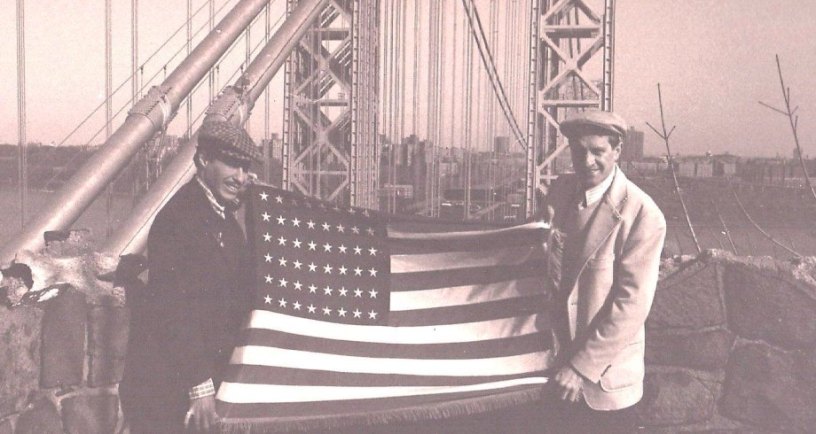
His Fort Lee High School athletic teams that he participated on were called “The Bridgemen,” named after “The World Famous George Washington Bridge,” alias “The Diamond Necklace” and “The Bridge to Everywhere.” It is an immense historic landmark and one of the most iconic structures on the globe. Embedded at “Bluffs Point” where the heroic leader of the Revolution stood spellbound on November 16, 1776, it stretches across the Hudson River to where the twin fort was in Washington Heights. The author crossed over it countless times by car and by foot on pilgrimage to the Cloisters, a medieval monastery museum located in that same area. His father marched over it with his Boy Scout Troop at the Grand Opening Ceremony in 1931, with future president Franklin Roosevelt presiding.
Yet another notable Fort Lee Historical Landmark was “The Riviera” Night Club, dubbed “America’s Showplace” prior to Las Vegas and built on the cliffs alongside the bridge. It was originally a “Gin Joint” or speakeasy during the Roaring 1920’s that drew some unsavory characters lurking in the shadows. A fire burnt it to the ground on Thanksgiving of 1936. It could have been just a hot potato or overcooked turkey, or a bolt of lightning with finger prints of the Italian/Jewish mafia! It just happened to be rapidly rebuilt bigger and better than ever and flourished till 1953 as a showcase for various entertainer headliners like Frank Sinatra, Sammy Davis, Jack Benny, Milton Berle, Pearl Bailey, Danny Kaye, Jackie Gleason, Abbot and Costello, Bing Crosby and Bob Hope, Dean Martin and Jerry Lewis and many more. It was also the hang-out of other famous Hollywood stars and sports legends like one of Baseball’s Greats, Mickey Mantle, and Boxing’s Best pound for pound Champion, Sugar Ray Robinson, who could be seen intermingling in the crowds. Another landmark was Palisades Amusement Park, which had its own song and was the world’s largest salt water pool.
As an “Ambassador of Good Will” and “Entertainer’s Entertainer,” The Traveling Troubadour journeyed throughout this great country singing Traditional Early Americana and international themed songs along with the comedy of yesteryear for all walks of life, including performing for many of the above mentioned celebrities of Hollywood’s Golden Age, renowned sports greats, award-winning music artists, military heroes, and global political figures. All of his experiences of patriotism were rooted, stemmed, and blossomed from his upbringing in that the historic town of Fort Lee. No matter where the winds of the Holy Spirit directed his mission as “The Traveling Troubadour” on many adventurous quests, it was there from whence he came and where he would return to hang up his many songster hats and take a needed retreat and rest. It was this place of family, hearth, and home, by which he was truly blest!
 Fellowship & Fairydust