
BY G. CONNOR SALTER
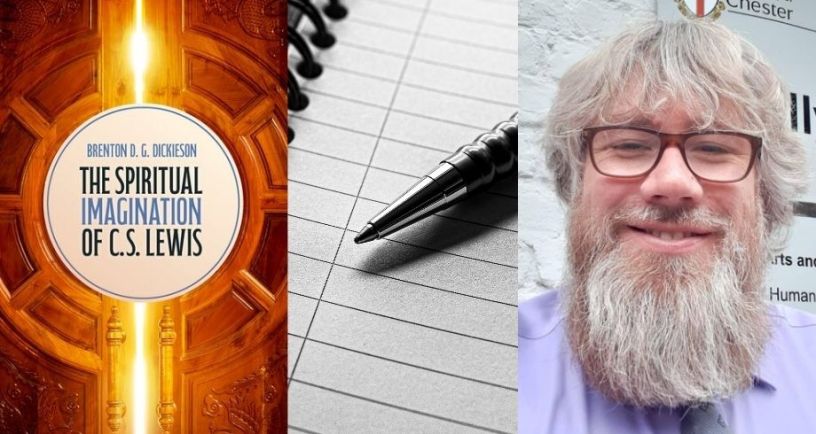
Brenton Dickieson (PhD, University of Chester, 2020) is a noted scholar of C.S. Lewis and L.M. Montgomery. His work on Lewis and other Inklings has appeared in all of the major peer-reviewed Inklings journals and on his highly popular blog A Pilgrim in Narnia.
The website has become home to his own insights, from timelines showing how long it took Lewis to compose the Chronicles of Narnia, to a review of Marvel Comics’ adaptation of The Screwtape Letters, to guest posts from such scholars as Kat Coffin on “The Problem of Susan.”[1]
He has contributed to several books, including The Faithful Imagination: Papers from the 2018 Frances White Ewbank Colloquium on C.S. Lewis & Friends and The Inklings and King Arthur: J. R. R. Tolkien, Charles Williams, C. S. Lewis, and Owen Barfield on the Matter of Britain. His first monograph, The Spiritual Imagination of C.S. Lewis, is forthcoming from Oxford University Press.
What was your introduction to C.S. Lewis?
Like a lot of kids my age, I found myself reading Narnia and, of course, loving it. Truthfully, it had slipped out of my imagination by the time I became a teenager. As I was studying theology in my undergrad and graduate work, I kept trying to read Mere Christianity. I could never get past the first part—the apologetics section, which I kind of loved in my feisty youth. I just could not resonate with most of the book.
However, one day after I’d finished my first graduate degree, I decided to download the audiobook of Mere Christianity. I had heard that the chapters had originally been lectures on the BBC, so I thought I would try reading with my ear rather than my eyes. It was in this mode that I really got a sense of what Lewis is doing there. I was able to connect a lot more authentically than by just reading and rereading the fast-moving, fun apologetic stuff and drifting off on the other bits. Ultimately, I’ve come to see it as a book more about the spiritual life as a whole than simply an apologetics text.
But it wasn’t Narnia or Mere Christianity or the quirky science fiction books—which I loved even then—that really did it. Peculiarly enough, it was The Great Divorce. I had never really heard of this book before I was assigned it as a teaching text in Japan. I was leading a free community class for advanced English speakers at our local church. To prepare for teaching this odd little story, I found myself looking up words in the first few pages and restarting it so I could figure out what was going on. I never imagined it would catch my attention. However, its haunting atmosphere and the little vignettes that we encounter drew me in little by little. It’s now become a bit of a mission for me—this Cinderella story of a novella. The Great Divorce gives me the most pleasure, it makes me think about the text, and it allows me to play with ideas more than any of Lewis’s books. It has a kind of ethereal loveliness that reminds me of both medieval and modern writers.
The move from being a reader of Lewis to trying an academic study of his work came after a fairly long journey … a journey where I spent less time actually doing research and more time fighting with myself. Most of us, at least in our age and generation, find ourselves boxing shadows at one time or another. For me, I was struggling to find a topic for my PhD thesis proposal that would be worthwhile working on for a decade or so.[2]
One day, I was at a conference, sitting by myself reading a manuscript of a novel I’d written. I was hoping to submit it to a publisher with the dream of starting a second stream as a novelist. A guy comes up to me—this sometimes happens at conferences; it doesn’t sound possible or real when you’re not in the academic world, but it does make sense in that context—and he says to me, “Hey, I’d like to publish your book.” I told him, “You would not like to publish my book.” He said, “Why? What’s it about?” I told him it was a kind of coming-of-age tale, except most coming-of-age tales are about growing older and this one’s about growing younger. It’s about a girl who thinks she’s an adult and is living her incredibly boring life quite happily and in a well-organized way, until her life turns upside down when a curiosity-filled orphan handsprings her way into her life.
So the guy says, “Well, no, I definitely don’t want to publish your book”—which is always such an encouragement, right? As we were talking, though, I realized that I was actually discouraged about my PhD thesis idea about American evangelicalism. I had long observed that there are certain trends and movements, particular recoveries and apexes within American evangelicalism. Often Americans are too close to the trend to see it clearly or universalize their sense of culture or Christianity by imagining what they experience locally in the Unites States is normal elsewhere and elsewhen. As someone who is proximate to the American civilisation but not himself an American living in the midst of it, I had a peculiar point of view. So I thought I had this thesis proposal all ready to go, and then all of a sudden someone published a book and it just blew everything apart. The new book revealed that everything I was predicting came true, which is nice. But it happened all in one go before I even had a chance to submit the proposal, so I was back at square one.
So I tell this dream-crushing guy my story, and he says to me in his always encouraging way, “You’re doing everything wrong.” He says I should never do a thesis with “Evangelical” in the title if I ever wanted to have a real job. No doubt he was right about that. Then he tells me that I can’t study something that’s emerging, because it’s not stable enough as research for a PhD. There’s time to become a prophet once you find yourself out in the field, but the PhD thesis is too slow-moving for that sort of thing. And he said a third thing: that I should study a person, not a random idea or movement. If I root myself in a person’s ecosystem of thought, if I connect with a creative public thinker and invest myself in someone with a certain body of writing, I can immediately join societies that discuss those ideas.
This was the most helpful discouraging person I’ve ever met, so I decided to leave the conference at that very moment. I walked down the hill from the campus and went into a bookshop downtown. I began pulling books off the shelf, one by one. I tried Wesley, various North American theologians, and the Germans I admired—Emil Brunner, Dietrich Bonhoeffer, Karl Barth, Jürgen Moltmann—but none of them fit. I needed to spend a decade with someone, so I had to enjoy it long enough to keep my attention. And it had to be somebody who had something sufficient to say but who had not said absolutely everything. Otherwise, else there’s no real reason for me to spend any time on it at all. Nobody in the “Theology” section in that bookshop fit the bill.
So I left the bookstore and did the most normal thing I could think of: I gave up. Why keep boxing shadows when I can visit my niblings, who live about an hour away? If I were going to fail as a scholar, I was still going to succeed as an uncle and have some time with my niece and nephew.
As I was driving across the New Brunswick wilderness, I had a CD set of C.S. Lewis’s lectures on The Four Loves. I had inherited them from the widow of a man who had been a student of both Tolkien and Lewis, and I had never listened to them. Out of mild curiosity, I put the CD in and was floored to discover that all four of the lectures are in Lewis’s own voice—actual recordings from the late 1950s.
I could hear that he had this combination of evocative writing with grand ideas, foundations deeper than he can show in just a few words, yet he left me all the space I needed to turn his ideas inside out and upside down into other kinds of cultural moments. But what I especially found was that he was smiling. It may seem like an odd observation, but it was an important discovery for me—that Lewis was enjoying himself. He was telling a story, and he couldn’t wait until he shared it with us. He was like a céilidh storyteller (kitchen party orator) from my own culture, telling the same old story again but with an entirely new energy and with something that is going to make us drop our jaws when we catch up.
I came to realise that all of Lewis’s work is rooted in speech. Much of it began in classrooms, or papers read for societies, or in lectures or sermons or debates, or shared with his Oxford writing group, the Inklings. Reading Mere Christianity by audiobook is an authentic way to experience that text, because that’s how the first audience heard it. And once I found this secret reality—that Lewis was a storyteller and a lecturer who spoke his ideas aloud and carried them around with him until he could write them down and then echo them in a new form later—I found I really understood the whole of his work. Things that seemed obscure or unimportant took on new meaning for me.
It was a fun way to read and a fun discovery to make, and I figured out that he had left me the space to do work on my own while also being a guide of what excellent and engaging nonfiction writing could look like—not to mention his world-class fairy tales. Next step? I began to read everything that C.S. Lewis wrote, chronologically, day by day and page by page. It took me about two-and-a-half years to finish. I just pretended I was already in a PhD programme until, one day, I finally found myself enrolled at the University of Chester.
Unless I’m mistaken, you came into Inklings studies after getting a bachelor’s and master’s in biblical studies. What are some ways you have been able to apply your earlier scholarly interests to studying Lewis?
The Shape of the Cross in C.S. Lewis’s Spiritual Imagination answers that question for the most part. Readers should buy it or have their library purchase it for them, but I will try to answer this question here.
It’s not surprising to me that I turned from Paul’s First Letter to the Thessalonians directly to The Screwtape Letters. My first publication was on what I call the “Cosmic Preface”—the missing archival material that shows Dr. Ransom as the translator and C.S. Lewis as the editor of a discovered correspondence by a demon in low places.
I knew from my studies of the New Testament how to read letters well. I knew how to think about epistolary fiction—fiction written in the form of letters. I knew how to read life writing, what we call memoir or autoethnography, the scholarly practice of studying culture through the lens of personal experience. Like Paul’s letters, to read The Screwtape Letters well, we can’t be thinking on a single line. We must always be turning things around and seeing them from the other angle, because sometimes Screwtape is lying, sometimes he’s telling the truth, and sometimes he is lying to himself. On any page, he might be telling us the truth or a falsehood in his æons-long project to cosmically gaslight humans. Screwtape is not a black-and-white, two-sides-of-the-coin text. It is more than satire. It is also the kind of thing that Saint Paul keeps doing to us.
There are other natural connections between the two fields. For Sørina Higgins’s Mythopoeic Award-winning collection The Inklings and King Arthur, I did a study on intertextuality—the way texts speak to and through each other—that came directly out of my Pauline methodologies. I also work with scholars like Michael Christensen and Leslie Baynes as they study Lewis’s views and use of scripture. It’s not one thing or another—biblical scholar or literary critic—because as all things unite in Lewis’s thought, those things are essential to bring together when reading Lewis.
Some academics would focus on publishing their work in journals, but from nearly the beginning, you’ve shared a great deal of your work through a blog. What motivated you to share so much of your work as it was progressing?
Yes, I’ve done an awful lot of writing, and I’m sure quite a few people think it is far too much!
Starting A Pilgrim in Narnia came out of a few motivations. First, I wanted to become a better writer—an ambition encouraged by hearing Lewis’s lectures and then reading his essays more carefully.
Second, because I was pretending to be a PhD student, I needed a place to talk about the things I was learning and the questions I had—a virtual classroom where I was both student and teacher. I needed it to be a sandbox, not a journal. A place safe to play, where I could be wrong and where I could be held accountable for my ideas and my limitations, because in the end, it’s all noise and nonsense unless it is good, true, and beautiful.
Third, I needed to find my way into the network of people who read C.S. Lewis and the Inklings. At that point, the blogosphere was the best thing going. In terms of creating space for communities to develop, I now think that our algorithmic overlords are letting us down, but back then, we could share and network easily.
Finally—and this is the hardest part to talk about—I knew that by studying C.S. Lewis, I was walking off the pathway of vocational wisdom. It was unlikely that I was ever going to get a job, is what I mean. There aren’t many Canadian universities specifically looking for a C.S. Lewis scholar, or that have been waiting years for a theologian of fantasy literature to show up. These aren’t job descriptions that come up in the want ads very often.
I knew from the beginning that I was never going to have a secure place at a university—that I was never going to send off a letter with a grand signature like “Chair of Speculative Worldbuilding at Awesome University,” or “Master of Arcane Knowledge, St. Lucy College, Oxford.” I knew I was going to be an independent scholar—that dreaded in-between position where so many great minds and great teachers work little by little on their big projects after their day jobs, or by taking forty percent pay from a university that says it values people and knowledge, but it just doesn’t value you in particular, or the things you care about.
Since I was never going to have that strong position, I had to make a space like that for myself. I was never going to be Fiction Chair at Highbrow University, so I decided I had to be Brenton Dickieson, Curator of apilgriminnarnia.com. I hope this doesn’t seem crass, but it was one of the realities behind my platform creation and my choice to become my own editor.
And … let’s be honest: no other editor would have allowed me to publish half the things I’ve been able to publish on my website.
From day one as a blogger, I decided I would not apologize and that I would write what I wanted to write. No doubt any student of psychology could sense a certain rebelliousness there! But because of my platform, I’ve published between one hundred thousand and half a million words a year for the last dozen or so years, and it is nice to feel I’ve been of some use. A hundred or perhaps two hundred people might read a super-hot essay in an academic journal. A good essay gets ten or twenty or fifty times that readership when it is offered free online. That’s my math.
You have observed in one of your posts that rereading Lewis’ work is more important than reading him.[3] What Lewis books do you especially enjoy returning to?
Here’s an answer any good editor will groan at: I enjoy most the C.S. Lewis book I’m reading now, whatever that might be. That’s cheesy, I know. But I don’t often think about Prince Caspian on its own. If I were to accidentally pick it up and start reading, though, I would find new delights and new ideas and things that make me suddenly heartsick or eternally overjoyed or itching to write something down. I mean, they published an audiobook of his OHEL volume—the Oxford History of English Literature, about five hundred pages of pretty obscure sixteenth-century poetry and prose—and I enjoyed experiencing it in that mode. I ruined my OHEL first edition by filling it up with my marginal notes.
Since I’ve already confessed that The Great Divorce is my favourite, let me add a few others. I enjoy Out of the Silent Planet and That Hideous Strength more than Perelandra, though I love Perelandra’s beginning and ending, its fictional frame, and the gorgeous world Lewis built there. I am always amazed when I reread An Experiment in Criticism. And I try to read Till We Have Faces every year, sometimes alongside Sheldon Vanauken’s A Severe Mercy. I suspect Till We Have Faces will eventually be the best regarded of Lewis’s writing from a literary standpoint.
One of your most notable discoveries was publishing an early draft of The Screwtape Letters that showed Lewis was planning to connect the book to his science fiction trilogy. How has reading The Ransom trilogy and The Screwtape Letters as belonging to the same series changed how you approach those books?
Well, I’ve written a whole paper on that, free online in Mythlore! Beyond this pithy evasion of your question, there are a few things worth noting.
There’s a certain tenor or timbre to Lewis’s World War II writings. He is working in certain modes and developing his vocabulary in a way that’s sensitive to particular audiences. The Ransom cycle is written almost entirely within that journey, and I believe the wartime pressure produced great creativity. His apologetics trilogy—Mere Christianity, The Problem of Pain, and Miracles—were primarily written during the war. The Abolition of Man is worked out in fiction in That Hideous Strength, both written during the war. He writes Perelandra while working on A Preface to Paradise Lost, and you can see the connection when you read them side by side. This is what I call the “Echo Effect” in C.S. Lewis—the way he tries out an idea in a workbook, a poem, or a lecture, and then develops it into a story, book, or essay. Seeing Dr. Ransom appear in unexpected places makes sense once you understand that Lewis was bringing everything together in his mind during this period.
Another part of this comes back to my interest in speculative worldbuilding. Imagine that we discover the fictional worlds within Out of the Silent Planet as anthropologists of the future. We would want to study language, ecology, history, physics, metaphysics, understandings of the spiritual, questions about magic and engineering, the heart’s desire of the people and the things they fear—all the things that make up a world. Then, because we have Perelandra and That Hideous Strength, we can extend our understanding of cosmology, theology, natural philosophy, and linguistics throughout the trilogy. Those three books are in different genres and speak quite differently, but they are united by a blend of medieval and modern cosmoscapes—the imaginative landscapes of the cosmos—that provide both atmosphere and meaning.
We also have The Dark Tower, a partial book that helps us understand Lewis’s thinking about creativity and the kind of story he wanted to write. Charlie Starr and I later published a piece that we believe is Lewis’s attempt at an angelic letter—an answer to Screwtape—and now we have even more of that story.
Adding The Screwtape Letters into that speculative universe tells us all kinds of things about the Field of Arbol (the fictional world of the Ransom books). Just as we have a picture of Malacandra, Perelandra, and Thulcandra, and That Hideous Strength shows us the people of this silent planet, The Screwtape Letters shows us what’s happening in the spiritual sphere—the space of these intelligences that engage with the inhabitants of their world. It’s a huge opening of dimensions, and if I could find the time, you could read a book about it.
Many early readers pick up on some obvious Christian references, but there are many other ways that Lewis alludes to theological concepts or biblical images. Can you think of any surprising allusions that you did not discover until re-reading the books?
Perhaps this is an opportunity to follow the path of the ridiculously gassy Gilderoy Lockhart—your professor at Hogwarts—and say, “See my published works!” My book on the shape of C.S. Lewis’s spiritual imagination is largely about the surprising, creative, unusual, embedded, and symbolic ways of expressing biblical, theological, and philosophical images.
The thing about writing a book is that whether or not it’s an obviously good or relatively poor book, you go through a whole process of study—looking at the text in detail, reading it over and over, trying to read it in different ways or by different media, pulling it apart and putting it back together, changing the question and turning it upside down and restarting and disproving everything you want to say, and a hundred other ways of living within the text. The result of all this is a personal connection, true, but mostly it is a framework for rediscovery—true, engaged, critical, and creative rereading.
Part of this journey is rereading in community. Whenever other scholars or artists dig into great work, I get to experience it in new ways and learn, often for the relatively low price of a book.
While many readers remember the way Aslan parallels Christ in The Lion, The Witch and the Wardrobe, it is not the only moment in Lewis’ writings where he considers the cross and its meaning. What are some other ways that you see “cross-shaped thinking” appearing in the Chronicles?
There are two ways to answer this question. The first, most obvious way is to look for scenes that parallel the Stone Table scene in The Lion, the Witch and the Wardrobe and throughout Lewis’s fiction. Dr. Elwin Ransom offers up his life in Malacandra and Perelandra. The Princess Psyche becomes a sacrificial replacement for the whole community in Till We Have Faces. King Peter offers himself as a combatant against Miraz the Usurper in Prince Caspian to save the Narnian creatures from further suffering. The pattern of laying down one’s life, like Jesus, is vividly present throughout Lewis’s writing, just as the Christ figure is a living part of Western civilization’s literature.
I’m not going to take this approach—though I won’t ignore it totally, either. In The Spiritual Imagination of C.S. Lewis, I look at “the shape of the cross” in his writings. The events of the cross—Christ descending into death and rising into new life—are patterned everywhere in the library Lewis left us. This U-shaped action—down and up again, but tilted on its side—is the shape of the there-and-back-again nature of fairy tale. It is the pattern of comedy as a classical genre. It is the shape of satire, where everything gets turned upside down. It is patterned in Lewis’s invitation to childlikeness and humility as a reader. The dying-to-self and the raising-to-life pattern is conversion—not just Lewis’s own conversion story, but the way each character must face a core weakness or critical flaw, surrender that thing, and live with grace and confidence on the other side of their struggle.
And the death-and-resurrection pattern of Easter weekend is the shape of the plot in so many cases, like the descents and ascents of Dr. Ransom in Perelandra, or the ladders of humility for Jane and Mark in That Hideous Strength. It is patterned in the series of downward and upward movements in The Silver Chair that form a chiasm—a series of twinned bookends: The story begins and ends in a schoolyard in our world. The heroes go through the doorway to Aslan’s country, then down into Narnia, then down into a land beneath Narnia with a peak even further to the uncharted fire-world of Bism. Then the story turns and the heroes go up from the darkness into Narnia, and then up to Aslan’s country, and then back to their schoolyard gate.
The pattern is always there not just because Jesus’s self-sacrifice is an archetypal pattern that we tap into. It’s also more than just a compelling story that captures the essence of self-giving love. Rather, for Lewis, this U-shaped death-and-resurrection is built into the inherent structures of our universe because it is there in the character of God. It’s a very cool journey to have made in Lewis’s writings, and I hope others will join me by reading The Spiritual Imagination of C.S. Lewis, which will be out in July 2026.
Scholars often debate whether Tolkien really organizes his worldbuilding better than Lewis. You have written several times about your skepticism of the Planet Narnia Thesis, so I’m curious: what do you see when you read the Chronicles of Narnia? A chaotic jumble of mythologies or a mix that offers its own pleasures?
I’m one of the few scholars who has worked through what I consider the essential problems with the Planet Narnia thesis. But I’m also someone who uses that book in my teaching and research and considers it understudied in key ways. Take the concept of donegality—the secret atmosphere built into writing. This needs more work and more testing, because besides being a productive lens, but also because Lewis’s own writings pushback against the intentionality of meaning that the theory presupposes.
What I don’t doubt about the Narnia code is that the planets—as imagined by medieval folk and early Renaissance poets, based on the classical models they loved—are influences in various ways throughout the Narnia Chronicles. Ward’s book captures something essential about Lewis’s bookshelf within the book: the stories and sources Lewis read that find their way into the Chronicles and his other works.
In The Inklings and King Arthur collection, I argued that when Lewis draws other stories and bits of nonfiction or philosophy into his fiction, he is not just bringing in quotes or even ideas. He is drawing the entire world of that other piece into his own world. When he is writing, Lewis’s mind works like a wormhole to other fictional worlds. The medieval cosmology—this beautiful and intricate dance of the planets and the music of the spheres that informs medieval and Renaissance poetry—is not just a nice structural element or a key idea in the Chronicles. It fills the entire world.
Michael Ward argues that the plot lines of Narnia are informed by and infused with these planetary ideas, and for the most part, I agree, though I don’t always see it when we go passage by passage together. He also argues that the rules of the world are made up of this medieval cosmology—that each book has a planetary structure, and the ways they relate inside and between books are structural walls. I want to push further. In a talk for St. John’s College in Cuddalore, India, last year, I tried to take my listeners on a walk within the walls of the world. Lewis is bringing in not just the ideas and beauty and structure of medieval cosmology but the whole worldview. That reality seeps into the walls of the world and gives it its whole flavour. This is where Ward gives us the best possible resources, even if I don’t buy the Planet Narnia thesis itself.
That still does not address the question of intricacy. J.R.R. Tolkien is not just an intricate worldbuilder compared with Lewis, but compared with pretty much anyone in the known universe. We love to read The Hobbit and The Lord of the Rings and discover all these wonderful stories, but the author lived as much for the world as for the literature. His life work wasn’t telling Frodo’s story exactly, but building the world in which Frodo lived. He spent his whole life doing that, always worried he would never finish. He never finished.
Anyone who has studied the remaining documents in The History of Middle-earth knows that Tolkien himself had thought-jumbles and mythologies and things thrown in together. That was his process—trying to find his way to the story in its fullest form. But those contradictions and jumbled-together bits are not problems. They’re like the layers of a Renaissance painting within one of the great studios, where months and years of work—and in Tolkien’s words, “many hands and minds”—find their way into meaningful story by the author’s hand. It is those other hands and minds combined with his emerging artistic process that make him such an original genius. Part of that includes the support network he was part of, especially C.S. Lewis and the Inklings.
Lewis never approached anything like the Middle-earth project. Even though he called himself a systematizer and loved bringing together the bits and pieces of different worlds and making them connect, he never had anything like a desire to do what his good friend did. It wasn’t on his mind—to write that way, to live that way. It is simply not how his maker’s mind worked.
And there are remarkable gaps in Lewis’s worldbuilding. I was in the Bodleian Library reading through Lewis’s archive, and I found a transcript of the English poet Ruth Pitter chatting with the Lewis brothers, in which she notes the problem of finding fresh potatoes after a hundred years of frost. Lewis laughed and said to her, “I refer you to the text.” It wasn’t his interest. He likened fictional writing to a bubbling-up process—a conversation between the artist who generates ideas and words and images, and the person, the man with a conscience and personal goals, who structures that into something readable and carries meaning beyond his own capacities.
But this is where the question itself creates a distinction I don’t think is necessary. To say that things are mixed together in Lewis—that various mythologies and images sit alongside other kinds of sources—is not to say there is an inherent weakness in the work. That we find Nordic as well as Greek and Roman influence in Tolkien’s Middle-earth is only to say it is a rich world, bringing in those threads not just from their original spaces but through various medieval lenses. It’s that worldview-seeping-through thing, like maps bleeding through the parchment.
For Lewis, the process goes a step further back. There is a deeper meaning in his mixing of mythologies and his pulling in of other works and worlds. It’s not random—it’s emergent. It’s part of the bubbling-up process that gave him great joy as a writer and creator.
So yes, I absolutely think Narnia has pleasures of its own in its construction. It’s not haphazard, but it’s not intricate either. The Narnian himself is uncovering the world as he goes, as is the case with many writers. He is looking for verisimilitude—that quality of seeming true, of feeling lived-in. If you take time to walk within the walls of his worlds, you will see what delights so many readers and elevates their reading experience.
You observed in a 2021 blog series that Tolkien scholarship often appears stronger than Lewis scholarship, and then offered a follow-up blog series recommending various Lewis studies.[4] What are a few things you would like to see future Lewis scholars explore?
A difficult question, because one of the strengths of C.S. Lewis studies is the natural, integrated connectivity between the people doing the scholarship and the kinds of topics they explore.
I would like to see scholars use the full toolbelt of literary-critical approaches to explore Lewis’s writings, instead of casting away the whole enterprise as “literary theory” in quotation marks. I’m curious about new structural readings, material studies, or conversations about gender, class, or race from scholars who have lived in various parts of the world or who are growing up in emerging spaces of readership—Nigeria, India, Korea, Brazil, and so on. I would like to see more on Lewis and his classical roots, and I think it’s time for a good book on cartography—though as a cartographic non-specialist, I am looking at mapping in the work I do. There are many ways I would love to see more work on Lewis; the beauty of it is that I can’t do it all, or even most of it. Since writing that blog series, the volume of Tolkien materials has increased and continues to produce good work every year.
Because of that volume, when a student wants six sources on a particular topic, they’re likely to land with six better sources in Tolkien studies than in Lewis studies. But it is our job as educators to teach students to be discerning about their research. Part of the strength of Lewis studies is the integrated aspect—you’re more likely to find something on faith or worldview where the author is making a personal connection, or something using an autoethnographic lens, a mode of study where the scholar’s own experience becomes part of the critical conversation.
But I want to flag a few provisos.
First, there is a Lewis industry of books and blogs and articles and podcasts, and you’re far more likely to find people simply sharing discoveries or talking about the parts they like, or doing scholarship without looking at what others have said, even when their own close readings are good.
Second, because Lewis is a holistic writer who brings all things together, scholars need to approach him with that kind of study at the deepest level of research. That’s hard to do, and often obvious when it’s missing.
Third, John Garth, author of Tolkien and the Great War, has reminded me that there’s a depth as well as a breadth to Tolkien’s writings that gives more space for scholarly development. This is true in the Middle-earth materials especially, and Tolkien studies as a whole shows more openness to using the full range of literary tools, which produces more dynamic experimental work.
My biggest caution, though, has to do with self-awareness, and this concerns me in both Tolkien studies and Lewis studies.
Both are British writers who spent most of their lives in the Oxbridge context. Both are literary scholars working out of a Christian worldview but expressing it very differently. Both wrote at theoretical levels in their disciplines as well as providing historical studies and numerous kinds of literary criticism. What disturbs me most is that Anglo-American readers can forget the gap of time and space between us and them.
Right now, I am reading a pretty good book of Lewis essays, and the contributors keep using the phrase “our culture.” Everyone in the volume is American or doing significant work in the United States. It’s not clear to me that “our culture” automatically includes Lewis and Tolkien. The contributors write from a specific religious point of view, one for which I have a great deal of sympathy. But two essays in a row begin with American examples—one quoting an American president, the next beginning with an American legal case. Nothing wrong with this. But I don’t think all of the scholars know that they are local and they are using local case studies. The phrase “our culture” does not encompass their readers in England, Canada, Australia, and beyond. They always aren’t fully aware of the international space into which they’re speaking from their American intellectual home.
It’s also not clear to me that Christian cultural critics know that the American church at this particular time and place is one local church within a global community—actually a trans-dimensional community that crosses time and space through history and across different parts of the world, the church, which is the most ethnically diverse institution in human history, with supernatural layers beyond anything we can imagine, “terrible as an army with banners,” as Lewis puts it in the second Screwtape letter. The local struggles of the United States in the 2020s have complexities and nuances that Lewis and the Inklings would not just be unaware of—they couldn’t conceive of them. That’s one of the points of us reading these old books.
When Lewis uses a phrase like “transsexual” in a context where he also says “transgastronomic,” we need to recognize the distance between his gender conversation and ours. The political instincts are simply different, with a more conservative, restorationist foundationalism and biblicism in the United States, though there are progressive and liberation threads as well. These are not the tensions Lewis was writing into. When Lewis critiques socialism or capitalism, it is quite a distance from the socialism and capitalism that need intelligent criticism in the United States—not to mention the other countries where readers sitting down to read this American collection of essays.
It’s not that Lewis cannot speak to our cultural moment—he precisely can. He encouraged the reading of old books to allow those books to critique us and to point out mental and cultural gaps that are hard to see from our own angle. But to do that, as he lays out in his methods for reading literature, he wants us to respect the distance between the author’s world and the reader’s world. The text becomes the mediating bridge. We draw that distance together by learning about cultural differences and distinguishing between our space and his—between our reading chair and his writing desk.
Among the many Lewis lovers on podcasts and YouTube and blogs, there is a fervent desire to take in this great wealth of work—this brilliant bookshelf of mortal and eternal moments. I’m glad. That’s awesome. But I don’t think they know that they are local, and that their locality is not the same as the author they’re reading.
This is the critical point where Lewis scholarship is in the most danger of failing to understand the way Lewis read and lived—and, especially, the ways he taught us to read and live well. It’s not that Americans are particularly problematic individually—it’s that so much material, often great material, comes out of the United States. When I read someone using Lewis for cultural criticism or theological development, I want to see that they have allowed these old books to critique them and that they’ve embodied that critique. I usually see this prophetic criticism in theological works on Lewis. I see it far less with cultural criticism that uses Lewis to talk to American culture.
So many times, someone writing about gender or race or class or systems is using Lewis to address the problems in their own world—and yet it is hard for me as a reader to see that they have allowed Lewis to critique them and point out their blind spots. This sounds harsh, but it is the fundamental problem of C.S. Lewis scholarship today. The problem is not that so many people are writing devotional books, or using Lewis in their sermons, or writing what looks like scholarship but is really smart popular reading—all of that is well and good, as far as each individual piece is good. The real problem is this: Do we, as writers and scholars and artists who use C.S. Lewis, know that we are local? Do we use the text to bridge the space between us and the author? Or, in our fervent and passionate energy to capture ideas and build them and make them live in new ways, are we actually eliminating the time and space between us and an author who has something to say to us precisely because he is not sitting next to us?
[1] https://apilgriminnarnia.com/2018/09/13/a-timeline-for-the-creation-of-narnia/; https://apilgriminnarnia.com/2015/12/10/abigail-santamaria-on-joy/; https://apilgriminnarnia.com/2019/04/24/problem-susan/.
[2] Dickieson tells a fuller version of this PhD journey on his blog, at https://apilgriminnarnia.com/2021/03/30/the-other-reasons/.
[3] https://apilgriminnarnia.com/2023/03/29/rationale/.
[4] https://apilgriminnarnia.com/2021/04/06/why-is-tolkien-scholarship-stronger-than-lewis-scholarship-part-1-creative-breaks-that-inspired-tolkien-readers/.
 Fellowship & Fairydust