
BY G. CONNOR SALTER
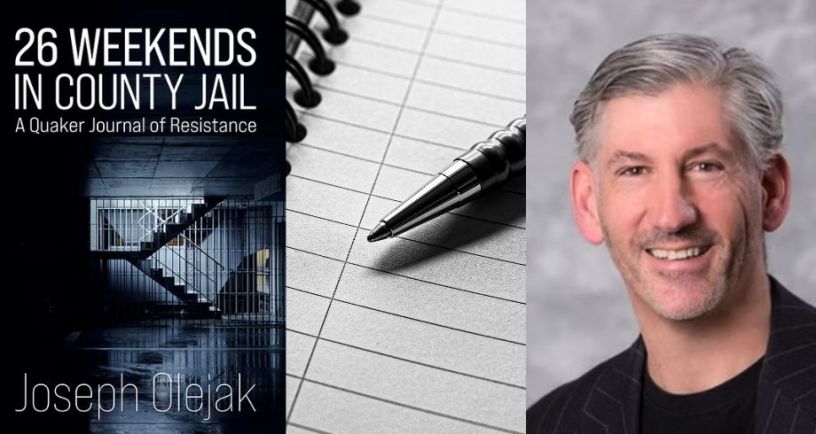
The question of what it means to follow God and also be a good citizen, whether to follow a society’s policy or rebel against it, has plagued Christian thinkers for centuries. Dr. Joseph Vincent Olejak, D.C., reflects on that dilemma in his new book 26 Weekends in County Jail: A Quaker Journal of Resistance, based on his 2013 experience serving time in New York state’s Columbia County Jail for not paying income tax since 1994.
As Olejak describes it, he became concerned about his income tax being used to support war efforts when the Clinton administration brought economic sanctions against Iraq. A key moment came in 1996, when he watched then-Secretary of State Madeleine Albright’s interview on 60 Minutes about the sanctions killing half a million Iraqi children and Albright stating the sanctions were “worth the price.” Olejak declined to file federal and state income taxes throughout the economic sanctions, the Iraq War, and the later War in Afghanistan.
In the 2000s, the IRS investigated Olejak for evading income tax, an investigation that would eventually include federal agents removing documents from his office and numerous court appearances. When Olejak was eventually charged, he informed probation officers of his religious reasons for declining to pay taxes, citing his participation in a Quaker community. In 2013, Olejak was sentenced to pay over $262,000 in back taxes and serve 26 weekends in jail, as well as 200 hours of community service and five years of probation. His story gained the attention of Forbes finance writer Peter J. Reilly, as well as profiles in Friends Journal and the Times Union.
Olejak is an active member of the Old Chatham Monthly Meeting in Chatham Center, New York, promoting peace and justice issues. He has written about faith and incarceration for Friends Journal, New York Yearly Meeting, and the National War Tax Resistance Coordinating Committee.
Interview Questions
How familiar were you with Christian traditions that promote peace and nonviolent resistance when you began taking your stance against war taxes?
I was brought up in the Catholic church and then later an evangelical Christian denomination until I went to college. The story of Christ stopping Paul in the garden when he cut the ear off the sentry and then healed him was a powerful story. Christ promoting peace was always a part of my life. When the US embargoed Iraq and starved 500,000 children, it was a very deep violation of the ethics I was brought up with. That’s when I became a war tax protestor.
You have published anecdotes from your jail experiences in Friends Journal in 2015. What led you to decide to publish a book version?
Writing the journal was in the back of my mind, but it really wasn’t my decision. It was a leading that I followed. In the Quaker tradition, of which I am now a part, being led refers to leadings of the spirit. At the end of each weekend in jail I had what I can only refer to as a “download.” I was literally compelled to write what I had witnessed. I did not quite understand why at the time, but a decade on from that experience it became clear that it was to share. And now that we are a nation at war again in Iran it more prescient than ever.
You mentioned in a 2015 Quaker Author Podcast interview with Martin Kelly that you were proceeding but had not yet formally joined the Religious Society of Friends when you were charged. Can you share some of your journey to becoming a Quaker?
I stopped paying taxes in response to the violent actions of the US government against the children of Iraq.* The embargo was a war crime of collective punishment to get at Saddam Hussein. I became a Quaker in 2009 and was charged in 2011.** My journey was swift. I entered the Old Chatham Quaker Meeting looking for a spiritual home and instinctively knew I had reached the right place the moment I walked into the building. The social justice aspect of Quakers really spoke to me. It was as if these people really put their actions where their values were.
Was there anything that specifically drew you to the Religious Society of Friends (also known as the Quakrers) over other Christian traditions that emphasize nonviolence?
Among the peace churches I was aware of (Quakers, Mennonite, and Brethern) the vibe of the Quakers; in particular the silent worship, resonated with me. In particular, Quakers have no creed. There was no ritual or rites to adhere to. One finds their own way to God. One listens for the leadings of Spirit. And its not an individual thing, Spirit moves through a gathered meeting where many are listening in the same way.
In your Friends Journal article, you mention being interested from the start of your jail time in keeping a Quaker journal. For those unfamiliar with the history, what is a Quaker journal?
Quakers have a long history of being jailed and writing journals. The Journal of George Fox was about his experiences following the light of God within and his writings on social justice during his time. He called it a journal. Writings teach and inspire. They also live beyond our brief sojourn and can guide future generations. I had read Fox’s journal and as the story of the men I had met in jail congealed into the book it is now, it made sense to call it a journal in keeping with Quaker traditions.
You had published nonfiction writing before your case, even being listed as a co-author of a 2004 book with Bruce Bond, but your earlier work focused on nutrition and chiropractic care.*** What was it like shifting to a new genre?
The book with Dr. Bond was a technical book on how to apply nutritional support for health issues. It was a book about facts, diagnosis and recommendations, but it was definitely not story. 26 Weekends is a very different kind of book. It is about the realities of peoples lives and it weaves in and out of how laws and government systems affect us. It is a book about how listening can change our perspective. How compassion and empathy can grow out of that awareness. On some level it is a Christian story.
You’ve described being given a copy of Howard Haines Brinton’s collection Quaker Journals: Varieties of Religious Experiences Among Friends before going to jail, and reading Nelson Mandela’s Long Walk to Freedom during those weekends in jail. Did any other books influence your writing style?
Without a doubt, the greatest influence on my development as a writer was being handed a copy of Kurt Vonnegut’s Slaughterhouse-Five when I was 16. A friend, and Quaker educator at George School in PA, gave me the book because he was a conscientious objector [CO] during the Vietnam era. He was very concerned about young men being called to war even though during the eighties we had a volunteer army—but as we know all of that can change at any time.
Vonnegut’s description of the burned bodies (the Leichenschrumpfung) after the allies fire bombed the city of Dresden (considered a safe city by German refugees) had a profound effect on me. Vonnegut’s description of being part of a corpse squad is a visual image that never left me.
During the Cold war, I had many fears about a nuclear holocaust and being turned into one of those burned corpses. Carl Sagan’s writings also influenced me. And while he was agnostic about God, he did have a lot to say about the stupidity of war and in particular the trillions of dollars wasted on it. That spoke deeply to my condition.
Many readers may not know that writing about one’s life is often a task of rewriting, expanding material or finding a new framework. Did you revise any of the material as you were editing it for publication—adding chapters reflecting on your experience, that sort of thing?
No, the book came out of me one download at a time. My editors helped to organize the manuscript and place social commentary as endnotes rather than inside the chapters. What is interesting is that the framework has not changed. The framework was and still is listening to that of God within me. That voice has persisted over time and I’ve come to trust it. I really feel as though the book was and is complete as it came out each weekend.
You write about choosing to connect with other inmates at the jail—offering chiropractic care, performing yoga exercises and listening exercises with them, hearing their stories. What surprised you the most about these interactions?
I was confronted by my own prejudice. I had so many “Ah ha” moments where I expected one thing and was pleased to discover that human beings are human beings; full of kindness and not at all one sided. Skin color has nothing to do with it. What was most shocking to me was how deeply I was unaware of the effect of my own prejudice upon my perceptions of others. How it was just operating silently in the background. I’ve had to confront that and do the internal work to see people for who and what they truly are. It has been humbling.
Reading some of your writings where you describe conversations with inmates, I was reminded of And the Criminals With Him, civil rights campaigner Will Davis Campbell’s writings critiquing the prison justice system. You raise many concerns about policies that make it difficult to avoid becoming a repeat offender, particularly how the criminalization of narcotics affects people with addictions. How has your thinking about the prison system developed since then?
I have an even dimmer view of the system since I was incarcerated. Since that time we have developed a system of concentration camps in the US to detain people without due process. We dehumanize by calling them “aliens.” ICE is a paramilitary force that is arresting people (and killing Americans) without judicial warrants. Those ideas alone constitute criminal behaviour on the part of the government and US taxpayers are forced to fund it. Obama, Biden, Trump and probably the next occupant of the white house will separate families and arrest and jail children. It is so offensive that I find it hard to even find words to describe it.
Here in New York state, we have a Department of Corrections that is barely functioning in terms of obeying the law. Many quit (or were fired) over their response to the HALT legislation [Humane Alternatives to Long-Term Solitary Confinement Act] that limited solitary confinement. The system is still not fully staffed and inmates have lost a great many services that could foster rehabilitation (such as religious services and educational programs)
In your 2014 video interview for QuakerSpeak, you suggest a potential legal reform for citizens concerned about how much of their income tax goes to war efforts. Have any Christian thinkers inspired you as you continue to ponder these ideas?
The notion of a Peace Tax Fund has been around for a long time. It grew out of the Vietnam war in 1971. A Quaker and CO [Conscientious Objector], David Bassett, wanted a way for people to follow their conscience and the law. The main Christian thinker that has inspired me was Martin Luther King, Jr. I remember the day I heard his speech in the Riverside Church in Harlem where he talked about the three evils of racism, povery and war.**** I was so riveted by it I pulled my car off the road to not lose the radio station and listened until the end. That’s it!! I thought to myself, if we can do something about these three things we can make a difference and bring about what King called the blessed community.
You have mentioned the great sacrifices that came with your stance—struggles with family members, financial problems. Unless I am mistaken, you were sentenced to five years of probation and finished your probation period in 2019… not long before the COVID pandemic occurred. What helps you stay encouraged in difficult circumstances?
Many of my friends have said that similar circumstances would have broken them. I would say that my resilience is due to the good people that have surrounded me throughout this entire situation. A great deal of goodwill has flowed my way from the Quaker community and from the many friends I have in Columbia County. They see part of themselves in me and the actions that I took. That seeing had them lend a hand and offer the kind of emotional support that bears people up in hard times. It’s the Sermon on the Mount. It’s that of God in everyone.
Any Quaker authors you would encourage readers unfamiliar with the tradition to explore?
Walter Wink, Nadine Hoover, and Phillip Gulley have been very clear Quaker thinkers over the last many years. Understanding Quaker process is a way to put the Quaker values of Spirituality, Peace, Integrity, Community, Equality and Service (SPICES) into action. An old Quaker saying goes like this: A child asks her mother, “Mama, when does the service begin?” And she answers, “When silent meeting for worship is over.”
26 Weekends in County Jail: A Quaker Journal of Resistance is published by Catalyst Press and available through all major book retailers.
* Some articles about Olejak’s case mix the date he started withholding taxes (1994) and the year of Albright’s 60 Minutes interview (1996). When asked for clarifacation, Olejak explained, “1993–1994 was when the embargo (and my withholding taxes) began. I pegged the date [to] the Albright interview because that is when I got really upset about the whole thing.”
** New York state court documents attest that the IRS first served Olejak with a summons to present income tax information in 2006. He recalled the IRS investigation began in earnest in 2009 with agents siezing documents from his office, then he was charged in 2011 and sentenced in October 2013, finishing his jail sentence in May 2014.
*** Olejack is listed as co-author with Dr. Bruce Bond, D.C., of Synergistic Therapeutics: Combining Whole Food Nutrition and Herbal Medicine for Common Ailments (2004).
**** This particular broadcast of the speech occurred after King’s death, not live coverage from 1967. Rediscovered recordings of King’s 1961–1967 Riverside sermons are available at the Riverside Church Archive.
 Fellowship & Fairydust