
BY G. CONNOR SALTER
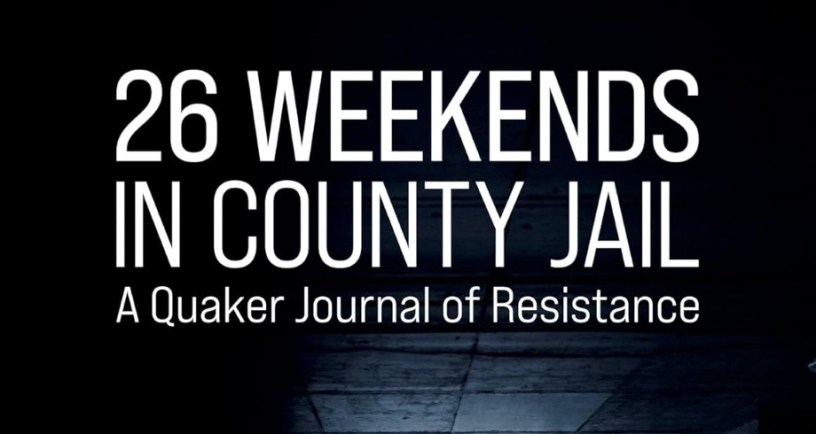
26 Weekends in County Jail: A Journal of Quaker Resistance. By Joseph Olejak. Flare Press (a division of Catalyst Press), April 2026. Paperback, 256 pages.
When Joseph Olejak entered the Columbia County Jail in New York State in 2013, most the other inmates didn’t know Quakers still existed in America, much less active Quakers protesting the government. Olejak had been sentenced to spend twenty-six weekends in county jail, along with probation and financial penalties, for refusing to pay income tax since 1994.* He had stopped paying taxes when he realized over half of his income tax supported military efforts and that he could not condone the War in Iraq.
During his weekends in jail from 2013–2014, Olejak challenged himself to avoid bitterness, using meditation on the Bible and other disciplines to keep the isolation and harsh environment from getting to him. He also bonded with many fellow inmates, offering his experience as a chiropractor to help with their medical issues and his legal experience to recommend appeals. As Olejak helped these men, he heard their stories. Construction workers who bought narcotics to relieve chronic pain. Vietnam veterans exposed to heroin during their service. Child abuse survivors who fell into cycles of violence. Paroled criminals sent back for slight offenses. What begins as a time to reflect in solitude on his decision to protest war taxes becomes a journey to understand how much addiction, profits, and bureaucracy inform who gets imprisoned and how hard it becomes to avoid returning to the prison system.
While this text is rooted in journal entries written in 2013–2014 (many published in the Quaker publication Friends Journal), the text has been considerably expanded to include reflections on the political themes that Olejak’s experiences brought to mind. When he thinks about how many of his fellow inmates have drug addictions from being given prescriptions instead of physical therapy for pain, he includes recent studies on the benefits of seeing a chiropractor or pursuing organic medicines. When he reflects on how access to treatment centers determines whether people addicted to pain medication can handle their pain through legal venues before trying drugs, he highlights how the Obama and Trump administrations affected people’s access to treatments centers. For all the new material, the book is essentially an expanded version of the concerns Olejak raised in the 2010s, showing how little has changed. Bureaucratic tax systems making it difficult for concerned citizens to avoid complicity in unjust wars, profit-seeking making it difficult for Americans to get holistic care for chronic pain, and bureaucratic justice systems making it difficult for people who develop addictions from pain issues to avoid imprisonment… whatever solutions the reader believes will handle these issues, they can agree the issues have not gone away.
Given how much Olejak expands on his earlier reflections with new books and articles, I did find myself wishing he went deeper into discussing Christian authors who have discussed these problems. He cites a few stories about Quaker protestors resisting the government, but not many by name. He evokes Martin Luther King Jr.’s concerns about racism and applies those ideas to prison reform, but does not discuss King’s famous “Letter from Birmingham Jail” or writings by Will Davis Campbell, an associate of King’s who became known for his radical commitment to solidarity with prisoners. Part of my surprise may be down to my reading tastes; Campbell is under-read today. It may also be that my knowledge of Christian pacifism flows from a different stream. When I think about Christians protesting governments or resisting war efforts, I think of Mennonite ancestors from my maternal family, the vivid narrative that Anabaptists carry of their history. Quakers, according to Olejak, prioritize feeling the Holy Spirit over following a creed. Having a detailed sense of a movement’s history usually means the movement has developed creeds and institutions mandating how those creeds are passed on. So perhaps the Quakers emphasis on feeling the spirit trumps having a strong institutional memory.
As much as I wanted a deeper engagement with Christian pacifism, I appreciated the author’s passion for handling important issues. I also appreciated the critiques Olejak raises as a chiropractor and nutritionist of how profit-seeking enables some of the problems he saw in jail, and then bureaucracies make it difficult for people to move past their problems and become better citizens. I cannot say I shared every one of Olejak’s views on how to solve these issues. But he points in the right direction, challenging readers to ask important questions.
An engaging memoir about resistance and a convicting call to consider the forces that make violence, addiction, and imprisonment pervasive in America.
*The book opens with a moment in 1996 when the author considered writing a tax check and chose not to file it after seeing Madeleine Albright’s 60 Minutes interview discussing sanctions on Iraq. The author clarified in a recent interview that he associated his commitment to protest war taxes with that strong memory, but he had been withholding income tax since 1994.
 Fellowship & Fairydust