
BY G. CONNOR SALTER
Tell us a little bit about yourself.
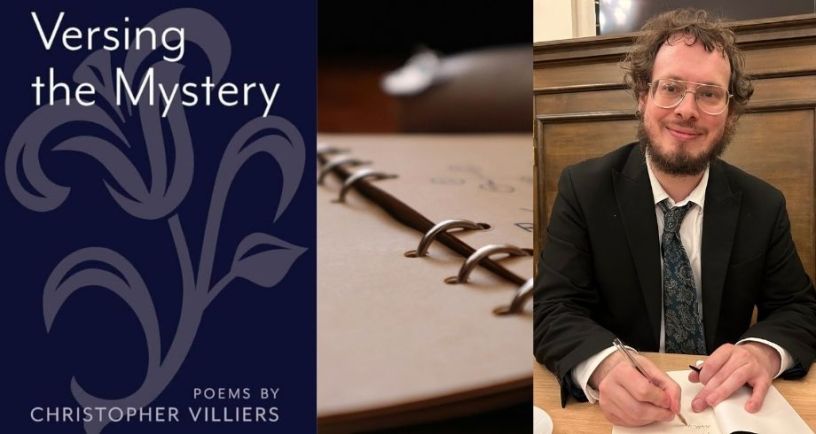
I am a poet, editor and many other things who lives in North Devon, a beautiful if rainy district in south-western England. My poems have been published in several magazines and ended up as four books, the latest of which Versing the Mystery has been published by Arouca Press. I am a Catholic Christian with a university education in Theology who is inspired by faith, mythology, history, my local land and seascape, not to mention conversations with cats.
What first inspired you to start writing?
I played a bit at creative writing as a child and like many another adolescent produced awful verses as a sort of literary acne. However, I first started writing seriously at the grand old age of twenty-five. This was after I had read The Artist’s Way by Julia Cameron, which is a book about unblocking creativity. Having started some of its exercises, I found that words started forming patterns in my head. The poems started coming and I had to write them down.
How did you first become interested in poetry?
I was enchanted by the poetry of Shakespeare I was taught at school, in his sonnets and plays. Studying Twelfth Night was a fun and enlightening experience (I would read out the part of Malvolio in class and still think he is not so bad as many think). In my teens I came upon some of the poems of John Donne and loved their knotty lines of meter and playful thought. When I was sixteen, I was introduced to the poems of Robert Frost which had a big impact on me, the thoughtful, at times dark poems rooted in a landscape and people not so very different from my own. However, I would say that my serious interest in poetry began in my twenties, when as I have already said, words started doing things inside me.
What is your favorite school of poetry?
I try not to confine myself to any “school” great poetry ultimately transcends such confines. However, much as I enjoy some free verse, not least as written by Walt Whitman, I generally prefer formal verse, either blank or rhyming. Perhaps because I am naturally a chaotic person, I crave order and overt discipline. Some of my favourite poems are sonnets, such as the holy sonnets of John Donne and the many fine sonnets of Gerard Manley Hopkins which combine reverence and insight into God and nature so exquisitely.
What started you on the journey from writing privately to sharing it with the world as a published author?
In 2015 I started writing poems and posting them on my Facebook page, attracting a little attention along the way. When Lent came, I decided to write and post Biblical meditations in sonnet form as a religious exercise and later that year I was discovered by a kind lady who ran a small publishing firm. She approached me with the idea of publishing my religious verses and when I realized that she was willing to do so at her own expense I gladly took up her gracious offer. So was published my first book Sonnets from the Spirit in December 2015, the start of my career as a published author in earnest. Perhaps ideally I would have waited a little longer to build up more of a profile, not least in magazine publications and to gather a more polished body of work but I thank God of the privilege of seeing my work in print and touching a few lives for the better in the process.
Some of your poems contain historical characters. What is your process in terms of research and bringing those characters to life?
I do take seriously the need to research for my work, reading up on the relevant details. When writing about Greek mythological themes, I make sure I do not confuse the goddess Hera with Aphrodite. I try to think how I might think and feel in the position of the historical characters in my poems. One does not have to always sympathize, but empathy is important. It is vital not to present characters as two-dimensional caricatures, even people who do monstrous things are still people, with all the complexity and mixture of good and evil that entails. We are all human beings, and there is a Jezebel, Herod and Attila the Hun in us all.
What are your favorite and least favorite parts of writing poetry?
My favourite part of writing poetry is the sheer joy of creation; it is worth remembering that the word poetry comes from the Greek verb poiesis which means to make. To make something meaningful and hopefully beautiful out of words is a magnificent thing. St John Paul II in his Letter to Artists described the artist (he includes poets) as an image of God the creator and I think he was right. I often think of creation as the epic poem of God. Prose is not always enough, sometimes words need to dance into poetry to partake of deepest truths, there is in all the creative arts something beyond the mundane which can raise us towards heaven. We are all called upon as human beings to cooperate with the creative work of God, to practice good husbandry of all he has given us, as a poet I am participating in something with a spark of the divine. Almost like Balaam’s talking donkey in the Bible.
My least favourite part of writing poetry is editing and sometimes having to admit a poem simply does not work, though a line or two might be salvageable for another project. If you are serious about writing poetry or anything else as more than a private hobby or therapy, then you need to hold your work to professional standards of craft. Sincere and passionate good intentions do not excuse cliches, bad rhymes or clunky meter etc. Being able to take constructive criticism from others and being honest with yourself is vital. Occasionally you must look at your writing in a cold hard sober light, say “this is dreadful” and start again.
You have published several poetry books now. How have you chosen which poems to include in which books?
Certain of my poems have attracted a degree of positive attention when I have performed them at readings or posted them on social media, so I make sure to include them in my books. Over the years I have tried to be sternly objective about the quality of my work, so if a poem does not read well to me some time after I have written it, or someone I respect tells me it does not work, I edit it or skip publishing it altogether.
What makes your latest book different from previous poetry collections?
Funnily enough, my latest book is largely a collection of my previous poetry collections. My former publisher shut down her business and all my books with her went out of print. Versing the Mystery contains most of my previously published poems (with some revision here and there as well as a few weaker poems kicked out) along with some new material, such as my poems about my home village and my first day at school (some kids are just trouble from the beginning!). Perhaps the sense that nine years work is being gathered in for harvest after some hard thought makes my latest book different from my previous collections. God willing, I have more poems left in me, but this book completes a phase of my younger self.
Were there any lessons you learned from working on this book that you wished you had known when you were working on your first one?
As the philosopher Kierkegaard observed, life must be lived forwards but is understood backwards. I wish I had known more about the importance of marketing a book, before as well as after its publication. I also wish I had got someone to proofread and edit my first book or three with a sadistic fine-toothed comb. As with moral failings, it is easier to see the typos and clunky parts of other people’s writing than your own. I would also have made more of an effort to get book reviews, in publications as well as on Amazon. It can be tiring and humiliating, beseeching folk to acknowledge the existence of your book, but it does matter.
What is your method to integrate fictional characters and situations into the historical setting when your poems feature history?
I try not to be clunkily anachronistic, though in representing characters from different ages and cultures I do need to translate for a twenty-first century Anglophone audience. Many of my poems are dramatic monologues in the character of historical figures, such as King Herod, or the Emperor Constantine. I do some historical research to ground my work in reality and avoid taking unforgivable liberties (I must not pretend Herod was a pacifist or Constantine was father of the year), but I do not pretend to be a historian and as a poet can perhaps benefit a little more from the willing suspension of disbelief than say a historical novelist.
Many poets have writers who influenced their work. If you had the chance to speak with one of your influences, what would you ask?
If I had the chance I would love to meet Gerard Manley Hopkins, he had such a sensitivity to the beauties of nature and a profound spiritual vision. I would like to ask him about how he wrote his poems, his experiments with sprung rhythm, and the relationship of his faith to his art.
What do you find more enjoyable/difficult: First drafts or editing/rewriting?
First drafts are fun, it is great suddenly finding that I can write, often an idea bothers me like a little stone in my shoe, but I can’t quite get it in writing. It is a joy and relief when the words finally flow. There is the saying “write drunk edit sober” and there is a pleasant intoxication in writing out a first draft. Editing/rewriting can feel more like a hangover, but it is essential, what seems right in the heat of the moment can be seen clearly and harsher later. It is not always pleasant, but it is important and I try to take all the necessary stages of creation seriously.
How have you gone about publicizing yourself and your works?
Like most writers, I am an introverted socially awkward sort who is not a born salesman. However, a writer does need to understand marketing and sales, I have organized and advertised quite a few poetry readings in libraries and churches where I might hope to find a sympathetic ear or two. Social media has its uses; I post my poems there and use LinkedIn and Facebook to promote my book.
Do you have any advice for authors sharing their work at public events?
Rehearse! Try to read at a speed and volume which allows your words to sink deeply into the audience. Express feeling without being melodramatic. Don’t attempt to script everything but come prepared and have a couple of charming anecdotes about your work ready to amuse your audience. Try not to panic, being an author sharing work in a public event can be scary but it’s not all that scary. Most people, especially the sort choosing to come and witness you sharing your work, are not really so bad. I’m pretty sure nobody will come to your event to hoot at you and throw rotten turnips in your direction. Remember that, smile, take a deep breath and trust in your muse.
What are some of the main themes/morals you would like readers to take away from your works?
I hope at least some of my poetry gives the sense, to quote Gerard Manley Hopkins “The world is charged with the grandeur of God.” I would like readers to take away from my work a sense that existence is a blessing, though very far from perfect. While I do not shy away from the tragic and even sinister sides of life, my poetry tries to communicate that creation is ultimately lovable and redeemable. Writers should avoid being too didactic, I don’t want to preach at people from an iambic pulpit, but I pray that my poems help to make people enjoy life and endure it a little better.
What is some advice you would give aspiring authors, especially those focusing on your craft?
Keep going! It is not always easy and sometimes alligator wrestling might seem a cheerier and less difficult pastime but if you persevere – even if you just write a few sentences a day – you will accomplish something worthwhile in the end. Write everyday, keep a journal if nothing else and read, read, read. Read all sorts of things, prose, poetry, fiction and non-fiction inside and outside your comfort zone, explore all kinds of genres. Everything is enlightening if you bother to take an interest. Be honest with yourself as an editor. Join, if you have not already done so, a creative writing group, slowly but surely accustom yourself to sharing your work with others. Above all else pay attention. There is a story to tell about everything in this wonderful terrible universe, just still yourself and listen, then the story which is seeking you to tell it shall find you.
Author Website and/or Contact Details:
Here is my blog: The Rhymester’s Revels and details about my book on my publisher’s website: Versing the Mystery.
 Fellowship & Fairydust