
BY JOHN TUTTLE
Many people get introduced to the Jewish writer and Holocaust victim Anne Frank via her Diary of a Young Girl in a middle school literature class. Or perhaps the adventurous youth picks up Alice Hoffman’s more recent When We Flew Away: A Novel of Anne Frank before the Diary. But my own first impression of Anne came from her less well-known Tales from the Secret Annex, which deviates from the tone and material of her Diary in that it is a collection of mostly fictitious anecdotes and sketches.
Born in Germany in 1929, Anne acquired a love for letters early on. It appears she kept a commonplace book, the “Book of Beautiful Sentences,” which contained snippets from literature that moved her heart in a big way. She received the now-famous diary on her 13th birthday; it was, as yet, empty and devoid of the honest musings that would later make her a household name. She would soon remedy that. One can easily imagine the titular character of “Cady’s Life” discloses a sentiment shared by its author – that she “had never known that writing could give her so much pleasure.”[1] She wrote her stories, not for the public, but for personal fun.
Anne loved to read and write. She was also drawn to the transcendent beauty experienced in nature and in all of life. This attraction seeps into the very marrow of her characters, too. Throughout her work, including the illustrious Tales, she offers insight into the human condition, offering her thoughts on living well, finding happiness, being self-aware but also God-conscious. All this she accomplishes with charming brio. Even as a young teenager, her writing already serves up wisdom and whimsy. She proves herself a master of painting a scene, developing characters, using metaphor and simile, and offering glimpses into the longings and possible satisfaction of her heart and the hearts of her characters.
Anne’s budding literary pursuits ran concurrent with the feverish rise of Nazism in her motherland. Her father, Otto Frank, moved the family to Amsterdam for their safety. It wasn’t long, however, before Nazis invaded the Netherlands. This family, along with other Jews in the area, lay low and tried not to be detected. Someone ratted on them, and the Gestapo followed up the lead. The Franks were hauled away to a concentration camp and eventually split up. Anne and her sister Margot died of typhus in either February or March of 1945; Anne was 15 years old. Their mother, Edith, fell ill and died that January in Auschwitz. Otto, also sick, was liberated from the same death camp on Jan. 27. Afterward, he made sure the Diary got published posthumously.
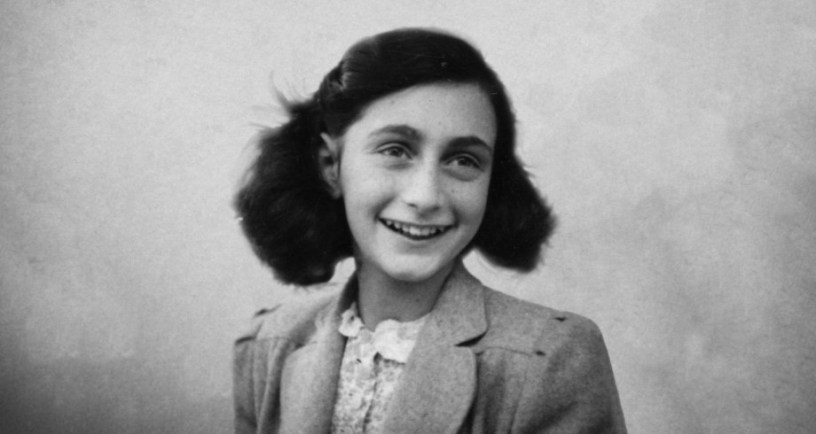
In her photos, Anne is often found beaming, and sometimes at her desk writing. Despite the gravity of the circumstances that took place in her adolescence, Anne’s stories can often be rather fanciful, though her characters are not without their own troubles and sorrows. There are usually moralistic lessons to take away, especially from her fairy stories.
In “The Wise Old Dwarf,” Anne relates the story of the happy-go-lucky elf Dora and the somber, “long-faced” dwarf Peldron. Their personalities being diametrically opposed to one another, each challenges the other’s attitudes. But it’s good to be challenged. An older, wiser dwarf forces these two into a sort of virtue boot camp. It involves grown-up responsibilities, teamwork, and attending elf chapel on Sundays. Dora and Peldron “paid more attention to the words of the dwarf-preacher than they had before, and they felt quite content as they walked back through the shady woods.”[2] By the coda of the story, the two opposites mellow out and achieve virtue – the via media between the two extremes embodied by Dora and Peldron at the outset. They both acquire the mean between the excess of Dora’s refusal to take anything seriously and the defect of Peldron’s overly serious attitude that is devoid of joy. Through the challenges they share, they learn from each other.
In “The Fairy,” the young writer explores the tale of an extraordinary fairy named Ellen, who turns to charity with all the money left her by her deceased parents. She reasons that she can’t take it with her in death (fairies are quite mortal in this telling), so she puts it to the best use she can imagine. Not only is she generous with monetary gifts to others, but in her cheerful way, she listens to their woes and shares with them her heart. To a tired, dejected wife and mother, Ellen advises what she does herself in times of sorrow: Rest in the forest and grow calm. “Alone with nature, all worries leave one,” she explains. “You grow first quiet, and then glad, and feel that God has not deserted you.”[3] The advice helps the downcast woman. And all of Ellen’s days are spent thus, gaining her the admiration of fairies, elves, children, and people of all sorts. It’s certainly one for Anne’s moralistic repertoire. Even the name of the protagonist, Ellen (which connotes brightness or shining light), suggests her function in the story: A guiding light to show the way of virtue and of happiness.
Does the mention of God and spirituality in Anne’s fairy stories dullen them? I think not. In both fables, Anne taps into a long, rich tradition of the fantasy genre. Fantasy often invents or borrows religious figures and symbols (eg: pagan mythology is full of gods, men, beasts, and everything in between), or else offers religious allegory (eg: the works of George MacDonald and C.S. Lewis). The folklore of medieval Europe would come to be simultaneously populated by God, angels, demons, phantoms, fairies, ogres, and a wide array of fantastic creatures. The same Joan of Arc who heard her elders speak of little sprites under the “Fairies’ Tree” (or “Ladies’ Tree”) in her childhood had no qualms about saintly and angelic apparitions in her teenage years.[4] This is just one example of how popular spirituality and superstition blended together in the Middle Ages. It seemed natural that they go hand-in-hand. This was so plain to G.K. Chesterton that he claimed modernity dislikes Joan of Arc’s story both for its acknowledgment of fairies and religion.[5]
The nature of fairies is elusive; their realm seems transcendent. In Judeo-Christian tradition, there have been varying views on whether heaven – where the supernatural is on full display – is a place or a mode of existence. J.R.R. Tolkien, in his essay “On Fairy-Stories,” similarly suggests that fairyland, or “Faërie,” is “the realm or state in which fairies have their being.”[6] At the same time, in all the stories, the people of fairyland interact with everyday humans. For Anne Frank, too, there is “the world” and, embedded in it, “the world of elves and dwarves.”[7] The spiritual and the fantastical inhabit a metaphysical space which breaks into, even permeates, our current existence. The universal, albeit often hidden, realm of faith and the hinterland of Faërie overlap.
Fantasies and fairy tales, like beauty itself, can speak of numinous things in unobtrusive ways, though some writers, like Frank, are more overt. Such stories speak of something higher, something transcendent. It is something innately human to long for a beauty beyond words. To some, that’s what heaven means. And for some, it is something they try to get at through fantasy. Most of us might not see fairies, or even angels, in our daily lives with our mortal eyes. But we can follow the advice of Anne Frank, speaking through that very special fairy, Ellen:
…take a walk through the big forest until you reach the moor. Then, after walking a while in the heather, sit down somewhere and do nothing. Only look at the blue sky and the trees, and you will gradually feel peaceful inside and realize that nothing is so hopelessly bad that something can’t be done to improve it.[8]
An edited version of this essay was previously published on Close Reading, the official blog of Slant Books.
###
[1] Anne Frank’s Tales from the Secret Annex, trans. Michel Mok and Ralph Manheim (New York, NY: Bantam Books, 1994), 70.
[2] Ibid., 43-44.
[3] Ibid., 59.
[4] Joan of Arc: In Her Own Words, trans. Willard Trask (New York, NY: BOOKS & Co./Turtle Point Press, 1996), 4.
[5] G.K. Chesterton, In Defense of Sanity, ed. Dale Alquist, Joseph Pearce, and Aidan Mackey (San Francisco, CA: Ignatius Press, 2011), 233.
[6] J.R.R. Tolkien, The Tolkien Reader (New York, NY: Del Rey, 2021), 38.
[7] Anne Frank’s Tales from the Secret Annex, trans. Michel Mok and Ralph Manheim (New York, NY: Bantam Books, 1994), 41.
[8] Ibid., 59.
 Fellowship & Fairydust